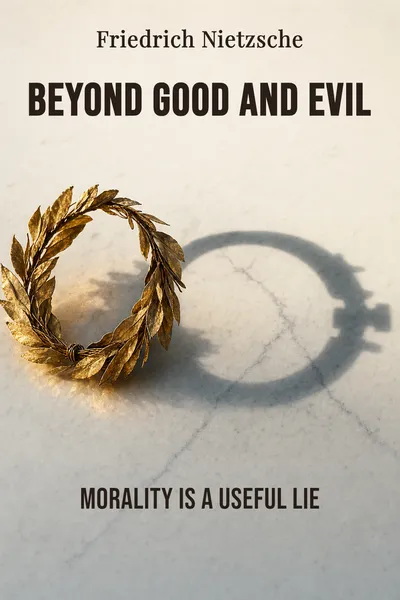
Beyond Good and Evil
Morality is a useful lie
Description
In 1886, a nearly blind former professor was living out of boarding houses in the Swiss Alps and the towns of northern Italy, writing at furious speed and paying to have his own books printed because almost nobody bought them. Friedrich Nietzsche had walked away from a brilliant academic career in Basel years earlier, wrecked by migraines and stomach trouble, and he now spent his days on long walks and his evenings filling notebooks. That year he published Beyond Good and Evil, a book he described, only half joking, as a work that said the same terrifying things as his earlier Zarathustra, but in a way scholars might actually be forced to argue with.
The book has no plot and barely a straight line of argument. It moves in aphorisms — some a single stinging sentence, some a couple of dense pages — and it circles one accusation again and again. The philosophers who came before him, Nietzsche says, all pretended to be pursuing pure truth, when really they were smuggling in their own moral prejudices and calling them eternal. Good and evil, he insists, are not features of the universe we discover. They are things human beings made, at particular times, for particular reasons, usually reasons the makers would rather not admit.
This is where the book earns its reputation for being dangerous, and also where it gets misread. Nietzsche is not writing a permission slip for cruelty, though plenty of people have tried to read it that way. He is doing something stranger and harder to shrug off: treating morality itself as a thing with a history, a birthplace, and a set of interests behind it — the way we might treat a law or a fashion rather than a law of nature.
The question we’re asking : If good and evil aren't written into the world, where did they come from, and what were they for?What we’ll see : How Nietzsche puts morality itself on trial — its hidden origins, its buried motives, and what he thinks is left standing once it falls.
Table of contents
01 Chapter 1 — The philosophers who never asked why they wanted truth
Beyond Good and Evil opens not with morality but with a taunt aimed at Nietzsche's own profession. Every great philosophy so far, he writes, has really been a kind of confession — the personal memoir of its author, dressed up as impartial reasoning. Kant, Spinoza, the Stoics: each built an elaborate system that just happened to prove that the world was arranged the way its author already wished it were. The apparatus of logic came after the conviction, not before it. What looks like cold pursuit of truth is, underneath, a set of values looking for a respectable outfit.
The move that makes the whole book possible is a single question nobody had thought to ask out loud. Philosophers had spent centuries assuming that truth is obviously more valuable than falsehood, that we should want the true over the comforting. Nietzsche asks why. Why should we want truth at all? Some illusions, he points out, are exactly what keep us alive and functioning; a false judgment can be more useful to a living thing than an accurate one. The will to truth, he suspects, might itself be a moral prejudice — one we've never examined because examining it feels almost obscene.

02 Chapter 2 — Master morality, slave morality, and the long revenge
Having cleared the ground, Nietzsche asks the question that gives the book its bite: where did our ideas of good and evil actually come from? His answer is that there have not been one morality but two, born from opposite positions in life. He calls them master morality and slave morality, and he presents them less as neat historical periods than as two ways of stamping value onto the world that still fight inside us.
Master morality, as he tells it, is the older one. The strong, the confident, the fortunate looked at themselves and called what they were good — noble, powerful, truthful, capable of overflowing generosity. Good meant, roughly, us, and bad meant the contemptible, the weak, the cowardly. Value here flows outward from a full sense of self. The noble type does not first study his enemy to decide what to condemn; he affirms himself and lets the rest fall into shadow. Good comes first, and bad is just the leftover.
03 Chapter 3 — The herd, and the free spirits who won't join it
Once morality is exposed as something made, the next danger comes into view: the pressure that keeps everyone making the same thing. Nietzsche's word for the majority mode of living is the herd. The herd is not a class or a nation; it is a tendency, the deep pull to feel, judge, and want whatever those around us feel, judge, and want. Morality, in its everyday form, is largely herd instinct wearing a crown — the community's need for its members to be predictable, useful, and above all similar, so that nothing threatens the flock.
He watches this instinct dressing itself in the language of his own century. The talk of equality, of universal rights, of general welfare, is for Nietzsche the herd achieving self-consciousness and declaring its values to be the only values. He is not sneering at kindness itself; he is pointing out that a morality built entirely to protect the weakest also works to level the exceptional, to make greatness suspect, to treat any towering individual as a problem to be smoothed down. A culture that fears the strong will, he warns, breed increasingly comfortable and increasingly small human beings.
04 Chapter 4 — A world that has to be created, not obeyed
Step back from the specific quarrels — masters and slaves, herd and free spirit, God and its shadow — and a single question is driving all of them. Nietzsche is not really asking which morality is true. He has already argued that none of them is true in the way they claim to be. He is asking who gets to create value, and whether human beings can bear to do it knowingly. Once you accept that good and evil were made rather than found, the ground shifts under your feet: the question is no longer how to obey the moral law but whether you have the nerve to legislate one.
This is why Beyond Good and Evil is easy to misuse and hard to dismiss. The phrase in the title does not mean beyond right and wrong, a green light for doing whatever one pleases. It means beyond the specific, inherited coordinate system called good and evil — beyond the assumption that those categories are handed down from outside and simply binding. What Nietzsche wants is not the abolition of value but its honest authorship: values affirmed by someone strong enough to know they are theirs, and to take responsibility for the world such values would build.
05 Conclusion
The nearly blind man in the Swiss boarding houses had perhaps three lucid years left when Beyond Good and Evil appeared; in early 1889 he collapsed in Turin and never recovered his mind. The book sold almost nothing in his lifetime and was later ransacked for slogans by people he would have despised. Its actual argument is harder and quieter than the caricature: that our deepest moral certainties have a history, that this history runs through weakness and resentment as much as through wisdom, and that the categories of good and evil we treat as eternal were assembled by human hands for human purposes.
Related books