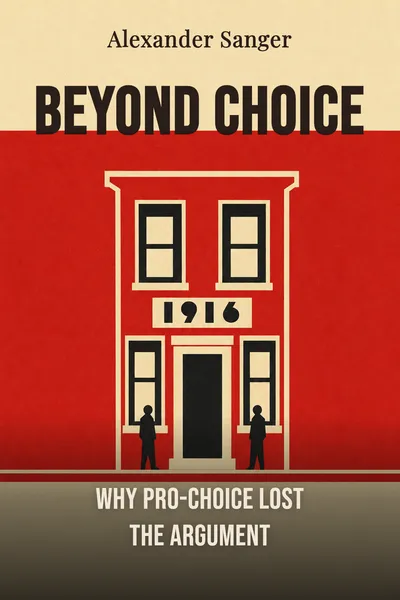
Beyond Choice
Why pro-choice lost the argument
Description
By the time Alexander Sanger sat down to write, Roe v. Wade had been the law of the land for thirty years, and the fight over it had gone nowhere good. Sanger was not a bystander. He is the grandson of Margaret Sanger, the woman who opened the first birth-control clinic in the United States in 1916 and spent her life at the center of the reproductive-rights fight. He ran Planned Parenthood of New York City through the 1990s and went on to chair the International Planned Parenthood Council. From that seat, he watched a movement that had won the biggest legal victory imaginable slowly lose the ground around it.
The numbers he was looking at were not encouraging. Since 1996, state legislatures had passed close to three hundred pieces of legislation restricting abortion — waiting periods, parental-consent laws, clinic regulations designed to close clinics. Polling showed younger Americans drifting away from the cause rather than toward it. A movement that assumed time and modernity were on its side was watching both walk in the other direction. And the argument that had carried the day in 1973 — a woman's right to privacy, her right to choose — had stopped persuading anyone who wasn't already persuaded.
So Sanger, in his 2004 book Beyond Choice, asked a question his own side found close to heretical. What if the pro-choice movement had been making the wrong argument all along? Not a losing tactic, but a losing frame — one that ceded the moral high ground to the other side and then wondered why it kept losing votes in state capitals. His answer sends him somewhere reproductive-rights advocates rarely go on purpose: into the biology of reproduction, and into the moral case they had spent decades refusing to make.
The question we’re asking : Why has a movement that won in the Supreme Court kept losing the argument in the country, and what would it take to change that?What we’ll see : How the case for legal abortion was built, why the frame it chose stopped working, and where Sanger thinks it has to go instead.
Table of contents
01 Chapter 1 — A stalemate three decades in the making
When the Supreme Court decided Roe v. Wade in January 1973, abortion-rights advocates treated it as an ending. The right had been recognized; the argument was over; the rest was defense. Three decades later, Sanger looked at where that defensive posture had landed the movement and saw something closer to slow retreat. The law had held, more or less, but the ground beneath it had eroded steadily and no one on his side seemed able to explain why.
The evidence was in the state legislatures. From the mid-1990s onward, opponents of abortion stopped attacking Roe head-on and started chipping at its edges — mandatory waiting periods, parental-notification requirements, restrictions written to shut clinics down under the cover of health regulation. Sanger counted nearly three hundred such measures since 1996 alone. Each one was survivable on its own. Together they described a movement that had lost the initiative and was fighting to hold a line rather than to win anyone over.

02 Chapter 2 — The trouble with a right to privacy
The word that organized everything was choice. A woman's right to choose, her private decision, her body — the vocabulary was deliberate, and for a while it worked. It kept the state out of the doctor's office and framed abortion as a matter of individual liberty rather than public morality. Sanger's argument is that the frame carried a hidden cost the movement never reckoned with, and that the bill came due slowly over thirty years.
The legal foundation was privacy. Roe rested not on any explicit constitutional guarantee but on a right to privacy the Court had been assembling since the 1960s, first around contraception. It was, Sanger acknowledged, a somewhat improvised basis for so consequential a decision, and legal scholars across the spectrum had been uneasy about it from the start. A right built on inference is a right that can be inferred away, and opponents understood this long before advocates did.
03 Chapter 3 — Sanger's wager on biology
Having diagnosed the frame, Sanger goes looking for a new one, and the place he looks surprises even sympathetic readers: evolutionary biology. His wager is that the strongest case for reproductive freedom is not a legal abstraction but a biological fact about how human reproduction actually works — and that this fact, honestly stated, undercuts the opposing side more effectively than any appeal to privacy ever could.
Nature, he argues, is not pro-life in any sentimental sense. Human reproduction is spectacularly wasteful. A large share of fertilized eggs never implant; a large share of pregnancies end in miscarriage, often before a woman even knows she is pregnant. Reproduction is a process of relentless selection, not a smooth journey from conception to birth. The idea that every fertilized egg is a person whose life must be protected at all costs collides, on Sanger's telling, with the way the body itself treats those eggs. He is not being flippant; he is pointing out that the biological reality is messier and more brutal than the moral slogans allow.
04 Chapter 4 — Why the safest ground is the moral one
Step back from the biology and Beyond Choice is really a book about how a movement talks, and what happens when it decides certain questions are too dangerous to touch. Sanger's larger claim is that the pro-choice movement made a strategic error familiar to any cause that has ever felt righteous: it assumed that because it was right, it did not need to persuade. It treated the moral discomfort of ordinary people as a problem to be managed rather than an argument to be answered, and in doing so it handed the entire field of moral language to the other side.
This is the part of his thinking that reaches past abortion. Any movement that wins a decisive institutional victory faces the same temptation — to mistake the victory for the argument, to defend the position rather than keep making the case for it. The right was secured, so the persuasion stopped. Sanger's warning is that a right which is no longer actively argued for does not stay settled; it becomes a target, and its defenders find themselves reacting to each new attack without a coherent story of why the right matters at all.
05 Conclusion
Sanger wrote as an insider trying to shake his own house, and the reception was predictably mixed. Grandson of Margaret Sanger, a lifelong figure in the reproductive-rights establishment, he was arguing that the establishment's central slogan had become a liability — that a movement organized around choice had talked itself into a corner where it could no longer explain why choice mattered. The nearly three hundred restrictive laws he counted were, to him, not an accident of politics but the predictable cost of ceding the moral argument.
Related books