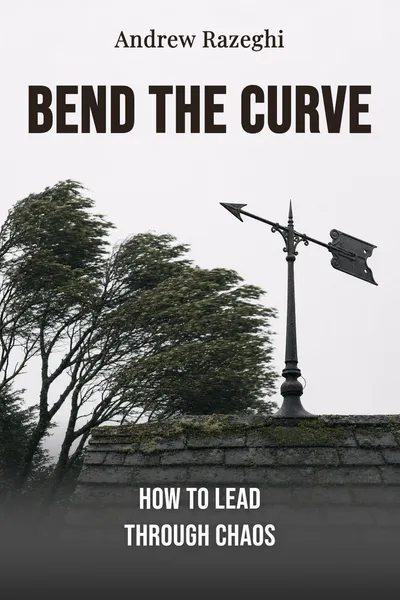
Bend the Curve
How to lead through chaos
Description
Every leader has a version of the same nightmare: the model that worked for years stops working overnight. A pandemic empties the office. A competitor no one had heard of takes a third of the market in eighteen months. A technology renders a core product quaint. The org chart is intact, the people are talented, the strategy deck is polished — and none of it fits the world that arrived on Tuesday. Andrew Razeghi, who teaches innovation at Northwestern's Kellogg School and advises companies on exactly these moments, wrote Bend the Curve for the leaders standing in that gap, watching a plan built for one reality collide with another.
The instinct in those moments is to brace. Cut costs, freeze hiring, wait for things to stabilize, then resume the old plan. Razeghi's argument runs the other way. The curve — the trajectory a business is on — does not straighten out on its own, and stability is not coming back in the shape leaders remember it. His premise is that chaos is not an interruption of normal conditions but increasingly the normal condition itself, and that the organizations that thrive are the ones that learn to treat disruption as raw material rather than as weather to be survived.
That reframing sounds motivational until you try to operationalize it, which is where the book earns its keep. Razeghi is less interested in telling leaders to be brave than in showing them what agility looks like as a set of habits, structures, and decisions — the difference between an organization that reacts to change and one that generates it. The through-line is that leading through chaos is a discipline, not a temperament, and disciplines can be built.
The question we’re asking : How do individuals and organizations stop reacting to disruption and start using it to grow?What we’ll see : How Razeghi turns a survival instinct into a leadership practice — agility, innovation, and the mindset that treats change as fuel.
Table of contents
01Chapter 1 — The moment the curve breaks
Razeghi opens with the observation that most organizations are optimized for a world that no longer exists. Efficiency, standardization, predictability — the virtues that built the modern corporation — are exactly the qualities that make it brittle when the environment shifts. A machine tuned to run one process flawlessly has no idea what to do when the process itself becomes obsolete. The curve, in his language, is the path a business is traveling: its assumptions about customers, competitors, and value. For long stretches that curve looks smooth. Then something bends it, and the smoothness turns out to have been fragility all along.
What interests Razeghi is the behavior of leaders at exactly this inflection point. The natural move is denial dressed as prudence — this is temporary, we've seen downturns before, let's hold the line. He draws on episodes where companies mistook a structural break for a passing storm and kept executing a plan the world had already abandoned. The failure was rarely a lack of intelligence or resources. It was a category error: reading a permanent change as a temporary one, and responding with patience where the situation demanded reinvention.

02Chapter 2 — What agility actually means
Agility has become one of those words that means everything and therefore nothing — sprints, standups, a poster in the break room. Razeghi tries to give it back some weight. In his framing, agility is not speed for its own sake; it's the capacity to change direction without losing coherence. Plenty of organizations can move fast and plenty can stay aligned, but the ones that thrive in chaos can do both at once — adjust their tactics wholesale while keeping a stable sense of what they're actually for.
He locates agility less in process than in how decisions get made and by whom. Rigid organizations route every meaningful choice up a hierarchy, which is fine when the environment is slow and disastrous when it's fast — by the time the decision comes back down, the window has closed. Agile ones push judgment closer to the edges, to the people actually touching customers and problems, and accept the messiness that comes with distributed decision-making. That requires a kind of trust that command-and-control cultures find genuinely difficult to extend.
03Chapter 3 — Making innovation a habit, not an accident
If agility is how an organization moves, innovation is what gives it somewhere to move to. Razeghi is impatient with the romance around innovation — the myth of the lone genius, the flash of insight, the disruptor who saw what no one else could. His account is more mundane and more useful: innovation is a repeatable practice, and organizations that treat it as a lottery win occasionally, while those that treat it as a discipline win reliably. The question is not how to have a great idea but how to build a system that keeps producing and testing them.
Much of that system, in his telling, is cultural. Innovation dies quietly in organizations that punish failed experiments, because people learn to stop proposing anything that might not work — which is to say, anything genuinely new. He argues for making the cost of a smart failure low and the cost of not trying visible, so that the safe move stops being the one that avoids risk. Creativity, in this framing, isn't a gift certain people have; it's a behavior an environment either invites or suppresses.
04Chapter 4 — When the disruption is the strategy
Step back from the tools and a larger claim emerges from Razeghi's book: leading through chaos is a discipline, not a disposition. The temptation is to treat these capacities — agility, creativity, comfort with ambiguity — as personality traits that some leaders happen to possess. Razeghi's framework insists they are practices, and practices can be learned, structured into how an organization works, and rehearsed before the crisis rather than improvised during it. That shifts the burden from finding heroic individuals to building resilient systems.
The deeper move is what he does to the idea of stability itself. Traditional management treats change as the exception and steady-state as the goal — you manage disruption so you can get back to running the machine. Razeghi inverts that. If disruption is now the normal condition, then the job is not to metabolize the occasional shock and return to equilibrium; it's to build an organization that runs on change as its ordinary fuel. Equilibrium, in that light, is not safety but slow decline, because a curve that isn't bending toward the future is bending away from it.
05Conclusion
Bend the Curve returns, in the end, to the leader standing in that opening gap between the plan and the world. Razeghi's answer to that person is not reassurance that things will stabilize, because his central bet is that they won't — not in the old sense. What he offers instead is a way to stand there differently: to read the break as a window rather than a wound, to have already built the agility and the experimental habits that turn a shock into a set of moves, and to treat the discomfort of self-disruption as the price of staying relevant.
Related books