
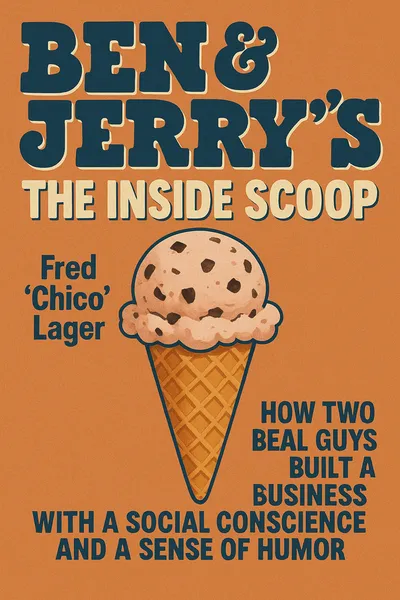
Ben & jerrys: the inside scoop
Principles over profits
Description
In 1978, Ben Cohen and Jerry Greenfield opened a quaint ice cream parlor in Vermont, turning their homemade recipes featuring generous chunks into a local sensation.
With minimal business acumen, they nonetheless succeeded in capturing the hearts of ice cream lovers, leading to the distribution of their pints in supermarkets.
Their rapid ascent transformed them into a beloved national brand. Throughout their expansion, they remained steadfast in their commitment to social causes and community support, embedding this ethos into their brand's core.
Faced with the decision to sell or sustain growth, they opted to go public, securing the capital needed to meet increasing demand.
Despite the pressures of scaling up, they never wavered from their original spirit of fun and dedication to social principles.
By 1994, Ben & Jerry's had emerged as a top contender in the American super premium ice cream market.
Table of contents
01 Ben and jerry's early lives and friendship
Ben Cohen and Jerry Greenfield first bonded in seventh grade during a gym class at Merrick Avenue Junior High School. Both struggled with their weight as kids, but their paths diverged after high school. Jerry excelled academically and attended Oberlin College in Ohio on a scholarship, studying pre-med. Ben, on the other hand, attended Colgate University in New York, known for his extracurricular activities. He worked in the campus cafeteria to pay for school but was fired for violating hygiene policy.

02 Deciding to start an ice cream business
Jerry and Ben, two food enthusiasts, initially considered starting a bagel delivery service, but the high cost of equipment and lack of a full-week business model led them to explore other options. They then turned their attention to ice cream, investing in a correspondence course and scouting locations. Despite a setback when a competitor opened in their chosen location, Saratoga Springs, they decided on Burlington, Vermont, due to its student population.
To fund their venture, they each contributed $4,000, with additional funds from a small bank loan. They also purchased a sailboat on a whim, which became a source of leisure during their planning phase. Their business plan for Ben & Jerry’s Homemade Ice Cream and Creperie was adapted from a pizza shop's plan, and included both ice cream and crepes to attract year-round customers.
03 Opening the first ice cream shop
In 1978, Ben Cohen and Jerry Greenfield opened their first ice cream shop in a renovated gas station in Burlington, Vermont with a $12,000 investment. The opening day on May 5th was uneventful, with customers wandering in to try the ice cream. Cones were sold for 45 cents, and a "buy one, get one free" deal attracted patrons. The shop featured about 12 rotating ice cream flavors, sometimes running out before a better freezer could be purchased. As the business grew, the need for staff became apparent. Jerry took on hiring, while Ben, albeit reluctantly, handled firing, sometimes considering wearing a black mask for the task. High turnover was initially an issue, often due to improper scooping techniques.
04 Expanding into Wholesale Distribution
Ben and Jerry launched their ice cream business in 1978 with a modest budget and little experience. By May 1979, they had secured around 30 restaurants as wholesale customers. With summer approaching and demand increasing, they realized the need to expand production. They obtained a $30,800 SBA-backed bank loan to establish a manufacturing plant in an old textile mill. Jerry produced ten-gallon batches of ice cream while Ben delivered them using a refrigerated 1969 truck. Although their original shop started making a profit, the wholesale side struggled.
05 Raising expansion capital through stock offerings
With Jerry focusing on special projects, Ben hired Chico Lager to manage the manufacturing plant and serve as general manager, allowing Ben to concentrate on sales and marketing. Ben & Jerry's began selling ice cream in Boston, leveraging a distributor and a quirky 10-second TV ad to boost their brand. They also gave away free ice cream in office buildings, which surprisingly increased sales, necessitating a production capacity expansion.
To fund the new plant, they needed $2.5 million, with $750,000 in equity. Ben innovatively offered stock to Vermont residents, raising $700,000 from 1,800 households and securing the rest through debt. Sales soared to $1.6 million in the first half of 1984, but Pillsbury's Haagen-Dazs brand tried to squeeze them out of Boston. Ben & Jerry's fought back with legal action, a media campaign, and grassroots efforts, eventually settling out of court.
06 Dealing with competition from haagen dazs
Ben & Jerry's was gaining traction in the ice cream industry when Richie Smith, who had sold his Frusen Gladje brand to Kraft for $30 million, acquired Steve's ice cream and proposed a merger with Ben & Jerry's. Smith threatened to compete directly if Ben Cohen declined the offer. Instead of merging, Ben realized the need for rapid expansion to preempt competitors like Steve's. He planned to introduce Ben & Jerry's in major cities across the U.S., starting with Philadelphia, Atlanta, Washington D.C., and Florida, followed by Chicago, San Francisco, Los Angeles, and Dallas, entering a new city each month.
07 Ben considers retirement but expansion continues
In 1985, Ben, co-founder of Ben & Jerry's, expressed a desire to semi-retire, similar to his partner Jerry. However, his plans were delayed due to a competitive ice cream program. After a promotional trip, Jerry reiterated his retirement plans, aiming for the end of 1986. Replacing Ben would be difficult due to his meticulous attention to quality control, including using X-ray and MRI machines to ensure each pint's quality.
Ben was also crucial to research and development, often taking home numerous variations of potential new products to determine the best one. His creativity drove many successful marketing campaigns and new product ideas, contributing to the company's annual growth. However, his unpredictable nature, such as last-minute revisions and sudden product ideas, could be challenging.
08 Implementing social mission goals
In the late 1980s, Ben & Jerry's was on a steep growth trajectory, with sales projected to jump from $32 million in 1987 to $75 million by 1990. To keep up with demand, the company focused on ramping up production. Concurrently, co-founders Jerry Greenfield and Ben Cohen, still on the board, proposed a Joy Committee to make work more enjoyable for employees. This committee introduced whimsical initiatives like Elvis Day and a Synchro-Energizer machine, alongside a Barry Manilow Day. To maintain the company's ethos, a Mission Statement was crafted, encompassing Product, Social, and Economic Missions, all underpinned by a commitment to creativity, respect, and community.
09 Ongoing growth and national expansion
In 1988, Ben & Jerry's was projected to see a 50 percent increase in sales from the previous year, reaching $48 million. The company, with 76 franchise scoop stores, was the third-ranked super premium ice cream brand and was closing in on the second spot.
Despite this growth, the company faced challenges in filling key management positions, partly due to a salary cap policy implemented in 1985. By 1989, sales climbed to $58 million, securing Ben & Jerry's the number two position with a 25 percent market share, although Haagen-Dazs led with 62 percent.
An attempt to introduce a "lighter" ice cream failed and was quickly replaced by a successful premium frozen yogurt line. In 1990, sales hit $77 million with a profit of $2.6 million. The following year, factory tours began, drawing 225,000 visitors and becoming a leading Vermont tourist destination.
Related books