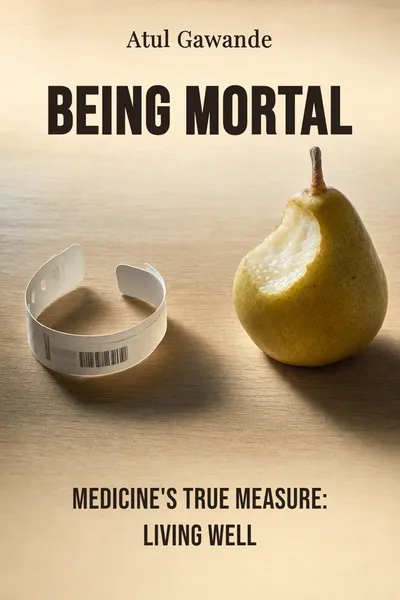
Being Mortal
Medicine's true measure: living well
Description
Atul Gawande is a surgeon in Boston, and he begins his 2014 book Being Mortal with a confession that no medical school prepares you to hear from a surgeon. In all his years of training, he writes, he was taught to save lives, to diagnose and repair, to push back against decline with every tool the profession has built. What he was never taught was what to do when the pushing stops working — when a body is winding down and no operation, no drug, no clever intervention will change the ending. The dying, in his education, were a kind of failure. And so, like most doctors, he learned to look away from them.
The book grows out of that gap. Gawande watches his own patients reach the point where medicine has nothing left to offer except more medicine — another scan, another round, another few weeks bought at a steep cost in suffering. He watches his father, also a surgeon, face a spinal tumor and the same impossible choices. And he starts to notice that the questions everyone avoids are the ones that matter most: not how do we survive, but what makes a day worth living, even a diminished one.
Gawande's argument is that modern medicine has quietly swapped its own goal. It set out to relieve suffering and extend good years, and somewhere along the way it began treating survival itself as the only prize — even when survival costs a person everything that made survival worth wanting. Being Mortal is his attempt to name that mistake and to ask what a wiser kind of care would look like.
The question we’re asking : What happens when medicine keeps fighting for survival long after survival has stopped serving the person it is meant to save?What we’ll see : How a surgeon came to see that the true measure of care is not how long a body lasts, but whether a life still feels like one worth living.
Table of contents
01 Chapter 1 — The training that had no chapter for dying
Gawande is candid about where he started. Medical school taught him the body as a machine to be kept running: here is the disease, here is the fix, here is how you buy more time. Mortality appeared only as the thing you were fighting against, never as a condition you might have to work with. He recounts reading, late in his training, a single assigned book on caring for the dying — and even that, he admits, he skimmed. The subject felt like the absence of medicine rather than a part of it. Doctors were trained to intervene; standing at a bedside with nothing left to intervene with felt like standing nowhere at all.
This produces a strange blindness, and Gawande traces it through his own early years on the wards. Faced with a patient whose cancer was no longer treatable, he and his colleagues reached for the next treatment anyway, because offering treatment was the one script they knew. Saying "there is nothing more we can do to cure this" felt like abandonment; offering another experimental round felt like hope, even when the odds were near zero and the side effects brutal. The default, always, was to do more.

02 Chapter 2 — When safety becomes the enemy of a life
Before he reaches the hospital, Gawande turns to a quieter setting: the nursing home. He follows the history of how societies came to warehouse their old, and the picture is not flattering. As families spread out and lifespans lengthened, the frail elderly ended up in institutions designed, above all, for safety and efficiency. Meals on a schedule, medications on a cart, floors that could be cleaned, residents who could be monitored. Everything optimized so that no one fell, no one wandered, no one got hurt. And in the process, he observes, everything that made a life feel like one's own quietly disappeared.
He gives the problem a sharp name through the people fighting it. There is Bill Thomas, a young physician who took over a demoralized nursing home in upstate New York and, almost as an experiment, filled it with life — dogs, cats, a hundred parakeets, plants in every room, children coming through. The staff thought he was mad. But residents who had been slipping away began to revive. People who needed a reason to get up in the morning suddenly had a bird to feed. Deaths and prescriptions fell. Gawande's point is not that pets are magic; it is that having something to care for, some thread of purpose, turned out to matter as much as any medication.
03 Chapter 3 — Asking the only questions that matter
The heart of Being Mortal is a set of conversations most doctors never have. Gawande learns them slowly, partly from experts in palliative care and hospice, and partly through his own father's illness. The breakthrough, he finds, is deceptively simple: instead of asking only what treatment to try next, you ask the person what they are living for. What do they understand about their situation? What are their fears and hopes as things get worse? What outcomes are unacceptable to them? And what are they willing to trade — and not trade — for the possibility of more time?
He illustrates it with a story he returns to often. A patient named Susan Block, herself a palliative-care specialist, faced surgery for her father and asked him exactly these questions. Her father's answer was startlingly concrete: if he could still eat chocolate ice cream and watch football on television, he wanted to stay alive. That single sentence became the compass for every decision that followed. When complications arose mid-surgery, the family knew what he could live with and what he could not. The question had turned an impossible medical choice into a clear one.
04 Chapter 4 — What it means to measure medicine by living
Step back from any single deathbed and Being Mortal makes a larger claim about what medicine is for. The profession, Gawande argues, has come to define success almost entirely as survival — more days on the calendar, more lines held against disease. That definition served brilliantly through the century when the enemy was infection and acute injury. But it has quietly become a trap, because it treats every death as a defeat and therefore keeps fighting long after the fight has stopped serving the patient. When survival is the only score, the doctor who stops treating looks like the one who failed.
Gawande's reframing is to make well-being, not mere continuation, the measure. The right question is not "how do we keep this body alive," but "what does a good day look like for this person, and how do we protect it for as long as possible." That shift sounds modest and is in fact radical, because it changes what counts as a job well done. A course of chemotherapy that buys three miserable months is a triumph by the survival measure and a failure by the well-being one. A decision to enter hospice is a surrender by the first standard and an act of care by the second.
05 Conclusion
Being Mortal closes where it began, with the dying his profession had trained him to look past — only now Gawande sees them clearly. His father's ashes are scattered on a river in India, in a ceremony chosen by the family, and the surgeon who once had no chapter for death has learned that the last chapter is one medicine must attend to as carefully as any other. The book does not offer a technique so much as a change of aim: the recognition that a longer life and a good one are not the same thing, and that when they diverge, the person deserves the choice.
Related books