

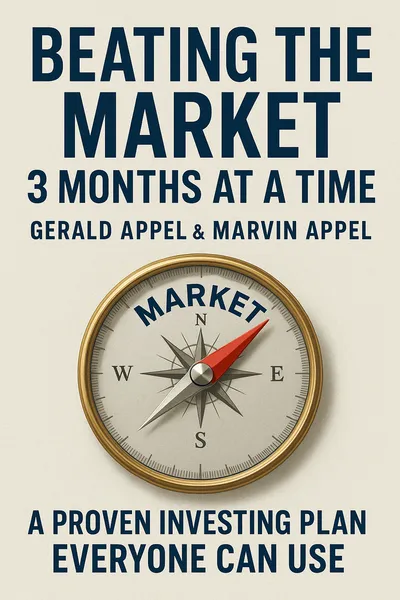
Beating the market 3 months at a time
A proven investing plan everyone can use
Description
Active investing can indeed be a rewarding strategy, as advocated by Gerald Appel and Marvin Appel. Instead of relying on a financial planner or mutual fund, becoming a self-sufficient investor can lead to better performance due to the absence of management fees. It also eliminates potential conflicts of interest and bias that professional money managers may have.
By taking control of your investments, you can decide when to invest, prioritizing your own interests. However, success in active investing requires applying well-researched strategies, maintaining discipline, and enjoying decision-making. With time and effort, investors can achieve significant returns and personal satisfaction from their investments.
Table of contents
01Grasping the foundations of investment diversification and risk management
Managing your own investment portfolio might seem like a daunting task, reserved for professional managers with years of training and experience. However, this perception is far from the truth. With a bit of study, dedication, and a level head, anyone can realistically manage their own investments. A well-managed investment portfolio is not rigid but is flexible, dynamic, and responsive to changes in the overall investment climate. To embark on the journey of becoming a self-sufficient investor, understanding a few fundamental principles is crucial.
The first principle is diversification. This strategyinvolves spreading your investments across different sectors of the economy rather than concentrating them in a specific market. Diversification provides a range of investments with varying risk-reward patterns, ensuring that at least one part of your portfolio performs well regardless of broader economic conditions. Diversification can be achieved in numerous ways, such as balancing between stocks and bonds, large and small company stocks, different types of bonds, income-oriented equities and growth stocks, stocks in different industries, and commodities. Investing in commodities like gold, oil, and agriculture can serve as a useful hedge against high inflation or economic uncertainty.
Understanding your risk tolerance is the second principle. Generally, investments aimed at generating consistent income carry less risk than those in the stock market. High-risk investments offer higher dividends due to the increased risk involved. Mutual funds can be either high or low risk, depending on the type of fund and its investments. Your personal risk tolerance will vary depending on your life stage. Younger investors may be willing to accept more risk for higher returns, while those nearing retirement may prioritize a steady, safe income.

02Understanding the elements of investment
The foundation of any investment portfolio is built on assets that are expected to appreciate over time and those that generate a steady income. Stocks and bonds have traditionally been the main wealth and income generators for long-term investors, playing crucial roles in any diversified portfolio. The journey from your current financial status to achieving your future financial goals can be navigated with guidance, and with experience, you can become your own best guide.
The stock market is typically divided into several major sectors, including the financial industry, utilities, real estate investment trusts (REITs), energy, materials, U.S. small capitalization companies, international equities, and international small companies. Each sector has its own performance characteristics and correlations with market indices or economic conditions. A fundamental principle of managing your investment portfolio is to periodically identify the strongest sectors and allocate the largest portion of your investments to these areas. Alternatively, you could distribute your stock market investments evenly across all sectors, creating a blend that performs well under various economic conditions. This approach requires a rebalancing mechanism, such as selling any position that has risen to more than 10% above its asset allocation and buying any positions that have declined by 10% or more from their original allocation. This strategy allows you to "sell into strength" and "buy into weakness," often securing good deals before sectors regain popularity.
03Creating your own successful investment portfolio
Understanding the basics of investment is indeed crucial for creating a well-structured portfolio that balances potential profits with risk management. A balanced portfolio should ideally include a mix of assets, clear entry and exit strategies, and effective risk management techniques. For instance, international stocks can offer high returns but also come with increased risks. A prudent strategy might be to allocate a portion of your capital to international markets through Exchange Traded Funds (ETFs).
When considering international ETFs, options such as the iShares MSCI Emerging Markets Index (EEM), iShares MSCI Japan Index (EWJ), and iShares Europe 350 Index Fund (IEV) can be evaluated. By examining their performance over the past quarter, you can identify the one that has yielded the best returns and allocate 18.75% of your capital to it. This approach allows for exposure to international markets while still maintaining a majority stake in more familiar domestic markets.
04Rebalancing your portfolio every quarter
The concept of stocks fluctuating as a collective entity, with certain clusters of companies within the broader market often outperforming others for extended periods, is a fundamental principle of investing. This phenomenon underscores the importance of regularly reviewing the performance of these groups and adjusting your portfolio accordingly. By doing so every three months, investors can significantly enhance their portfolio's overall performance with only a modest effort. This approach to investment, which simplifies the rebalancing process, involves two critical steps. The first step is to compare your current investments with their peer group alternatives, replacing any underperforming investments with those that are performing better. The second step involves rebalancing the weightings of your investments. For example, if your international investments now constitute 30% of your total wealth due to strong performance, you would sell part of your international ETF investment and reinvest the proceeds elsewhere in your portfolio. This maintains your chosen risk levels and overall portfolio balance.
Many investors, however, fall into the trap of assuming that past performance will continue indefinitely. This assumption is dangerous because past results do not guarantee future performance. By rebalancing every three months, investors can avoid this pitfall, using past performance as guidance only. The underlying concept is that superior performance tends to last more than one quarter at a time. By identifying and investing in currently well-performing funds, investors aim to achieve the best of both worlds. The quarterly ETF strategy is straightforward: at the end of every quarter, find the quarterly return for each of the recommended ETFs, invest equal amounts in the two with the highest returns, and hold for the coming quarter. This strategy does not require predicting which investment style will perform best; instead, the market informs you. This method increases the safety of your investments compared to holding a fixed portfolio and incurs modest transaction costs.
05Repeating this cycle for life
Starting early in taking proactive steps to manage and grow your net worth allows compound interest to work its magic. Aim to consistently add to your basic wealth accumulation assets every year. Even moderate additions to your capital base can significantly accelerate its growth. The key is consistency and commitment to a savings and investment plan that will sustain your lifestyle for life.
As you age, it's crucial to have an investment program that caters to your financial needs. Relying solely on a corporate pension fund or the government isn't advisable, as they may have other priorities. It's best to take control and build enough investments to support yourself for life.