
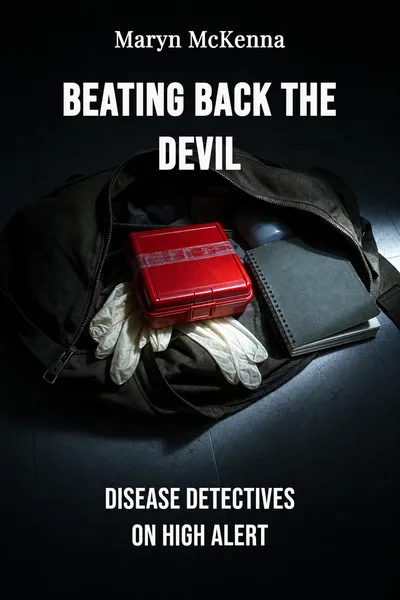
Beating Back the Devil
Disease detectives on high alert
Description
The phone rings at three in the morning, and on the other end is a voice that gives almost nothing away — a country, maybe, and a word for the thing that is killing people there. Sometimes not even that. The officer who picks up has a bag already packed by the door, because that is the deal she signed. Within twenty-four hours she will be on a plane, flying toward a place most people are trying to flee. This is the ordinary texture of life inside the Epidemic Intelligence Service, the small federal corps that Maryn McKenna spent a year following for her book Beating Back the Devil.
The instinct, when disease breaks loose, is to run. Empty the town, close the school, get the children away from the water. The EIS was built for the opposite reflex. Its officers run toward the outbreak, notebooks and blood-draw kits in hand, to work out what is happening while it is still happening — often before anyone has a name for it. They were among the first to face what the world would later call Ebola, hantavirus, and AIDS. They chased down the first Legionnaires' disease, the first toxic shock, the first E. coli O157. Most of them you have never heard of, which is more or less the point.
McKenna is the only journalist ever granted full access to the service in its half-century of existence, and she arrived at a hinge moment: the class that entered right after September 11, 2001, the first cohort trained not only against nature's outbreaks but against the deliberate release of disease as a weapon. Anthrax in the mail was days away. What she found was not a room of heroes but a room of tired researchers with young kids and low salaries, doing a job that only makes sense if you believe the next catastrophe is already on its way.
The question we’re asking : How did a Cold War fear produce a permanent corps of doctors who run toward epidemics, and what does keeping it running actually take?What we’ll see : An unglamorous readiness — packed bags, quiet fieldwork, and the strange arithmetic of a service whose biggest wins look like nothing happening at all.
Table of contents
01 Chapter 1 — The bag by the door
The rules of the job are simple and slightly absurd. You keep a suitcase packed. You do not stray far from a phone. When the call comes, you go — no negotiating the timing, no waiting for a fuller briefing. McKenna keeps returning to this image because it captures what makes the EIS unlike almost any other corner of medicine. The work is not scheduled. It arrives, and the officer's readiness is the whole product. A doctor who spends two years in the service and is never called to a genuine emergency has not failed; she has simply been the insurance policy that didn't have to pay out.
The people who sign up are a specific type. Many are physicians in their early thirties, often with a spouse and small children, and they trade two years of long hours and modest federal pay for a shot at the fieldwork almost nobody else gets to do. They come because the alternative — a comfortable clinical career, predictable and well compensated — feels thinner than the chance to stand at the front edge of an outbreak and figure it out first. McKenna is unsentimental about the cost. Marriages strain. Kids grow used to a parent who vanishes for weeks. The romance of the work and its toll are the same thing seen from two angles.

02 Chapter 2 — Korea, smallpox, and a corps built on fear
The EIS was not born out of scientific ambition. It was born out of dread. In 1951, with the Korean War on and Washington convinced the conflict might bring the use of biological weapons, an epidemiologist named Alexander Langmuir persuaded the Communicable Disease Center — the young agency that would become the CDC — to stand up a corps of doctors trained to spot an unusual outbreak fast and get to it faster. The reasoning was that a biological attack would announce itself the same way an epidemic does, as a sudden cluster of the sick, and that the country needed people whose whole job was to notice. Bioterror was the founding anxiety. Natural disease was the daily work that filled the decades in between.
03 Chapter 3 — The cases nobody else could crack
The heart of the book is the casework, and McKenna chooses episodes that show the method under pressure. There is the arrival of a mysterious respiratory illness in the American Southwest in 1993, later identified as a hantavirus, where officers walked the mesas and pieced together a connection to a boom in the rodent population. There is the summer West Nile virus crossed into New York in 1999, a mosquito-borne disease new to the hemisphere that the detectives had to distinguish from other causes before anyone could act. Each time, the pattern holds: an unfamiliar threat, a frightened public, and a handful of people quietly assembling the facts.
Then comes the class she was embedded with, the one that walked in the door as the twin towers fell. Within weeks, anthrax spores were moving through the postal system, and officers who had signed up for the abstract possibility of bioterror found themselves living inside it — tracing contaminated letters, testing exposed workers, working out how a powder in an envelope could kill. Soon after came SARS, a respiratory virus that leapt from Asia and demonstrated, in a matter of weeks in 2003, how fast a new pathogen could ride the world's flight paths. The service that had chased AIDS and Ebola in earlier decades was now facing threats that could cross an ocean before a diagnosis was even confirmed.
04 Chapter 4 — What a standing detective corps costs to keep
Step back from the individual outbreaks and a harder question surfaces, one McKenna keeps circling: how does a society justify paying, year after year, for readiness against threats that mostly do not come? The EIS is built on a paradox familiar to anyone who works in prevention. Its greatest successes are invisible. An epidemic caught early and stopped before it spreads leaves no headline, no death toll, nothing to point to. The corps is most valuable in exactly the moments when it produces, publicly, nothing at all. That makes it perpetually hard to fund and easy to underestimate, because the argument for it is an argument about disasters that were quietly prevented.
This is the deeper thing the service reveals about how modern states handle invisible risk. We are good at responding to catastrophes we can see and bad at maintaining the boring infrastructure that keeps them from happening. A packed suitcase by a door is not a dramatic image until the night it is needed, and by then the decision to keep the suitcase packed was made years earlier, by someone weighing a budget against a hypothetical. The EIS exists because a few people in 1951 took a hypothetical seriously enough to build for it. Every decade since has had to make that same wager again.
05 Conclusion
The suitcase by the door is the whole book in a single object. It sits packed because someone, decades ago, decided that a country needs people whose readiness is their contribution — who fly toward the thing everyone else escapes, and do most of their work in a quiet that never earns them a name. McKenna followed one class of them through the strangest possible year, from the fall of the towers to anthrax to SARS, and came back not with a gallery of heroes but with a portrait of ordinary, tired, capable people doing something that only makes sense if you believe in the next emergency.
Related books