
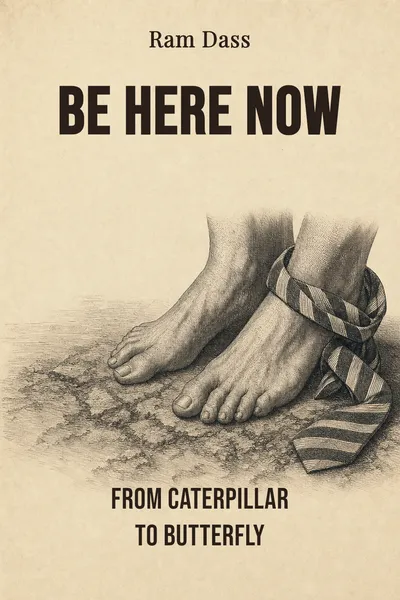
Be Here Now
From caterpillar to butterfly
Description
In the spring of 1963, a thirty-two-year-old Harvard professor named Richard Alpert lost his job. He had a tenure-track future in psychology, a Mercedes, an MG, a Triumph motorcycle, a Cessna airplane, and an apartment full of antiques. He also had, by his own later account, a creeping sense that none of it had made him the person he wanted to be. The dismissal came after years of running experiments with psychedelics alongside his colleague Timothy Leary, work the university had decided it could no longer house. Alpert was, on paper, a man at the top of his profession. Inside, he was a man who suspected his profession had no idea what it was talking about.
What happened next would have sounded absurd to anyone who knew him. The psychologist who had spent his life accumulating credentials and possessions ended up in India, barefoot, sitting at the feet of an old man in a blanket, with a new name and almost nothing else. He came back as Ram Dass, and in 1971 he published a book that didn't look like any book the spiritual marketplace had seen. Hand-lettered, printed on brown paper, half drawings and mantras, it was called Be Here Now, and it sold over a million copies by word of mouth.
The book is not really the story of how a man went East and got enlightened. Ram Dass was emphatic that it wasn't a travelogue and wasn't a confession. It was something closer to a set of instructions, written by someone who insisted he was not finished and had no business pretending otherwise. The image he reached for, again and again, was the one that gives this piece its frame: a caterpillar that doesn't improve itself, doesn't optimize, doesn't get a better caterpillar life. It becomes something else entirely.
The question we’re asking : What does a Harvard psychologist mean when he says the point isn't to feel better but to become someone structurally different?What we’ll see : How a man trained to measure the mind walked away from measuring it, and what he came back to say about changing from the inside out.
Table of contents
01 Chapter 1 — The Harvard psychologist who walked off the map
Richard Alpert had everything the 1950s told a man to want, and he tells us this not to brag but to set up the problem. He was a tenured-track psychologist, a pilot, a collector, a host of good dinners. By every external measure he was succeeding. And yet, he writes, he kept waiting for the feeling that was supposed to come with all of it, the feeling of having arrived, of finally being wise enough or settled enough, and it never came. He had spent his career studying motivation and behavior, and he could not explain his own quiet sense that he was a fraud at his own life.
The psychedelic experiments with Timothy Leary changed the question. Whatever one thinks of that period, and Ram Dass is honest about how messy and self-important it became, the drugs showed him there were states of consciousness his entire training had no vocabulary for. He could get to a place that felt like home, like clarity, like the thing he'd been missing. The trouble was that it always wore off. He kept going back, hundreds of times by his own count, and each time the door closed again and left him exactly where he'd started, only more certain that the room behind the door was real.

02 Chapter 2 — The mushroom that wore off, the question that didn't
For a while in India, Ram Dass was a tourist of the spiritual, the kind of seeker who collects teachers the way he had once collected antiques. He met holy men, sat through ceremonies, grew a beard, and remained, underneath, the same anxious Western mind taking notes. He was, he admits, still trying to acquire enlightenment, as if it were one more thing a clever man could obtain by reading the right material and meeting the right people. The framework hadn't dissolved. It had just changed costumes.
The turning point comes through a young Westerner he calls Bhagwan Das, a barefoot American who moved through India with no money and no apparent worry, and who refused to engage with Ram Dass's endless analyzing. Every time Ram Dass wanted to discuss the past or plan the future, the young man would say, in effect, don't think about that, be here now. It was maddening to a man whose whole identity was built on thinking about the past and planning the future. It was also, he slowly realized, the entire teaching in three words.
03 Chapter 3 — A barefoot man in a cave in the Himalayas
What Ram Dass learned from Maharaj-ji was not a doctrine he could write down and sell, and he's frank that this frustrated him too. The teaching was mostly the teacher's presence, a quality of attention and love that made everything around it feel more awake. Maharaj-ji didn't lecture. He fed people, teased them, knew things about their lives he had no way of knowing, and radiated a kind of unconditional welcome that Ram Dass had never encountered and could not reduce to a technique. The instruction, when it came, was disarmingly plain: feed people, serve people, love everyone, remember God.
The practices he was given were ordinary on purpose. Mantra, the repetition of a sacred phrase, to quiet the chatter. Meditation, to watch the mind without being swept away by it. Service, to wear down the relentless self-concern that the ego mistakes for a personality. Devotion, to soften the heart that analysis had hardened. None of it was exotic. All of it was hard, because the work was not learning new information but loosening the grip of the self that had been running the show since childhood.
04 Chapter 4 — From caterpillar to butterfly
The image Ram Dass keeps returning to does something the language of self-improvement cannot. A caterpillar does not become a better, more confident, more productive caterpillar. It dissolves. Inside the chrysalis it stops being what it was, almost entirely, before it becomes what it will be. That dissolution is the whole point, and it's why Be Here Now is not a book about feeling better. The promise of feeling better keeps the caterpillar intact and merely more comfortable. Ram Dass is talking about a change of being, in which the self you've spent decades defending is not upgraded but outgrown.
This reframing is what makes the book land differently from the psychedelic culture that produced it. Drugs gave him the glimpse, but a glimpse is a caterpillar peeking out of a cocoon it then climbs back into. What he came home to teach was structural: presence is not a peak experience you chase and lose, it's who you become through patient daily work, available without chemistry, available to anyone, including the housewife and the accountant he's careful to keep mentioning. The Himalayan cave was never the requirement. The requirement was the willingness to stop adding to the self and start dissolving it.
05 Conclusion
The man who lost his Harvard job in 1963 became, through the rest of his long life, one of the most recognizable voices in American spiritual life, and Be Here Now stayed in print decade after decade, passed hand to hand the way it had spread in the first place. Ram Dass never claimed to have arrived. He kept teaching, kept serving, and after a stroke late in life that took much of his speech, he reportedly described even that as part of the work, another stage of the same long dissolving.
Related books