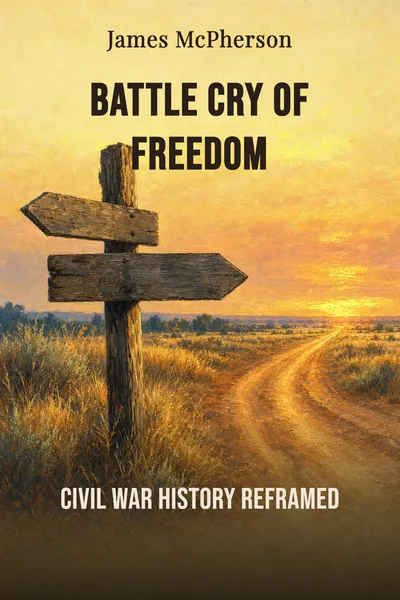
Battle Cry of Freedom
Civil War history reframed
Description
In 1988, a Princeton historian named James McPherson published a single volume that tried to do something the field had mostly stopped attempting: tell the entire story of the American Civil War, from the political fights of the 1840s to Appomattox, in one continuous narrative a general reader could actually finish. The result, Battle Cry of Freedom, ran to more than 850 pages, won the Pulitzer Prize the following year, and quietly became the book people meant when they said "the one-volume history of the war." It has stayed there ever since.
What makes the achievement strange is the moment it arrived in. By the late 1980s, professional history had splintered into specialties — economic history, social history, military history — each speaking its own dialect, each suspicious of the grand sweeping account. McPherson did the unfashionable thing. He folded the specialties back together: the price of cotton and the casualties at Antietam, the speeches of Lincoln and the ledgers of plantations, all braided into one moving line. The book reads like a story because McPherson decided the war was a story, with causes that could be traced and stakes that could be named.
And the stakes, in his telling, are not the ones popular memory has often preferred. Generations of Americans were taught a war about tariffs, states' rights, regional pride — anything, in some retellings, but the thing it was actually about. McPherson's narrative keeps returning the reader to the contradiction at the center, the one the founders papered over and the 1850s tore open. He does not lecture. He lets the documents and the dead carry the argument.
The question we’re asking : How does one historian's narrative turn a war remembered in a dozen conflicting ways into a single, defensible story — and what does that story insist we got wrong?What we’ll see : How McPherson rebuilds the road to war, the two economies behind it, the logic of how it was fought, and why the telling itself matters.
Table of contents
01Chapter 1 — A nation built on a contradiction it could not hold
McPherson begins not with the firing on Fort Sumter but well upstream, in the decades when the United States was, by his account, two societies pretending to be one. The founders had written liberty into the country's charter and slavery into its working order, and for a while the contradiction could be managed by compromise — Missouri in 1820, the patchwork deals of 1850. The book's long opening movement is the story of those compromises failing, one after another, until there was nothing left to compromise about.
The engine of the failure, in McPherson's reading, was expansion. As long as the country was growing westward, every new territory raised the same unavoidable question: slave or free? The Compromise of 1850, the Kansas-Nebraska Act of 1854, the violence in "Bleeding Kansas" — these were not separate crises but a single escalating one, each attempt to settle the matter producing a sharper fight than the last. The Dred Scott decision of 1857, which held that a Black man had no rights a white man was bound to respect, did not calm the storm. It convinced many in the North that the slave system meant to spread, not merely survive.

02Chapter 2 — The economics of two countries sharing a flag
Before the armies move, McPherson takes the time to weigh the two sides, and the contrast is stark enough to feel like fate — until he complicates it. The North, by 1860, was an industrializing society of roughly twenty-two million people, laced with railroads, factories, and a financial system that could raise and move money fast. The eleven Confederate states held about nine million, of whom nearly four million were enslaved and would not be fighting for the cause that enslaved them. On paper, the imbalance in men, factories, and miles of track looks decisive.
But the book resists the easy verdict that the North was simply bound to win. McPherson is careful to show what the South had going for it: the home-field advantage of a defensive war, the need only to survive rather than to conquer, and a society organized around a martial honor culture that produced able officers and motivated soldiers. The Confederacy did not have to march on Washington. It had to outlast the Northern will to keep fighting — a far lower bar, and one it nearly cleared.
03Chapter 3 — Why the South had to gamble, and the North had to win slowly
When McPherson turns to the fighting, he keeps the same discipline: battles matter because of what they do to the war's larger logic, not as set pieces to be savored. The Confederacy, lacking the men and material for a long war, needed to win quickly and dramatically, ideally winning European recognition along the way. Robert E. Lee's invasions of the North in 1862 and 1863 were not reckless aggression but the rational strategy of a side that could not afford a slow contest of attrition.
That logic is why Antietam and Gettysburg loom so large in the narrative. Antietam, in September 1862 — the bloodiest single day in American history, with some twenty-three thousand casualties — stopped Lee's first invasion and gave Lincoln the moment he had been waiting for to issue the Emancipation Proclamation. McPherson treats that move as the war's pivot: it turned a conflict to preserve the Union into a conflict to end slavery, foreclosed European intervention on behalf of a slaveholding power, and opened the army to Black soldiers, nearly two hundred thousand of whom would eventually serve.
04Chapter 4 — The book that turned a war into a second founding
Step back from the battles and a larger claim emerges from McPherson's synthesis, one that explains why this particular book mattered beyond the academy. The Civil War, he argues, was not merely a fight over the Union's survival but the moment the country decided what its founding documents had actually meant. The Declaration had promised that all men were created equal; for four score and seven years the nation had lived comfortably alongside the betrayal of that promise. The war, and the amendments that followed it, forced the question into law.
This is why McPherson borrows his title from a Union marching song and why "freedom" sits at the book's center. He shows a society that went to war in 1861 to preserve a political arrangement and emerged in 1865 having abolished slavery, redefined citizenship, and rewritten the relationship between the federal government and the individual. The thirteenth, fourteenth, and fifteenth amendments were, in his framing, a second founding — the original promise finally given enforceable form, however incompletely it would be honored in the century that followed.
05Conclusion
McPherson set out to write the kind of book the field had grown wary of — the whole war, one volume, one continuous story — and he succeeded so completely that Battle Cry of Freedom became the default. Its authority comes not from a single bold thesis but from the patient refusal to let any one specialty crowd out the others: the cotton ledgers and the casualty counts, Lincoln's speeches and the secession declarations, all held in the same frame until the picture coheres. The war it describes is contingent in its course and unmistakable in its cause.
Related books