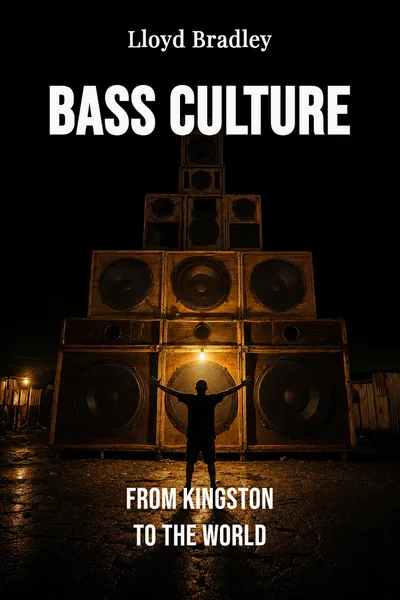
Bass Culture
From Kingston to the world
Description
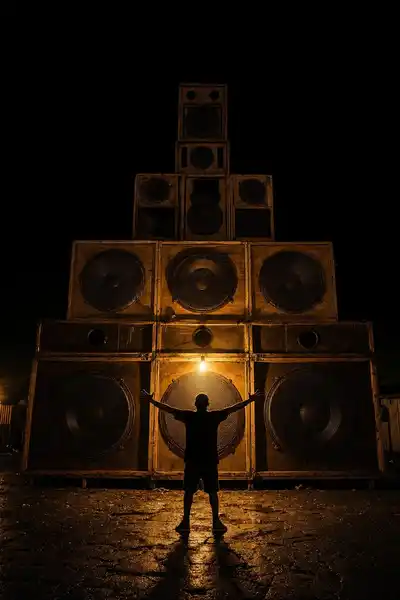
On a Kingston street in the late 1950s, a man named Duke Reid would arrive at a dance with a truckload of speakers, a generator, and a crate of American rhythm-and-blues records he had crossed the sea to buy. He wore a crown, carried a pistol, and called himself the Trojan. His rival, Coxsone Dodd, ran a competing rig across town. When the two set up within earshot of each other, the night became a battle: whoever had the heaviest bass and the rarest record won the crowd. These were the sound systems, and for a Jamaica too poor to own instruments, they were the closest thing the island had to a music industry.
Lloyd Bradley's Bass Culture is the first serious attempt to write down where that noise came from and where it went. A Black British music journalist, Bradley tracks the line from those street dances through ska, rock-steady, dub, and finally reggae — a music made in one of the poorest corners of the world that somehow ended up playing in every corner of it. Along the way he gathers the people who built it: Prince Buster, King Tubby, Lee Perry, and a young singer from the country parish of St. Ann named Bob Marley.
But Bradley is after something larger than a discography. The story of the music, in his telling, is the story of Jamaica itself — a colonial island stumbling into independence in 1962, a Kingston swelling with people who had nowhere to live, a country working out who it was in real time. The records were the argument, and the dancehall was where it happened.
The question we’re asking : How did a music made in the poorest neighborhoods of one small island end up shaping the sound of the whole world?What we’ll see : How Jamaica turned its own history — colonial, independent, restless — into a bassline that traveled.
Table of contents
01Chapter 1 — Sound systems built the country
Before there were Jamaican records, there were Jamaican dances, and before there were dances there was the sound system. Bradley makes the case that the whole edifice of reggae rests on this one institution. In the 1950s, radio in Jamaica played almost nothing a working-class Kingstonian wanted to hear, and buying a gramophone was out of reach for most families. So enterprising men built enormous mobile PA systems, stacked them in a yard or a lawn, and charged admission. The music was imported American R&B, and the appeal was physical: the bass came up through the ground, through the soles of your feet, into your chest.
The men who ran these rigs — Duke Reid, Coxsone Dodd, Prince Buster — became the first tastemakers of Jamaican popular culture, and the rivalry between them was ferocious. A sound system lived or died on exclusivity, so operators scratched the labels off their records to hide the titles from competitors, and sent buyers to the American South to find sides nobody else had. When the supply of good imports dried up in the late fifties, they did the obvious thing: they started recording their own.

02Chapter 2 — Ska, rock-steady, and a nation learning to walk
When Jamaica began cutting its own records, the first sound to emerge was ska: a fast, jumping music with the accent thrown onto the offbeat, horns punching over a scrambling shuffle. It arrived, more or less, alongside independence in 1962, and Bradley reads it as the sound of a country in a hurry — optimistic, up-tempo, ready to be its own thing after three centuries of British rule. Bands like the Skatalites, staffed by conservatory-trained horn players, gave ska a swagger that felt like a national mood.
Then, around 1966, the tempo dropped. The music slowed into rock-steady, a cooler, sparser style that pushed the horns back and let the bass and the voice carry the song. Bradley offers several explanations, and characteristically prefers the human ones to the tidy ones. One story holds that the summer of 1966 was too hot to dance fast. Another connects the slowdown to a harder mood in the city, as independence failed to deliver the jobs and housing it had promised and the Kingston ghettos filled with frustrated young men — the "rude boys" who became rock-steady's central subject.
03Chapter 3 — Dub, and the studio becomes an instrument
The most radical thing Jamaican music did, Bradley argues, happened almost by accident on the mixing desk. In the early 1970s, engineers began making special versions of hit songs for the sound systems — stripped-down cuts with the vocals dropped out, so a live DJ could talk over the rhythm. Someone realized the b-side didn't have to be a plain instrumental. It could be reassembled: drums yanked in and out, bass pushed to the front, snatches of voice drenched in echo and reverb until they dissolved.
The master of this was Osbourne Ruddock, known as King Tubby, an electronics repairman who built his own mixing equipment in a small studio in Waterhouse. Tubby treated the recording console not as a device for capturing a performance but as an instrument in its own right — muting, dropping, and drenching in real time, remaking a finished song into something spectral and new. Lee "Scratch" Perry, working at his Black Ark studio, took the idea somewhere stranger still, layering sounds until his tracks felt haunted. This was dub, and Bradley presents it as one of the genuine inventions of twentieth-century music.
04Chapter 4 — Marley, and the island that went everywhere
Reggae's arrival on the world stage has a face, and it belongs to Bob Marley. Bradley is careful not to reduce the whole story to one man, but he acknowledges the obvious: Marley, backed by Island Records' Chris Blackwell from 1972, became the first Jamaican artist to sell reggae as global rock. What Bradley wants to stress, though, is that Marley's music carried something specific — the Rastafari faith, the memory of slavery, the politics of a small Black nation — and that the world took all of it, not just the melodies.
This is where Bradley steps back from the discography to his real subject: reggae as the sound of a diaspora. Jamaica had always been an island that exported people. Its citizens had gone to build the Panama Canal, to cut sugar in Cuba, and, from the late 1940s, to work in postwar Britain. The music traveled the same routes. In London, the children of Jamaican immigrants grew up with the sound systems their parents had carried across the Atlantic, and reggae became the connective tissue of Black Britain — a way of holding onto Kingston while making a home in Brixton or Handsworth.
05Conclusion
Bradley ends where he began, with the sound system — because the thread never really breaks. The rig in the Kingston yard, the dub plate cut for a Saturday clash, the bassline that Marley carried to London and beyond: they are all the same instinct, the instinct of a people with almost nothing who decided that the one thing they would own was their own sound. The music changed shape every few years — ska, rock-steady, dub, reggae — but the engine underneath stayed constant, and it was always the dance.
Related books