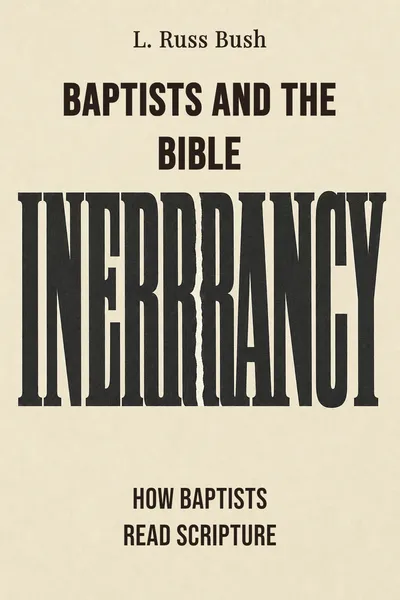
Baptists and the Bible
How Baptists read Scripture
Description
There is a habit among Baptists that outsiders sometimes find charming and sometimes find baffling: the willingness to argue about a single verse for an entire afternoon, in a church basement, over lukewarm coffee, with a Bible open on every lap. No bishop settles it. No council rules from above. The book is on the table, and everyone at the table claims the right to read it. That posture — the individual conscience meeting the text directly — sits close to the center of what it has meant to be Baptist for nearly four centuries.
L. Russ Bush, writing in Baptists and the Bible, set out to trace where that posture came from and what Baptists across the generations actually believed about the book they placed at the center of everything. His subject is not one controversy but a long inheritance: the convictions about Scripture that Baptists carried out of seventeenth-century England, refined through revivals and seminaries, and eventually turned into the sharpest internal fight the denomination has known. He wanted to know whether the modern quarrels were a break with the past or a continuation of it.
That question turns out to matter more than it first appears. When a community locates its final authority in a text rather than in an office, everything depends on how that text is read — and on who gets to say a reading is wrong. Bush's account of the Baptist relationship to Scripture is, at bottom, a study of what happens when freedom and authority are lodged in the same book.
The question we’re asking : What have Baptists actually believed about the Bible, and did the modern fights over it break with that inheritance or extend it?What we’ll see : How a people built their identity around a book, what their founders truly claimed for it, and why one word came to divide the whole family.
Table of contents
01Chapter 1 — A people defined by a book
Baptists did not begin with a doctrine of Scripture. They began, in the England of the early seventeenth century, with a stubborn refusal — the conviction that a church should be a gathered body of believers who had chosen their faith, not a parish that swept up everyone born inside its bounds. That refusal had a logic, and the logic ran straight back to the Bible. If you were going to reject infant baptism, the state church, and the authority of bishops, you needed something firmer than tradition to stand on. Scripture was the ground.
This is Bush's starting move, and it reframes the whole story. For Baptists, the Bible was never one authority among several. It was the authority that let them dispense with the others. Where Catholics had the church and Anglicans had the church-and-crown, Baptists had a text they believed spoke clearly enough that ordinary believers, reading it under God, could order their common life without a hierarchy telling them what it meant. Sola scriptura — Scripture alone — was not an abstraction for them. It was the practical foundation of their independence.

02Chapter 2 — What the older Baptists actually said
The heart of Bush's book is a long walk through the sources — confessions, sermons, systematic theologies, seminary lectures — to answer a deceptively simple question. When Baptists said the Bible was true, what did they mean? The question matters because a later generation would insist that the founders had believed in something like modern inerrancy, while critics answered that inerrancy was a twentieth-century invention smuggled backward onto men who never used the word. Bush wanted the evidence rather than the slogan.
What he found, laid out patiently across the confessions and the great nineteenth-century Baptist theologians, was a consistent conviction that ran deeper than any single term. Figures like John Gill and later the Southern Baptist teachers James Boyce and John Broadus wrote about Scripture as fully inspired, fully truthful, and trustworthy in what it affirmed. They did not, of course, use the vocabulary of later debates. But Bush's argument is that the substance was there long before the label: these writers plainly assumed the Bible did not err, because the alternative — a God who breathed out a text with mistakes in it — was one they never seriously entertained.
03Chapter 3 — The word that split the family: inerrancy
Those harder questions arrived from Germany. Through the nineteenth century, a scholarly movement often called higher criticism took the biblical texts as historical documents like any other — to be dated, sourced, and analyzed for the human hands that assembled them. Moses may not have written the first five books; the Gospels might weave together earlier fragments; some narratives might be theology dressed as history. To many this was simply honest scholarship. To Baptists whose entire structure rested on the reliability of the text, it landed as a threat to the foundation.
The response crystallized around a single, contested word: inerrancy. To affirm that the Bible is inerrant is to claim it contains no errors — not only in matters of faith and salvation, but in what it asserts about history and the created world. Bush's account makes plain why this word became the flashpoint. For those who held it, inerrancy was not an add-on doctrine but the modern name for the old total trust — the line that kept criticism from dissolving Scripture's authority piece by piece. For those who resisted it, the word imposed a rigid, defensive test that the founders had never demanded and that mistook the Bible's purpose.
04Chapter 4 — The Bible as the argument that never closes
Step back from the seminaries and the convention floors, and the Baptist story reveals something about any community that anchors itself in a text rather than an institution. The move that gives such a community its freedom is the very same move that guarantees its recurring conflict. Baptists could throw off bishops and creeds because they had the Bible and the reading conscience. But the reading conscience, multiplied across a whole people, produces readings that collide — and there is no chair at the front of the room with the authority to say which one wins.
This is the deep pattern in Bush's material, whether or not he frames it this way. The Baptist insistence on Scripture as sole authority is not a settled possession; it is a permanent assignment. Every generation has to decide, again, what trusting the book fully means under the conditions of its own moment. The founders trusted it against Rome and the crown. The nineteenth century trusted it against a rising skepticism. The twentieth trusted it, or argued about how to trust it, against a criticism that questioned the text's very construction. Same conviction, new pressure, fresh fight.
05Conclusion
We began with the church basement and the open Bibles, everyone claiming the right to read. Bush's long survey brings us back to that image with more behind it. The willingness to argue over Scripture is not a Baptist flaw or a Baptist accident; it is the direct consequence of the founding decision to make the book the final court and to seat no judge above it. From the London Confession to the Southern Baptist seminaries, the conviction held steady even as the questions grew harder — that the Bible could be trusted completely, and that trusting it was the price and the point of Baptist freedom.
Related books