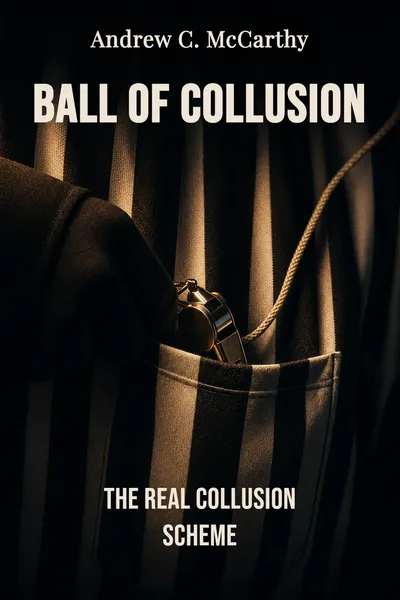
Ball of Collusion
The real collusion scheme
Description
For two years, one story dominated American political life: Donald Trump, it was said, had colluded with the Kremlin to steal the 2016 election. The word itself — collusion — became a fixture of cable chyrons, front pages and dinner tables. A former British spy's dossier, secret court warrants, a special counsel with a seemingly limitless mandate, a fired FBI director testifying before the Senate. Every week seemed to bring the smoking gun a step closer. And yet, as the months passed, the hard evidence of a conspiracy between the Trump campaign and Moscow kept failing to arrive.
In Ball of Collusion, the former federal prosecutor Andrew C. McCarthy takes that famous narrative and turns it inside out. His argument is blunt: the real collusion of 2016 ran the other way. Not between a Republican candidate and a hostile foreign power, but between the Clinton campaign and the sitting Obama administration — with the law-enforcement and intelligence machinery of the United States quietly enlisted in the effort. First to smooth the path for Hillary Clinton's succession. Then, when the voters refused to cooperate, to hobble the man they had actually elected.
McCarthy spent years as a prosecutor, and he reads the record the way a prosecutor does: motive, means, sequence, who knew what and when. What he assembles is less a partisan broadside than a reconstruction — a claim that the institutions a democracy relies on to stay above the fray had, in this instance, stepped into it. Whether one accepts the whole of his case or not, the machinery he describes is worth following closely.
The question we’re asking : If the collusion the country was told about never quite materialized, whose collusion was actually driving the story?What we’ll see : How a private email server, a curiously scripted exoneration and an unverified dossier fit together into McCarthy's counter-narrative of the 2016 election.
Table of contents
01Chapter 1 — The email system nobody was supposed to see
McCarthy starts where the trouble began: with a server in a basement. As Secretary of State, Hillary Clinton conducted government business through a private email system of her own, routed around the State Department's official channels. The arrangement, he argues, was not an accident of the digital age but a deliberate choice — one that kept her correspondence outside the reach of subpoenas, freedom-of-information requests and the ordinary archiving that governs official records. A cabinet officer had, in effect, built herself a zone of privacy inside a job that is supposed to have none.
The problem with running the nation's diplomacy off a homebrew system is that diplomacy is soaked in secrets. McCarthy makes the case that classified intelligence inevitably passed through the private account — material that, by law, is supposed to live only on secured government networks. He is precise about this because the law is precise: mishandling classified information does not require intent to be a crime. The statute reaches gross negligence. On his reading, a career official who had done a fraction of the same would already have lost a security clearance, if not their liberty.

02Chapter 2 — The exoneration written in advance
The investigation into Clinton's emails ended not with a bang but with a press conference. In July 2016, FBI Director James Comey stood before cameras and delivered a curious two-part verdict: Clinton and her staff had been extremely careless with classified material — and no reasonable prosecutor would bring charges. McCarthy fixes on the strangeness of that combination. The FBI does not, as a rule, announce whom it has declined to charge, still less deliver a public scolding of the person it is clearing. And the charging decision belongs to the Justice Department, not to the Bureau's director.
His deeper objection is procedural. Comey's own draft statement, it later emerged, had originally used the phrase gross negligence — the exact language of the criminal statute — before it was edited down to extremely careless, a formulation that carries no legal weight. McCarthy reads that edit as the tell. To find gross negligence would have been to find a crime; to say extremely careless was to describe the same conduct while defining it out of existence. The verdict, in his telling, had been reverse-engineered from the desired outcome.
03Chapter 3 — The dossier and the insurance policy
With Clinton comfortably ahead in the polls, McCarthy argues, a faction of intelligence and law-enforcement officials began worrying about the unlikely alternative — and decided they needed protection against it. The phrase he seizes on came from an FBI text message about wanting an insurance policy in the improbable event of a Trump win. Around that phrase he builds his account of how a counterintelligence investigation into a presidential campaign came to exist at all.
Its foundation was the dossier: a collection of memos alleging deep Trump-Russia ties, compiled by Christopher Steele, a former British intelligence officer. McCarthy is careful to trace the money. The research was ultimately paid for, through a chain of law firms and opposition-research shops, by the Clinton campaign and the Democratic National Committee. A document funded by one candidate to damage another was, he stresses, the seed of a federal probe into that other candidate — a fact its consumers inside the government understood.
04Chapter 4 — When the referee joins a team
Step back from the particulars and Ball of Collusion becomes a book about neutrality — specifically, about what happens when the institutions charged with being neutral decide they cannot afford to be. McCarthy's central claim is not merely that individuals behaved badly. It is that the FBI, the Justice Department and elements of the intelligence community allowed themselves to be pulled into the most divisive political contest in a generation, first on one side of it and then against its winner. The referee, in his metaphor, picked up a jersey.
The logic he attributes to them is almost reasonable from the inside. If you are genuinely convinced a candidate is a danger — to security, to the country, to the rule of law itself — then the ordinary rules of restraint can start to feel like negligence. Why sit on your hands when you alone can see the threat? McCarthy's answer is that this is precisely the temptation the rules exist to defeat. The power to investigate and surveil is trusted to these agencies only on the condition that they never turn it toward the political outcomes they personally prefer. Spend that trust once, and it does not easily come back.
05Conclusion
By the time Ball of Collusion closes, its author has reversed the picture the country had been staring at. The collusion that mattered, in his telling, was not a conspiracy between a candidate and a foreign capital but an alignment much closer to home: a campaign, an administration and the agencies beneath them, moving in the same direction at the same time. The dossier, the exoneration, the warrants and the leaks are not, for McCarthy, separate scandals. They are chapters of a single story about power protecting the outcome it wanted.
Related books