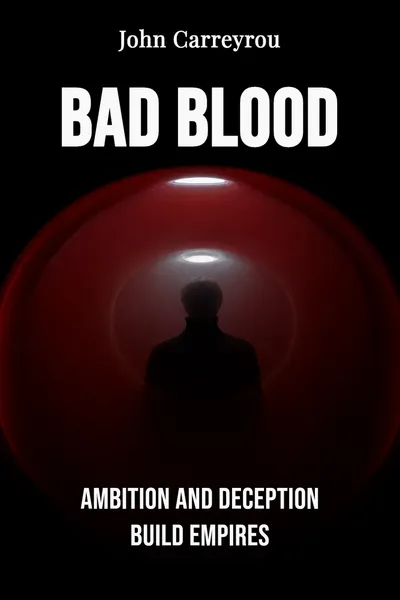
Bad Blood
Ambition and deception build empires
Description
In the summer of 2015, a Wall Street Journal reporter named John Carreyrou started making phone calls to former employees of a Silicon Valley company called Theranos. The company had a glittering story: a young founder, Elizabeth Holmes, who had dropped out of Stanford at nineteen, dressed in black turtlenecks like Steve Jobs, and promised to run hundreds of medical tests from a single drop of blood pricked from a finger. By then Theranos was valued at roughly $9 billion, Holmes was on magazine covers as the youngest self-made female billionaire in the world, and the company had put its testing machines into Walgreens stores. The board was stacked with former secretaries of state and four-star generals. The pitch was irresistible: cheaper, painless, faster blood testing that could catch disease early and save lives.
What Carreyrou heard on those calls did not match the covers. The machines, he was told, did not work. The finger-stick technology was unreliable, so the company quietly ran many tests on standard commercial analyzers it had bought from other firms — sometimes diluting the tiny blood samples to make them fit. Patients were getting results that were simply wrong. And anyone inside who raised concerns was threatened, isolated, or pushed out under the watch of the company's lawyers. Holmes had built a wall of secrecy, and behind it sat a product that could not do what she had sold to investors, regulators, retailers, and the sick people lining up at pharmacy counters.
Carreyrou's reporting, published first in October 2015 and later expanded into his book Bad Blood, set off the unraveling. Within three years the valuation collapsed to nothing, the company dissolved, and Holmes faced criminal fraud charges. The story reads like a thriller, but underneath the drama sits a harder question about how something this hollow got this big, with this many serious people vouching for it.
The question we’re asking : How did a company with a product that never worked attract billions of dollars, a celebrity board, and a place inside pharmacies — and what finally cracked it open?What we’ll see : The making of a founder myth, the machine that failed in the lab, the silence engineered to protect it, and what the whole episode says about the limits of Silicon Valley's favorite rules.
Table of contents
01 Chapter 1 — A drop of blood and a Stanford dropout
Elizabeth Holmes founded Theranos in 2003, at nineteen, after leaving Stanford with an idea that was genuinely appealing. Most people hate needles. Traditional blood draws fill several vials, go off to a lab, and come back slowly and expensively. Holmes proposed a device that could run a full panel of tests from a single finger-prick — a few drops, collected in a tiny container she called a nanotainer, processed by a compact machine that could sit in a pharmacy or even a home. The vision tapped something real: a world where you could monitor your own health cheaply and catch problems before they turned serious.
The trouble was that miniaturizing blood chemistry is brutally hard. Many tests need a certain volume to be accurate; diluting a small sample to stretch it introduces error. Holmes was not a trained scientist, and she pressed her engineers toward deadlines and demos rather than toward a working instrument. What she had in abundance was conviction and a talent for telling the story. She lowered her speaking voice to a baritone, adopted the Jobs uniform, and described a future so compelling that listeners filled in the missing technical proof themselves.

02 Chapter 2 — The machine that never worked
The central deception was simple to state and devastating in effect: the proprietary Theranos device, eventually branded the Edison, could not reliably run the broad menu of tests the company advertised. It handled only a limited set of assays, and even those wavered. So when Theranos launched commercial testing inside Walgreens stores in 2013, it could not actually deliver on the finger-stick promise it was selling to customers. The company's answer was to hide the gap rather than close it.
Behind the scenes, Theranos ran the large majority of its tests not on its own invention but on conventional analyzers made by companies like Siemens. Because those machines were built for ordinary venous draws, the tiny finger-stick samples had to be diluted to provide enough volume — a workaround that pushed some results outside the range the equipment was validated for. Quality-control checks failed regularly and were sometimes overridden. The lab, in short, was generating numbers that could not be trusted, and patients had no way of knowing which machine had produced their result.
03 Chapter 3 — The wall of silence
What kept the gap hidden for so long was a culture engineered around secrecy and fear. Theranos compartmentalized its own staff so that few people could see the whole picture: engineers did not talk to the lab, the lab did not talk to the commercial team. Employees signed aggressive confidentiality agreements. The man enforcing this, alongside Holmes, was Ramesh Balwani — known as Sunny — her partner in the company and, for years, secretly her partner in life, a relationship hidden from the board.
Sunny ran the operation with intimidation. Dissent was treated as betrayal. Workers who flagged problems were surveilled, accused of disloyalty, and often fired or driven to resign. The company's outside counsel, the famously combative attorney David Boies, was deployed not only as a lawyer but as a weapon — former employees who spoke to anyone were hit with letters threatening ruinous litigation. The cost of telling the truth was made deliberately high.
04 Chapter 4 — What a startup is allowed to promise
Theranos did not invent a new kind of dishonesty. It pushed a familiar Silicon Valley habit past its breaking point. The valley runs partly on the idea that you sell the vision first and build the reality afterward — the demo that overstates, the deadline that slips, the founder who projects certainty she does not yet have. For software, this often works out: a buggy app gets patched, and the early customers absorb the cost in mild annoyance. The whole funding model rewards founders who promise the impossible and then race to make it merely difficult.
What the case exposes is how badly that playbook breaks when the product is not an app but a medical result. The phrase "fake it till you make it" assumes a forgiving gap between the promise and the truth — a gap a patient with a misread potassium level cannot afford. Holmes carried the gestures of a tech visionary, down to the turtleneck and the world-changing mission statement, into a domain where being wrong is not a missed quarter but a misdiagnosis. The same swagger that funds a social network was, in a blood lab, a danger.
05 Conclusion
By 2018, the $9 billion company was worth nothing. Walgreens had pulled out, the lab was shut, and the Securities and Exchange Commission charged Holmes and Balwani with massive fraud. Criminal charges followed; in 2022 Holmes was convicted on several counts of defrauding investors and later sentenced to more than eleven years in prison, with Balwani convicted separately. The painless drop of blood that was supposed to democratize medicine never existed in any usable form. What remained was a trail of misled investors, wrong results, and the employees who had risked everything to say so.
Related books