Autobiography of a Spiritually Incorrect Mystic
Understand the life and teachings of Osho
Description
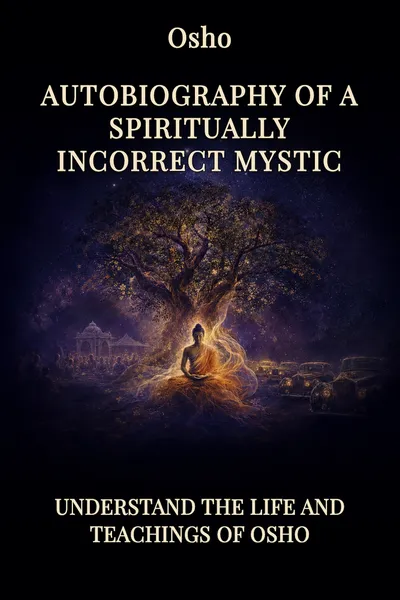
On December 11, 1931, a child was born in a small village in central India called Kuchwada, into a Jain family that traded in cloth. They called him Rajneesh Chandra Mohan. Decades later, after he had become Acharya Rajneesh, then Bhagwan Shree Rajneesh, then simply Osho, he assembled — through talks given to disciples over many years — something that reads like a life told backward, by a man who insisted he had no biography worth telling because the person who had lived it kept dissolving. The book that gathers those fragments carries a title he would have enjoyed: Autobiography of a Spiritually Incorrect Mystic. The phrase is a small provocation in itself. A mystic, by reputation, is supposed to be correct — serene, beyond reproach, slightly out of focus. Osho wanted the opposite reputation.
By the time he died in 1990, he had become one of the most photographed, recorded, and contested spiritual teachers of the twentieth century. Hundreds of his books — none written, all transcribed from speech — circulated in dozens of languages. A commune in Oregon had risen and collapsed in scandal, with charges that ran from immigration fraud to a mass food poisoning. He had been deported from the United States and refused entry by country after country. And yet the talks kept coming, and the disciples kept arriving, drawn to a man who told them, more or less, that everything they had been taught about becoming good was a trap.
The autobiography is not a chronicle so much as a self-portrait composed by a man suspicious of self-portraits. It moves between the village childhood, the university years, the meditation camps, the Pune ashram, the American experiment, and the long argument he carried on with every religion at once. What holds it together is less a sequence of events than a temperament — playful, combative, allergic to reverence, including reverence aimed at himself.
The question we’re asking : Who was the man who called himself spiritually incorrect, and what did he actually teach beneath the controversy?What we’ll see : A life told as a running quarrel with every tradition that tried to claim it, and the strange teaching that came out of the quarrel.
Table of contents
01 Chapter 1 — The boy who refused to inherit a god
The childhood Osho describes is unusually free for its time and place. He was raised largely by his maternal grandparents in Kuchwada, in a household where, by his telling, nobody insisted he conform. His grandfather indulged him; his grandmother, whom he speaks of with rare tenderness, let him roam, swim, climb, argue. He presents this absence of pressure as the first gift of his life. A child left alone, he claims, has a chance to stay whole. A child constantly corrected learns instead to perform — and the performance, eventually, replaces the person.
The death of his grandfather, when Osho was around seven, becomes the first hinge of the book. Watching the old man die over the course of a slow journey for medical help, the boy registered something he would return to for the rest of his life: that death is not an event at the end but a fact running through the whole of living, and that most people arrange their existence precisely to avoid noticing it. He says he stopped eating for days, not out of grief exactly, but to taste what it meant that someone could simply be gone. The episode reads less like trauma than like a first experiment.

02 Chapter 2 — Acharya Rajneesh and the campus that couldn't contain him
For a man who would later be famous for ninety-three Rolls-Royces and a commune in the desert, the next phase of the life is almost ordinary. He took degrees in philosophy, taught at universities through the late 1950s and 1960s, and held a post as a professor — acharya, in the honorific — at the University of Jabalpur. He was, by the accounts gathered here, a spellbinding lecturer and an exhausting colleague. He could not leave a comfortable belief unprovoked. Hinduism, Gandhi, socialism, conventional morality, the pieties of the newly independent nation — he went at all of them, and audiences grew.
What he was selling from the lecture circuit was not a doctrine but a method of suspicion. He told crowds that their religions were borrowed, their morals were fear dressed up as virtue, their respectability was a way of dying before they had lived. The talks were funny, which mattered. He understood that an audience laughing at its own sacred cows is an audience that has, for a moment, loosened its grip — and that loosening was the whole point. He was not asking people to believe him. He was asking them to stop believing so reflexively.
03 Chapter 3 — Pune, the Oregon detour, and the commune that swallowed itself
In 1974 the operation moved to Pune, and the Pune ashram became, for the rest of the decade, one of the strangest crossroads on the spiritual map. Thousands of Westerners arrived — many of them educated, restless, disenchanted with both the churches they had left and the politics that had failed to satisfy them. They got Osho's morning discourses, his enormous reading, his jokes, and a battery of therapies imported from the Western human-potential movement and fused with Eastern meditation. The mixture was deliberate. He wanted the catharsis of encounter groups and the silence of the mystics in the same building, and he was indifferent to whether the combination looked respectable.
The autobiography does not pretend this was tranquil. The therapies were intense, sometimes physically rough in those early years, and the sexual openness of the ashram drew constant attention. Osho leaned into the scandal rather than away from it. He spoke frankly about sex as an energy to be understood rather than suppressed, which earned him the lasting tabloid label of the sex guru — a label he found more amusing than wounding, since it confirmed exactly which buttons he had pushed. Underneath the provocation sat a consistent claim: that repression does not produce holiness, it produces obsession, and that a culture terrified of the body cannot be trusted on the subject of the soul.
04 Chapter 4 — What a mystic who distrusted mystics was actually selling
Step back from the Rolls-Royces and the salad bars, and a stranger figure comes into view: a man who built a religion out of an attack on religion. Osho's central teaching, repeated across the autobiography in a hundred forms, is that no teaching should be trusted, his own included. He told his sannyasins not to believe but to experience; not to follow a path but to notice they were already where the path was supposed to lead. The discipline he offered was a discipline of subtraction — drop the borrowed beliefs, drop the guilt, drop the ambition to become spiritual — until what remained was simply awareness without a project attached to it.
This is why the book reads as a quarrel rather than a creed. He fought Christianity for selling guilt, Hinduism for selling ritual, his own Jain inheritance for selling self-denial, and the modern self-help industry, before it had fully arrived, for selling improvement. What he proposed instead was meditation as celebration — a state he summed up in the word he liked best, the laughing readiness to be alive without a reason. It is a deeply attractive offer, and its attractiveness is exactly where the questions begin, because an offer that asks for no obligation can be very hard to tell apart from a product.
05 Conclusion
The man born in Kuchwada in 1931 spent his life refusing to be anyone's inheritance, and the book that bears his teachings keeps that refusal alive on every page. It tells the story of a Jain cloth-trader's grandson who watched his grandfather die, decided that most lives are spent avoiding that fact, and turned the avoidance itself into his subject. From the lecture halls of Jabalpur to the orange-clad thousands of Pune to the wreckage in Oregon, the through-line is not a doctrine but a temperament that could not abide a settled belief, including the settled beliefs his own movement produced around him.
Related books