
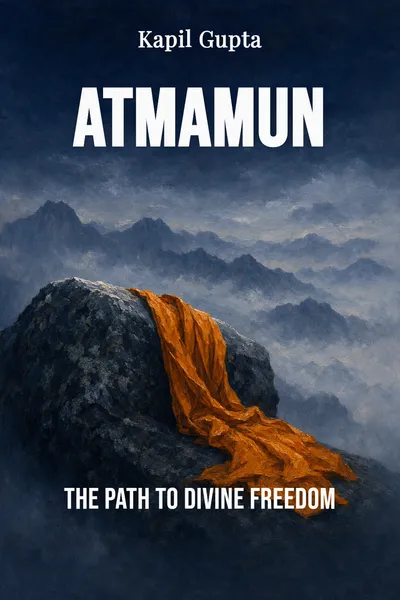
Atmamun
The path to divine freedom
Description
There is a certain kind of book that arrives promising to make us better — more productive, calmer, more disciplined, more at peace with the chaos of a Tuesday. Atmamun, published by Kapil Gupta, an American physician who left conventional practice to advise a small circle of elite performers, is not that book. Gupta writes toward something he calls the freedom of a living god, the settled interior stillness he attributes to the Himalayan swamis who spend their lives in pursuit of nothing else. And he is unusually blunt about the price. The freedom he describes cannot be bought with a morning routine, a gratitude journal, or a better set of habits. It asks for something most of us are not willing to give.
The word itself is a coinage — atma, the self or soul, joined to a suffix that suggests sovereignty over it. Gupta's claim is that nearly everything sold to us as growth is in fact decoration: we rearrange the furniture of a life we never questioned, and call the rearrangement transformation. He wants to go under the furniture, under the floor, to the thing that was doing the arranging. The tone is spare, sometimes severe, closer to a set of transmissions than a step-by-step guide. He seems almost uninterested in being liked.
That severity is the point, and it is what makes the book worth sitting with. In a genre built on reassurance, Gupta offers the opposite — a flat refusal to tell us what we want to hear, on the grounds that what we want to hear is exactly what keeps us where we are. The interesting question is not whether he is right about the swamis. It is what happens to the whole project of self-improvement once someone insists that improvement is not the goal at all.
The question we’re asking : What does Gupta mean by the freedom of a living god, and why does he insist the usual tools for reaching it are the very thing blocking the way?What we’ll see : How a doctor-turned-advisor reframes truth, the self, and the search for peace — and what his refusal to reassure asks of anyone who picks the book up.
Table of contents
01 Chapter 1 — The book that refuses to comfort
Kapil Gupta trained as a physician before walking away from clinical medicine to work privately with what he describes as world-class athletes, entrepreneurs, and performers — people who had already reached the top of their fields and found that the summit did not deliver what they had assumed it would. Atmamun grew out of those conversations, and it carries their texture: no small talk, no warm-up, an assumption that the reader is serious enough to be spoken to plainly. Gupta writes in short, declarative bursts, some barely a paragraph, and the effect is less like reading an argument than overhearing someone refuse to soften one.
The refusal is deliberate. Most books in this territory work by reassurance — they meet us where we are, validate the difficulty, and hand us a manageable next step. Gupta does almost the opposite. He tells the reader early that the search for peace, as most of us conduct it, is itself a symptom of the disease. We look for techniques because a technique lets us keep everything else about our lives intact. We want the reward without the surrender. And Gupta's whole point is that the surrender is the reward, that there is no path that leaves the seeker unchanged at the end of it.

02 Chapter 2 — Truth over knowledge
The central distinction in Atmamun is between knowledge and truth, and Gupta treats it as the whole hinge of the book. Knowledge, in his usage, is what we accumulate — facts, techniques, quotes, the collected wisdom of everyone who came before. It can be borrowed, memorized, repeated at dinner. Truth is different. Truth is what a person sees for themselves, directly, without an intermediary, and it cannot be transferred. We can be told a thousand times that the stove is hot; we do not know it until we touch it.
Gupta argues that the modern seeker mistakes the first for the second constantly. We read the great teachers, we can recite the insights, and we assume that having the words means having the thing. But the words are a menu, not a meal. A person can spend decades collecting spiritual knowledge — accumulating a library of borrowed truths — and remain exactly as anxious and divided as when they started, because none of it was ever seen. This is why gurus, in his account, are of limited use. The best a teacher can do is point; the seeing has to happen inside the one who looks.
03 Chapter 3 — The self is the whole problem
If truth must be seen directly, the obvious next question is: seen by whom? Here Atmamun turns its attention to the self — and this is where the book becomes genuinely radical rather than merely stern. Gupta's contention is that the self we spend our lives defending, promoting, and improving is not a solid thing to be perfected but a bundle of thought that has been mistaken for an identity. The restlessness we feel is not a flaw in an otherwise sound machine. It is the machine.
He returns often to desire and to the mind's compulsive commentary — the running narration that never stops, comparing, wanting, rehearsing grievances, planning the next acquisition. Most of us take this stream to be who we are. Gupta suggests it is closer to weather: something that passes through, that we could watch rather than obey. The swami's freedom, in his telling, is not the achievement of a calmer stream but the recognition that we were never the stream in the first place. That recognition, once it lands, does not require maintenance. A truth seen does not need to be re-earned each morning.
04 Chapter 4 — A method with no method
Step back from the specifics and Atmamun reads as an argument against the entire logic of self-improvement, which now saturates how we talk about our inner lives. The dominant promise everywhere — in apps, in productivity culture, in the endless supply of routines and protocols — is that we can accumulate our way to peace. More discipline, more optimization, more tracked habits, and eventually the good life clicks into place. Gupta's book is a sustained refusal of that promise. He is not offering a better technique for winning the game. He is questioning whether the game leads anywhere at all.
This is what makes the book awkward to place. It sits on the same shelf as the self-improvement titles, uses some of the same vocabulary, and yet its whole thrust runs against the grain of the shelf. Where the genre adds, Gupta subtracts. Where the genre reassures, he unsettles. Where the genre promises a method, he insists that any method the anxious mind can grasp and execute is, by definition, more of the same problem dressed as a solution. The freedom he points to cannot be manufactured, only uncovered — and uncovering is not something we do so much as something that happens when we stop doing.
05 Conclusion
Gupta ends where he began — with the figure of the Himalayan swami, settled and free, and the claim that this freedom is not exotic or reserved for renunciates but available to anyone willing to see through the self that keeps chasing it. Atmamun never softens into a program, and that is its integrity. The book that refused to comfort in its opening pages refuses right to the last, closing not with a plan but with a demand: look for yourself, verify for yourself, and stop mistaking the borrowed for the seen.
Related books