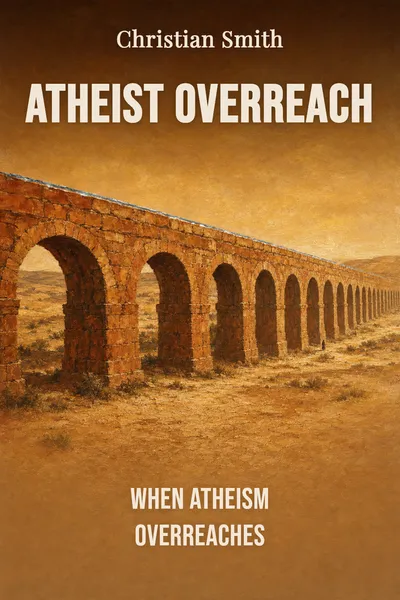
Atheist Overreach
When atheism overreaches
Description
Somewhere in the last two decades, unbelief got loud. Not the quiet, private atheism of a professor who simply didn't attend church, but a public, argumentative version with bestsellers, debate circuits, and a confident tone. The so-called New Atheists — Richard Dawkins, Sam Harris, Daniel Dennett, the late Christopher Hitchens — turned skepticism about God into a genre, and it sold. Somewhere along the way, being a non-believer stopped being a social liability in much of the West and became, in some circles, a mark of clear thinking. That shift is real, and Christian Smith, a sociologist at Notre Dame, takes it as his starting point.
But Smith isn't out to defend God's existence. His 2019 book Atheist Overreach does something narrower and, in a way, harder. It asks whether the confident public claims made by prominent atheists actually follow from their own premises. Can a purely secular worldview ground the kind of universal moral obligations most of us take for granted? Does science really support the sweeping conclusions attached to it? And is human nature what a strictly naturalistic account says it is? Smith, who has written extensively on morality and on how people actually live their beliefs, thinks the honest answer is often no — and that the gap matters.
What makes the book interesting is that Smith grants the atheists their metaphysics for the sake of argument. He isn't smuggling in a divine premise. He's checking whether the invoice matches the goods — whether the strong conclusions being sold are actually paid for by the reasoning underneath them.
The question we’re asking : When atheists make confident claims about morality, science, and human nature, do those claims actually follow from a secular worldview?What we’ll see : Where the public case for unbelief promises more than its own foundations can deliver.
Table of contents
01 Chapter 1 — The confident claim
Smith writes as a sociologist who spends his days studying what people actually believe and how they behave, not as an apologist scoring points. That posture shapes the book. He notices that public atheism in the 2000s and 2010s took on a particular register: assured, sometimes triumphant, and increasingly comfortable making claims that reached well past the narrow question of whether God exists. The argument was rarely just "there is no good evidence for a deity." It was that a godless universe could still deliver everything worth having — a robust morality, a full picture of the human person, a complete account of reality — with science doing the heavy lifting.
That bundle is what Smith wants to unpack. He draws a line he thinks the loudest voices tend to blur. There is atheism as a metaphysical position: the claim that no God exists. And there is the much larger package of confident assertions that often travels with it — that we can be "good without God," that reason and evidence alone settle our deepest questions, that anything worth calling knowledge comes through the scientific method. The first claim is legitimate philosophical territory. The second, Smith argues, is where the overreach lives.

02 Chapter 2 — What morality would actually require
The first promise is the one that matters most to ordinary life: that you can have solid, universal morality without God. Smith agrees that atheists can be perfectly moral people — that's not in dispute, and treating it as the question is a category error he refuses. Plenty of non-believers live decent, generous lives, and plenty of believers don't. The question isn't whether atheists behave well. It's whether a secular worldview can justify the specific kind of morality most of us actually want to hold.
And here Smith gets precise about what "most of us" want. Not just any morality — a strong, universal one. The conviction that every human being has equal dignity. That we owe obligations to strangers on the other side of the world we will never meet. That some things are wrong for everyone, everywhere, regardless of what a given society happens to approve. This is a demanding moral vision, and it's the one that underwrites human rights, humanitarian concern, and the modern conscience. Smith calls this "universal benevolence," and he notes that it is precisely what secular thinkers tend to assume without argument.
03 Chapter 3 — Science can't carry that weight
The second promise concerns science, and it's the one where the overreach is easiest to spot once you're looking. A recurring theme in popular atheism is that science is the only reliable path to knowledge — that if a question can't be settled empirically, it isn't really a question worth taking seriously. Smith has a name for this stance and a genealogy for it, and he thinks it collapses under its own weight.
The problem is straightforward. The claim "only scientific knowledge is real knowledge" is not itself a scientific finding. No experiment establishes it; no data set confirms it. It's a philosophical position about the limits of knowledge, smuggled in under the prestige of science. So it fails its own test: if only what science can verify counts, then this master claim doesn't count either. Smith isn't the first to notice this, but he presses it hard, because the whole confident edifice of "reason and evidence versus faith and superstition" leans on it.
04 Chapter 4 — The problem of the naturalistic self
Step back from the three specific claims and a single habit comes into view — and it's the habit, more than the atheism, that Smith is really writing about. His larger point isn't "atheism is false." It's that a worldview, any worldview, owes you conclusions no bigger than its premises can pay for. Overreach is what happens when the rhetoric outruns the reasoning, and Smith's insistence on that discipline is, in principle, indifferent to which side commits it.
The third promise makes this vivid. A strictly naturalistic account says the human person is a product of physics and blind evolution — an arrangement of matter with no built-in purpose, no soul, no special standing in the cosmos. Fine, Smith says; follow it through. If that's all we are, it becomes genuinely hard to underwrite the very things secular humanists most want to affirm: that persons have inherent dignity, that we are more than our usefulness, that human worth doesn't depend on power or productivity. Those convictions feel obvious, but obviousness isn't grounding. Smith's question is whether the naturalistic picture of the self can carry the moral weight routinely placed on it, and he thinks the confident answer that it can is, again, unpaid for.
05 Conclusion
The confident public atheism of the last twenty years won a real cultural victory: unbelief is more visible, more respectable, and more influential than it was a generation ago. Smith doesn't dispute that, and he doesn't want to reverse it. What he questions is the extra freight the victory has been made to carry — the assurance that a secular worldview delivers strong universal morality, that science answers our deepest questions, that a naturalistic self supports everything we want to say about human dignity. On each, he finds the same gap between what is claimed and what the argument earns.
Related books