Astroball
Innovation saves baseball's worst
Description
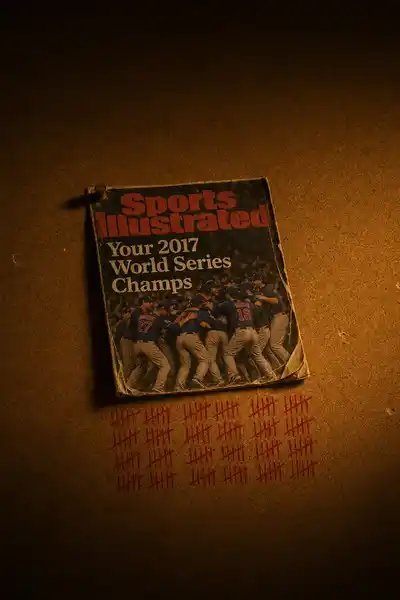
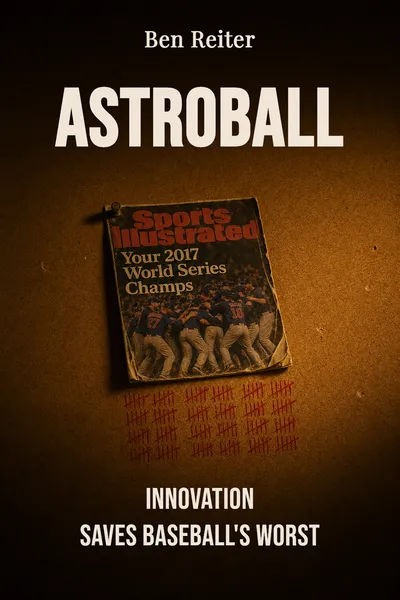
In the summer of 2014, Sports Illustrated put the Houston Astros on its cover with a line that read like a dare: "Your 2017 World Series Champs." At the time the prediction sounded close to a joke. The Astros had just lost 92 games, on their way to a third straight 100-loss season — the kind of stretch that empties stadiums and gets general managers fired. The team had stripped its roster down to almost nothing, traded away anyone with value, and was fielding a payroll near the bottom of the league. Picking them to win it all three years out wasn't optimism. It was an argument about how baseball was changing.
The argument turned out to be right. In November 2017, the Astros won the first World Series in the franchise's fifty-six-year history, beating the Los Angeles Dodgers in seven games. They returned to the Series in 2019. Ben Reiter, the journalist who wrote that cover prediction, spent years inside the building watching how it happened — and his book Astroball is the account of a team that decided to lose deliberately, rebuild around data nobody else trusted yet, and then discover that the numbers alone were never going to be enough.
What Reiter found wasn't a tidy story about machines beating humans. It was messier and more interesting: a front office trying to weld together two ways of seeing the same player — the statistical model and the scout's gut — and learning, sometimes painfully, where each one failed. The Astros didn't win because they out-computed everyone. They won because of what they did when the computer and the human disagreed.
The question we’re asking : How did baseball's worst team turn deliberate failure into back-to-back World Series, and what was the real source of its edge?What we’ll see : The tank, the model, the people who read it against their own instincts, and the limits of what data can ever measure.
Table of contents
01 Chapter 1 — The worst team money could lose on purpose
When Jim Crane bought the Astros in 2011 and hired Jeff Luhnow as general manager, the team wasn't just bad — it was directionless, an aging roster with no farm system worth the name and no plan beyond muddling along in the middle. Luhnow, who had come from the St. Louis Cardinals after a career in management consulting and tech, made a decision that looked to outsiders like vandalism. He chose to lose, and to lose as completely as possible.
The logic was cold but sound. In baseball, the worst teams draft first, and high draft picks are the cheapest way to acquire elite talent. A team stuck winning seventy games a year is good enough to miss the top picks and bad enough to miss the playoffs — purgatory. Luhnow gutted the roster, shipped out veterans for prospects, and slashed payroll to roughly $26 million, the lowest in the majors. The Astros lost 106, 107, and 92 games across three seasons. Reiter describes a clubhouse that knew exactly what was happening to it.

02 Chapter 2 — The model and the men who read it
At the center of the rebuild was a piece of software the Astros called Ground Control — a database that pulled together everything the team knew about every player it might ever want, weighted and scored and ranked. It was the kind of tool the post-Moneyball world had been promising, and Houston pushed it further than most. Decisions that other teams made on instinct, the Astros tried to make on evidence: who to draft, who to trade for, which minor leaguer was about to break out.
But Reiter's book pushes against the easy reading that this was a triumph of math over men. The most important figure in the story may be Sig Mejdal, the analyst Luhnow brought with him — a former engineer who had worked on fatigue research for NASA before deciding he'd rather build models for baseball. Mejdal's gift wasn't just the numbers. It was knowing what the numbers couldn't see. He spent a season riding buses in the minor leagues, embedding with scouts, trying to understand the things his spreadsheets kept getting wrong.
03 Chapter 3 — The trade that proved the math could feel
By 2016 the rebuild was producing talent — Correa, José Altuve, George Springer, Dallas Keuchel — but the Astros were still missing the piece that turns a good young team into a champion. Reiter's narrative builds toward the moves that closed the gap, and the most revealing of them wasn't about acquiring a star. It was about reading a person the numbers had quietly written off.
The case of Brian McCann and, more pointedly, the way the Astros evaluated character and clubhouse fit shows the front office bending its own instrument. The team had spent years teaching itself to distrust intangibles — the soft stuff scouts loved that rarely survived contact with the data. Yet as the roster matured, Luhnow's group found they couldn't build a winner on production alone. They needed players who would hold a young clubhouse together, and that was a judgment no model could make.
04 Chapter 4 — The thing the spreadsheet couldn't hold
The temptation, reading Astroball, is to file it as a story about analytics winning. It isn't, quite. Reiter's deeper argument is that the Astros' real innovation was organizational: they got better than anyone else at the unglamorous work of fusing two incompatible ways of knowing. The model saw patterns no human could; the scout saw context no model could. The advantage lived in the friction between them, in the meetings where a number and a hunch had to be reconciled into a single decision.
That fusion is harder than it sounds, and easy to get wrong in both directions. A front office that trusts the model too much drafts robots and misses the human variables that decide careers. One that trusts the scouts too much rebuilds the very biases the data was supposed to cure. The Astros' achievement was holding the tension without collapsing it — keeping people like Mejdal humble about the numbers and keeping the scouts honest about their eyes. For a few years, no organization in baseball did it better.
05 Conclusion
Ben Reiter's 2014 prediction came true almost to the season, and the cover that once looked foolish became a kind of artifact — proof that the change he'd glimpsed in Houston was real. The worst team in baseball had reorganized itself around a conviction that information, gathered and weighed more carefully than anyone else's, could overcome a payroll a fraction of its rivals'. It worked. The Astros lost on purpose, drafted shrewdly, traded boldly, and won the franchise's first title in 2017, returning to the Series in 2019.
Related books