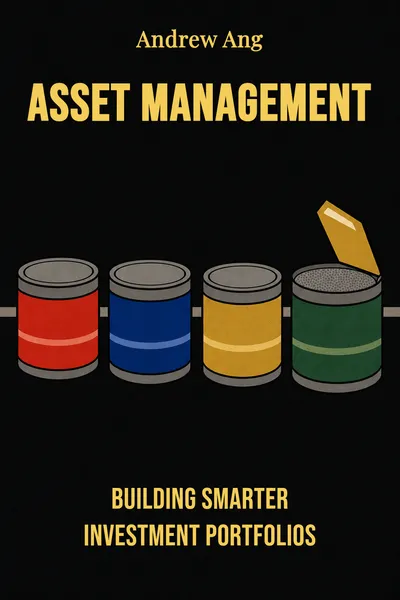
Asset Management
Building smarter investment portfolios
Description
In 2009, Andrew Ang got a phone call that most finance professors only dream about. Norway's sovereign wealth fund — one of the largest pools of money on earth, built on decades of North Sea oil revenue — had just lost roughly a quarter of its value in the financial crisis, and the country wanted to know why. Ang, a Columbia professor who had spent his career studying how returns actually behave, was brought in with two colleagues to dissect the fund's performance. What they found became the seed of a book. The fund thought it had been diversified across clever active managers. In reality, most of what those managers had delivered was exposure to a handful of the same underlying risks, dressed up in different clothes.
That diagnosis sits at the center of Ang's 2014 book, Asset Management: A Systematic Approach to Factor Investing. The argument is deceptively plain. We tend to sort money by the labels on the tin — stocks, bonds, hedge funds, real estate, private equity. Ang argues that those labels hide what really drives returns: a smaller set of underlying forces he calls factors, the way nutrients rather than foods explain what a diet does to a body. Once we see through the labels to the factors, most of the industry's mystique starts to dissolve, and a more honest set of questions comes into view.
It's a book aimed at anyone responsible for money over the long haul — a pension board, a foundation, a household saving for retirement. It is quantitative without being cold, and its central move is to keep asking not what an asset is called but what it exposes us to, and what we are being paid to bear.
The question we’re asking : If the labels we sort investments by hide what actually drives their returns, what should we be looking at instead?What we’ll see : How Ang rebuilds portfolio thinking from the ground up — from what really moves returns to why the person holding the portfolio is the part most likely to break it.
Table of contents
01Chapter 1 — It's the factors, not the labels
Ang opens with an analogy that runs through the whole book. Think about food. We eat eggs, bread, salmon, spinach — but what our bodies respond to are nutrients: protein, fat, vitamins, fiber. Two very different meals can deliver almost identical nutrition. Investing works the same way. We buy assets with names — a corporate bond, a value stock, a hedge fund position — but what actually determines whether we get paid, and how much we suffer along the way, are the underlying risk factors those assets carry. Ang's core claim is that we should manage the factors, not the food.
What are these factors? The most familiar is the equity premium — the extra return we expect for holding stocks rather than cash, compensation for the fact that stocks crater precisely when the economy sours. But there are others that show up across markets. Value stocks, the unglamorous and beaten-down, have historically earned more than expensive growth stocks. Momentum, the tendency of recent winners to keep winning for a while, is another. So is the compensation for holding illiquid assets you cannot sell quickly, and the yield earned for bearing interest-rate and credit risk in bonds.

02Chapter 2 — Risk is a thing you get paid to hold
If factors are what we should manage, the next question is why any factor pays anything at all. Ang's answer is bracingly unsentimental: factor premiums are compensation for pain. The equity premium exists because stocks deliver their worst returns during recessions, job losses, and market panics — exactly the moments when we can least afford them. We are paid, in the good years, to endure the bad ones. A factor that never hurt would not pay, because everyone would pile in until the reward vanished.
This is where risk management stops being a defensive afterthought and becomes the heart of the enterprise. Ang wants us to think in terms of bad times rather than abstract volatility. Volatility treats an upside surprise and a downside crash as equally troubling, which no real investor believes. What matters is how an asset behaves when the world falls apart. An investment that pays off in a downturn — like safe government bonds, which rallied in 2008 — is worth holding even if it earns little on average, because it cushions us when cushioning is scarce and dear.
03Chapter 3 — The investor is the weakest instrument
Having built the machinery of factors and risk, Ang turns to the person operating it — and finds the biggest vulnerability there. The most sophisticated factor strategy fails if the investor abandons it at the wrong moment. Value investing, momentum, rebalancing into falling assets: all of them require doing the psychologically hard thing, buying what feels awful and trimming what feels wonderful. The premiums exist partly because most people cannot stomach the discipline they demand.
Ang draws on behavioral finance without romanticizing it. We are loss-averse, feeling losses roughly twice as sharply as equivalent gains, which pushes us to sell at the bottom. We extrapolate recent performance, chasing last year's winners into this year's disappointments. We anchor on the price we paid and refuse to sell losers. These biases are not occasional lapses; they are the default settings of the human mind under uncertainty, and markets are engineered to trigger every one of them.
04Chapter 4 — What a good portfolio actually rewards
Step back from the mechanics and Ang's book is arguing for a particular idea of what asset management is for. It is not, at bottom, the search for genius stock-pickers or secret formulas. It is the patient, disciplined harvesting of risk premiums by an investor who understands their own obligations and can tolerate the discomfort those premiums require. Everything else — the manager pitches, the exotic products, the performance charts — is decoration around that simple core, and often decoration designed to obscure it.
This reframing explains why Ang is so preoccupied with fees and with what he calls factor-based benchmarking. If much of what active managers deliver is plain factor exposure that could be bought cheaply through an index, then paying hedge-fund fees for it is a straightforward transfer of wealth from investor to manager. His method — decompose returns into their factor sources, then ask what is left over — is a way of separating genuine skill from repackaged risk. Most of the time, once the factors are accounted for, very little skill remains, and the fees remain very large.
05Conclusion
The Norway assignment that opened the book ended with a recommendation the fund eventually adopted: manage exposures to systematic factors deliberately, benchmark managers against those factors, and stop paying premium prices for risks that could be bought plainly. It was a modest-sounding conclusion for such a large sum of money, and that modesty is the point. Ang's whole method is a slow subtraction of glamour from investing, replacing the fantasy of prediction with the practice of knowing exactly what you own and why it might hurt you.
Related books