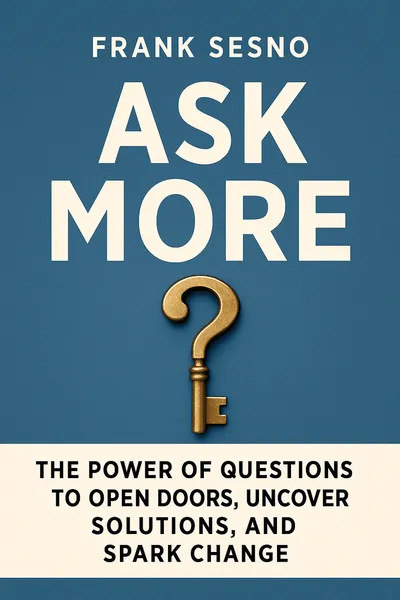
Ask more
Eleven pathways to better answers
Description
Asking the right questions can lead to meaningful connections, establish credibility, and pave the way for future plans. There are eleven types of questions that, when understood, can optimize outcomes. Successful individuals often ask numerous questions and act on the insights gained, demonstrating the power of inquiry.
Questions foster learning, innovation, and problem-solving. They enable us to envision new possibilities, reflect on our purpose, and set our goals. As John F. Kennedy suggested, we can live generously by asking what we can do for others. Curiosity fuels our minds and captivates our imaginations.
- Frank Sesno
Table of contents
01Problem solving
Diagnostic questions are a powerful tool for understanding the true nature of a problem. They form the foundation of any inquiry, helping to identify the underlying cause of issues. The process typically begins with an open-ended question about the problem, encouraging people to describe their experiences and perceptions. This is followed by exploring the history of the problem, looking for patterns and changes over time. The next step involves probing deeper to uncover hidden factors or consequences that may be influencing the situation. Finally, it's crucial to verify and double-check the information gathered to ensure its accuracy and reliability. This process requires careful listening and observation, looking for inconsistencies and comparing different versions of the story. It's also important to be open to challenging assumptions and questioning expert opinions to ensure the accuracy of the information.

02Visionary
Strategic questions are essential tools for making complex decisions under uncertainty, especially those with long-term consequences. They help to clarify the path to desired goals, evaluate risks, and consider alternative options. These questions are often simple but get to the heart of the matter, making them effective in decision-making processes.
When faced with a major decision, it's advisable to pause and ask strategic questions. These questions can be categorized into four main areas. First, start with the big picture, asking about the proposed course of action, its alignment with your interests and values. Second, do a quick gut check, considering if the decision serves a higher purpose, feels right, and if you have the passion and resources to follow through. Third, acknowledge what you're up against, identifying your opponents, potential challenges, and your plan for moving forward. Lastly, challenge your plan, considering potential pitfalls, your response to possible failures, the cost, alternatives, and the consequences of failure.
03Compassionate
Empathetic questions are a powerful tool for fostering deeper connections and understanding with others. They allow us to explore the thoughts, feelings, and fears of others without passing judgment. The benefits of asking empathetic questions include enhancing trust, reinforcing relationships, and gaining a better understanding of others and ourselves.
To ask empathetic questions effectively, start with open-ended inquiries about the person's experiences. For example, ask about their feelings during a particular event or what happened to them. Then, transition to appreciative inquiry, asking questions that frame things in a positive light and methodically unfold the conversation. For instance, ask about the setting before an event, what they liked about a certain situation, and how subsequent events transpired. As the conversation progresses, narrow the distance by asking increasingly detailed follow-up questions, signaling your interest through your facial expressions. Lastly, listen intently to what is being shared, picking up on any underlying emotions or experiences.
04Bridge building
Bridging questions are a strategic tool used to foster communication with individuals who may be reluctant, distrustful, or hostile. The goal is to establish a connection and encourage dialogue, often requiring a delicate approach and patience. Key principles include having a clear focus on the information you're seeking, avoiding triggers that may cause defensiveness, and affirming and validating the other person's perspective throughout the conversation.
05Challenging
Confrontational questions are a powerful tool for holding individuals accountable for their actions or statements. These questions are typically direct and straightforward, aiming to elicit a clear response and put the respondent on record. They can be used to air grievances, level accusations, or reinforce acceptable behavior rules. However, they are high-risk and often used in charged settings. To effectively use confrontational questions, one must know their aim and stick to it, ensure they are working from correct information, frame their questions precisely, project moral authority, and be prepared for defensive or evasive responses.
06Innovative
Creative questioning is a powerful tool that encourages people to think outside the box and generate original ideas. It involves imagining scenarios where normal rules don't apply, prompting daydreams and creative thinking. A prime example of this is Uber, where the founders asked themselves what it would be like to ride around town like a millionaire. This question led them to challenge the status quo and create a revolutionary transportation experience.
07Purpose driven
Mission questions are a powerful tool to inspire a sense of purpose and shared goals among a team. They require a clear identification of the mission and an understanding of everyone's roles, passions, and capabilities. These questions should be designed to draw out the underlying shared values and aspirations of the team, and to highlight the potential benefits of collaboration.
The process of asking mission-style questions can be broken down into four steps. First, start with discovery by asking about what matters to the team and why. This could involve questions about the issues they care about and the values they stand for. Second, move on to aspirations and mission, using follow-up questions to highlight what the team ideally wants to change or improve. Third, enlist collaborators by discussing what could be achieved through joint efforts.
08Investigative
Scientific questions are essential for sparking inspiration and generating fresh ideas to explore mysteries. They are often "slow" questions that don't have immediate answers and are built around the scientific method. To frame worthwhile scientific questions, start by observing a problem and formulating a question. Offer an initial hypothesis or explanation, and then put it to the test using real-world data through experiments and gathering observable facts. Share your idea with others to identify any obvious deficiencies. This process involves observing, hypothesizing, testing, gathering data, and forming conclusions.
09Evaluative
Interview questions serve as a tool to gauge compatibility and predict future performance within an organization. If you're a job applicant, it's crucial to anticipate these questions and prepare thoughtful responses in advance. Some common questions you might encounter include:
What do you enjoy about your current role? What are your most significant achievements in your previous positions? Can you share an instance where you turned a unique idea into reality? How did you handle a significant setback? What personal goals drive you? How would you approach a 15% budget cut? How would you manage a tight deadline that compromises your desired standard of work?
10Engaging
To transform your dinner party into an engaging and memorable event, it's crucial to know your guests, their interests, and passions. Creative and thought-provoking questions can stimulate multi-level engagement among your guests. Setting a positive mood from the start can also help to engage their emotions. You can structure your questions in a three-course manner, deciding whether you want to be probing, fun, or irreverent.
Here's a strategy to follow: Begin with a theme for the evening, such as "What is the one thing in the world that blows you away?" Kick off with riddles that have no definitive right or wrong answers, revealing guests' thinking and personalities. Introduce snippets on trends and current affairs to provoke thought and commentary. Engage your guests in a series of poignant questions for active debate and discussion. Add laughter and humor by inviting guests to share their most embarrassing or weirdest work experiences. Be attentive to any signs of annoyance, resentment, or impatience, and steer the conversation away from potentially offensive topics.
11Reflective
Legacy questions serve as a reflection on life's journey, focusing on accomplishments, achievements, and contributions made by individuals. These questions encourage introspection, allowing individuals to step back, acknowledge their accomplishments, and set future priorities. They provide context to one's life or career, asking about important accomplishments, sources of pride, lessons learned from mistakes, unfulfilled desires, and how one wishes to be remembered. They also delve into personal narratives, such as how one would title their life or career if it were a book, and who would portray them in a film adaptation. These questions touch on themes of meaning, spirituality, gratitude, regrets, and purpose, adding depth to the present and context to the future.
Related books