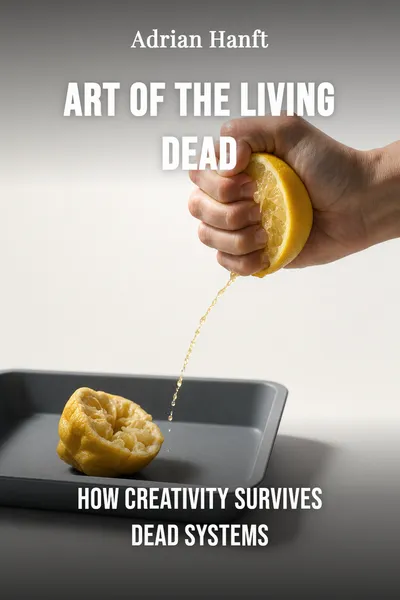
Art of the Living Dead
How creativity survives dead systems
Description
Adrian Hanft spent years as a designer inside the kind of place most of us have worked at least once: a company that still moves, still ships, still pays people, but stopped being alive somewhere along the way. Meetings happen. Decisions get made. And yet nothing new ever really comes out the other end — every proposal gets sanded down until it looks like the last proposal, which looked like the one before it. Out of that experience came a strange little book, Art of the Living Dead, which reads less like a business title than a survival manual for the parts of your brain that still have a pulse.
Hanft's premise is that the interesting question isn't why so few people are creative. It's the opposite. Creativity, he argues, is closer to a default setting than a rare gift — something children do without instruction and most adults quietly stop doing around the time they enter systems that reward predictability. The zombie in the title isn't a person. It's the organization, the industry, the inherited habit that keeps shuffling forward long after the reason for its existence has died, feeding on the living ideas of whoever wanders too close.
What makes the book worth sitting with is that it refuses the easy villain. Nobody in these dead systems is stupid or cruel. They're doing exactly what the machine rewards them for doing. The trouble is that the machine rewards a very specific thing — and it isn't the new. So the puzzle Hanft sets himself is practical, almost tender: how does anyone keep making real work while collecting a paycheck from something with no heartbeat?
The question we’re asking : How does creativity survive inside systems that have quietly stopped being alive?What we’ll see : How a designer's field notes turn into a theory of where invention comes from, why the mediocre outlasts the better, and what it takes to keep making things anyway.
Table of contents
01 Chapter 1 — The zombie in the org chart
Hanft borrows the zombie deliberately, and not for shock value. A zombie is something that keeps moving after the thing that animated it is gone. Applied to organizations, the metaphor is uncomfortably precise. Most companies begin with a live idea — a person who wanted to make something that didn't exist. Then the idea works, the company grows, and slowly the founding impulse gets replaced by process. The process was built to protect the original creativity. In time it becomes the thing that eats it.
The mechanism is banal, which is exactly why it works so well. A dead system doesn't announce itself. It sends the ideas out for review. It asks for alignment. It requests that the risky proposal be de-risked, the strange edge softened, the number backed up by a comparable that already exists. Every single step is reasonable. The person making the request is competent and well-meaning. And the sum of all those reasonable steps is a machine that reliably converts the new into the already-seen.

02 Chapter 2 — Where creativity actually comes from
If the dead system is the antagonist, Hanft still has to answer the harder question: what exactly is it killing? Where does creativity come from in the first place, and why do some people seem to reach it so easily while others convince themselves they were born without the gene? His answer is closer to the Romantics than to the productivity gurus, but he strips the mysticism out of it. Creativity, for Hanft, isn't a rare substance. It's a way of paying attention that most of us are trained out of.
Children are his standing evidence. A four-year-old will draw a purple horse with six legs and feel no shame about it, because nobody has yet told her which combinations are allowed. She isn't more talented than the adult who can't start a blank page. She's simply operating without the internal editor that adulthood installs — the voice that checks each impulse against what's normal, what's professional, what won't embarrass us. The creative adults Hanft admires aren't people who found something extra. They're people who managed to keep that editor quiet, or at least to overrule it long enough to make the first ugly version of a thing.
03 Chapter 3 — The tyranny of the good enough
Here Hanft turns to a puzzle that runs through the book like a low hum: why do worse things so often win? Why does the historical remnant survive when a plainly better option is available? He collects the examples from the everyday world — the layouts, the standards, the design conventions that everyone privately knows are clumsy but that nobody dares replace. His answer is that a dead system doesn't optimize for quality. It optimizes for not having to decide again.
Once a convention is in place, it stops being judged. It becomes the default, and defaults carry enormous inertia because changing them requires someone to take responsibility for the change. The good-enough solution has a decisive advantage over the better one: it already exists, it already works, and no single person has to stake their reputation on it. The better idea, meanwhile, arrives as a proposal — vulnerable, unproven, easy to kill. In a system that punishes visible failure more than it rewards invisible improvement, the incumbent almost always wins.
04 Chapter 4 — Making art inside the machine
Where the book earns its subtitle is in refusing the two easy exits. Hanft doesn't tell the reader to quit and chase a purer life, and he doesn't tell them to make peace with the machine and cash the checks. Both are forms of surrender. The living dead, in his framing, are precisely the people who have chosen one of those two exits without admitting it — the ones who left in bitterness and the ones who stayed and stopped noticing. His interest is in the narrow, difficult third path: keeping your artistry alive inside a system that has no use for it.
What that looks like, in practice, is less heroic than it sounds. It's the discipline of protecting the live bits of your own attention from the sanding machine — making the strange version first, before the internal editor and the external review have a chance to intervene. It's treating the compromise as the last step rather than the first, so that whatever finally ships still contains a trace of the thing that was actually alive. Hanft is realistic about the cost. This is more effort, more exposure, more small friction with people who mean well. The system will not thank you for it.
05 Conclusion
Hanft ends more or less where he began, back inside the ordinary building where people are still moving through their days, still shipping, still convinced they're being responsible. Nothing dramatic has happened. No villain has been unmasked, because there was never a villain — only a system doing exactly what it was built to do, and people reading its incentives correctly. The zombie is still shuffling forward. The question the book leaves open is not whether it can be defeated, but whether anyone inside it is still choosing to notice.
Related books