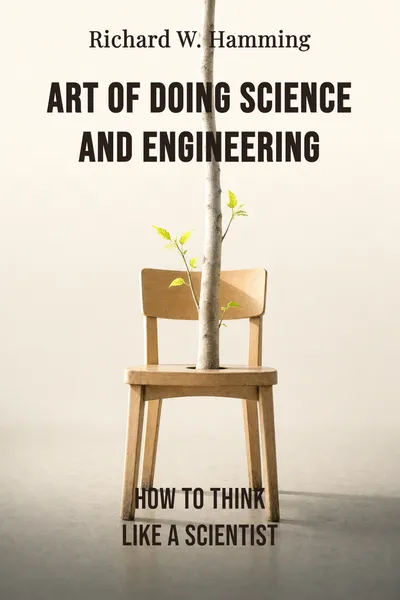
Art of Doing Science and Engineering
How to think like a scientist
Description
In the spring of 1986, a mathematician named Richard Hamming stood in front of an audience at Bell Labs and gave a talk he called "You and Your Research." He was not modest about the framing. His question, put plainly to a room of accomplished colleagues, was why some scientists do work that matters and most, equally clever, do not. Hamming had earned the right to ask. He had worked on the Manhattan Project, invented the error-correcting codes that carry his name and still keep our data intact, and spent decades at the lab that produced the transistor and the laser. He had watched Nobel winners up close, and he had watched brilliant people fizzle. The difference, he was convinced, was not raw talent. It was something closer to a habit of mind.
Late in his life he turned that conviction into a course, taught at the Naval Postgraduate School, and then into a book: The Art of Doing Science and Engineering, published in 1997, a few years before his death in 1998. The book is unusual. It moves through information theory, coding, digital filters, computers, and simulation — the technical furniture of a long career — but the actual subject is never the furniture. It is how Hamming thought while he built it. He tells the stories with the failures left in, because the failures, he insists, taught him as much as the wins.
What makes the book worth opening is a claim most people quietly reject: that clear, productive thinking is not a gift you are born with but a craft you can learn. Hamming believed style could be taught the way a good coach teaches — not by handing over rules, but by showing the work and reasoning aloud through it. He wrote the book for engineers and scientists who would spend their careers solving problems nobody had yet defined.
The question we’re asking : Can the way a great scientist thinks actually be learned, or is it just talent we dress up as method?What we’ll see : How Hamming turned a lifetime at the workbench into a teachable habit of attention, judgment, and nerve.
Table of contents
01 Chapter 1 — The professor who taught learning, not facts
Hamming opens with a warning about his own subject. Most of the specific technical knowledge in the book, he says, will be obsolete within a few decades. The transistors will change, the machines will change, the languages will change. So teaching facts, for a career that runs forty or fifty years, is close to useless. What lasts is the ability to keep learning after the facts have gone stale. That is the thing he actually wants to hand over, and it explains why he keeps interrupting the mathematics to talk about how he arrived at it.
This is why the book reads less like a textbook than like a long conversation with someone thinking out loud. When Hamming introduces information theory, he does not just present Shannon's results; he tells us what Shannon was and was not claiming, where the word "information" is doing honest work and where it is quietly misleading. He does the same with error-correcting codes, the field he founded almost by accident when a weekend computation kept dying on a single flipped bit and he got fed up enough to fix the problem for good.

02 Chapter 2 — The compound interest of paying attention
One of Hamming's most quoted arguments is almost aggressively unglamorous. Great work, he claims, is largely the product of sustained, directed effort — and the direction matters more than the hours. He watched colleagues of genuine brilliance drift through careers on interesting-but-minor problems, and he came to believe the drift was a choice they never noticed making. His famous prod, delivered over lunch to people he respected, was to ask what the important problems in their field were, and then why they were not working on them. It usually did not make him popular.
Behind the needling sits a real theory of accumulation. Hamming treats knowledge and skill like compound interest: small consistent investments, made in the right direction, dwarf occasional bursts of effort in the wrong one. The scientist who spends an extra hour each day reading beyond the immediate task, or who keeps a running file of open problems, is not doing something heroic. He is quietly building the capital that makes a later breakthrough possible. Ten years of this looks, from the outside, like luck.
03 Chapter 3 — Why the messy problems are the real ones
The technical chapters of the book keep circling back to a single uncomfortable fact: the clean problems have mostly been solved. What remains — what a working engineer actually faces — is ill-defined, tangled with constraints, and rarely amenable to the tidy methods taught in school. Hamming's digital-filter chapters make this concrete. The mathematics of an ideal filter is beautiful and physically impossible; the real design is a series of negotiated compromises, and knowing which compromise to make is judgment, not theorem.
This is where his insistence on keeping the failures becomes a method rather than a confession. Hamming describes chasing approaches that did not pan out, and he lingers on why they failed, because the failure usually revealed something about the shape of the problem that no success would have. A dead end that teaches you the constraint you had been ignoring is, in his accounting, more valuable than a lucky guess that works for reasons you never understand. The point is to fail informatively.
04 Chapter 4 — The style that outlasts the technique
Step back from the equations and a larger argument comes into view, one Hamming states almost casually and then spends the whole book demonstrating. Effective thinking, he believed, has a style — a recognizable way of moving through uncertainty — and style, unlike talent, can be studied and acquired. This is the wager the book is built on. If it were only talent, there would be nothing to teach and no reason to write. Hamming wrote precisely because he thought the opposite was true.
What that style consists of, gathered from the scattered lessons, is coherent. It means caring which problems you attack, not just how well you attack them. It means keeping your reasoning visible, to yourself most of all, so you can catch where it went wrong. It means treating failure as information and elegance as a temptation to be watched. And it means a certain courage — the nerve to work on something that might not pan out, because the safe problems, by definition, are the ones already claimed.
05 Conclusion
Hamming ends the book roughly where he began the 1986 talk: with the conviction that the difference between adequate and important work is mostly a matter of how a person decides to think, day after day, over a long career. He does not pretend this settles anything. He knows the reader can nod along and change nothing. But he has done what he set out to do — laid out a lifetime of successes and failures with the reasoning still attached, so that the habits, not just the results, are on display.
Related books