Are You Fully Charged?
Three keys to better days
Description
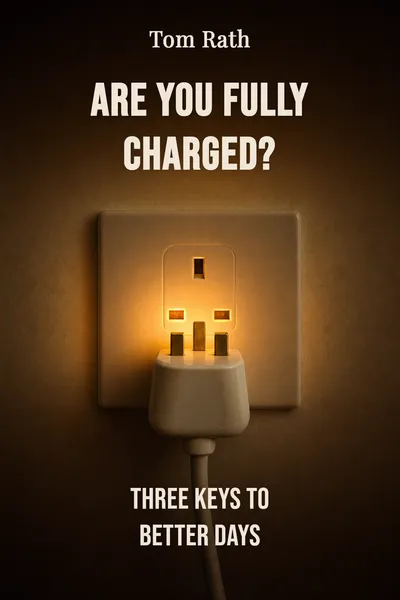
Most of us measure our phones more carefully than we measure ourselves. We watch the little battery icon all day, plug in before it dies, and feel a small anxiety when it slips under twenty percent. Tom Rath, who has spent a career studying what makes people thrive, asks us to turn that same attention inward. In his 2015 book Are You Fully Charged?, he frames the question literally: at the end of an ordinary day, how charged do you feel? Not happy in some grand sense, not successful on paper — just charged, with enough energy to be at your best for the people and the work that matter.
The answer, for most of us, is not very. Rath points to a long-running Gallup finding he knows intimately from his years there: only around eleven percent of people report having a great deal of energy on a typical day. The rest of us run flat, plugging through tasks, mistaking busyness for engagement and pleasure for fulfillment. We chase the wrong targets, fill our calendars with the wrong activities, and wonder why a day that looked productive left us depleted by dinner.
What makes the book more than a wellness checklist is where Rath goes looking for answers. He pulls from health science, psychology, and behavioral economics, and he keeps asking the unglamorous question of what actually moves the needle on a single day — because days, stacked up, are what a life is made of. The premise is that a better day is something we can engineer, deliberately, starting tomorrow morning, if we know which levers to pull.
The question we’re asking : What actually charges a day — and why do so many of us reach evening running on empty?What we’ll see : How Rath rethinks happiness, the people we share our hours with, and the body we tend to ignore until it forces us to.
Table of contents
01 Chapter 1 — The full battery, and why it runs flat
Rath's organizing image is the battery, and it carries more weight than a cute metaphor. A charged day, he argues, is built from three sources, and missing any one of them leaves us running below capacity no matter how well the others are doing. The three are meaning — doing something that matters to someone beyond ourselves; interactions — the quality of the moments we spend with other people; and energy — the physical state of the body we carry through the day. Pull on all three and the day lifts. Neglect them and we coast on fumes.
The honest starting point is how rarely we run full. Rath draws on the kind of large-scale survey work he spent years building at Gallup, where the picture that emerges is consistently sobering: a small minority of people report feeling genuinely energized on a typical day. Most describe something closer to managed depletion. We are not collapsing, exactly. We are just never quite topped up, and we have stopped noticing that this is unusual rather than normal.

02 Chapter 2 — Meaning beats happiness
The book's most pointed argument is also its most counterintuitive: stop chasing happiness. Rath is not against feeling good. His objection is that happiness, treated as a target, tends to slip away the harder we reach for it, and that the activities we associate with it — relaxing, consuming, indulging — turn out to be poor predictors of a day that leaves us charged. The thing that does predict it, in study after study he draws on, is meaning: the sense that what we did today created value for someone other than ourselves.
He leans on the distinction researchers have drawn between hedonic well-being, the pursuit of pleasure, and eudaimonic well-being, the pursuit of purpose. Work in this area — including findings Rath cites from social scientists studying daily experience — keeps landing on the same uncomfortable result. People who orient their days toward meaning report deeper, more durable satisfaction than people who orient them toward feeling good, even though the meaning-seekers often report more momentary stress and effort. Purpose, it turns out, costs something, and that cost is part of why it pays.
03 Chapter 3 — The people around us set the charge
The second key lives in the moment-to-moment quality of our interactions, and Rath insists this is not soft territory. The texture of our exchanges with other people is, on the evidence he assembles, one of the strongest predictors of how a given day will feel. We register every conversation as either adding to the charge or draining it, and over a day those small gains and losses accumulate into the difference between arriving home renewed and arriving home spent.
His sharpest tool here is the ratio. Drawing on relationship research — the work of John Gottman on married couples is a touchstone — Rath notes that thriving relationships tend to run at roughly five positive interactions for every negative one. Below a certain ratio, a relationship erodes; above it, it strengthens. The lesson generalizes well beyond marriage. Teams, friendships, and families all run on a balance of energizing and depleting exchanges, and the balance is more fragile than we assume because negative moments simply weigh more than positive ones.
04 Chapter 4 — The body keeps the score
The third key is the one we are most tempted to skip, because it feels like the least urgent. Rath puts physical energy last in the framework but refuses to treat it as least important — the body, he argues, is the literal battery, and the other two keys run through it. A meaningful project and a warm conversation both land differently on a body that slept well, moved during the day, and ate something that didn't spike and crash. Neglect the physical and we undercut the gains we work so hard to make elsewhere.
Three things draw his attention, and none of them require a gym membership. Sleep comes first, and he is unsentimental about it: cutting sleep to buy working hours is a trade that reliably loses, degrading the judgment, mood, and metabolism on which the rest of the day depends. Movement comes second, and his emphasis is less on intense exercise than on simply not sitting still — breaking up the long stretches of stillness that modern work imposes, because sustained sitting carries health costs that a single workout doesn't undo. Food comes third, framed less around weight than around the energy curve a given meal produces over the hours that follow.
05 Conclusion
The strength of Are You Fully Charged? is its refusal of the grand gesture. Rath is not asking us to overhaul our lives, quit our jobs, or find ourselves on a retreat. He is asking us to look at a single ordinary day and recognize that it has three working parts — what we do that matters, who we spend it with, and how we treat the body that carries us through it. Each part is responsive to small, deliberate action, and each one quietly feeds the others.
Related books