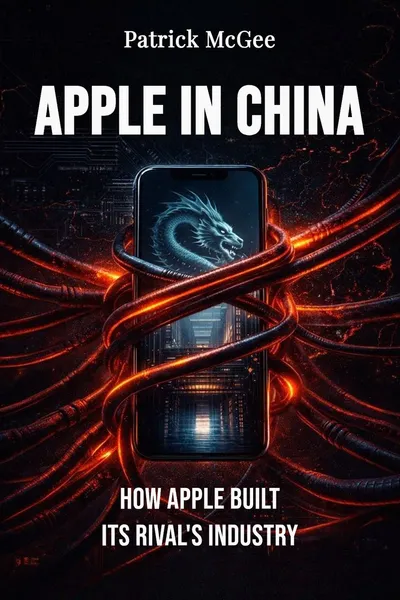
Apple in China
How Apple built its rival's industry
Description
Every iPhone still carries the same small print on the back: designed by Apple in California, assembled in China. We read past it, the way we read past nutrition labels. But Patrick McGee, a longtime Financial Times reporter who covered Apple for years, spent that book-length attention on the second half of the sentence — the assembly, and everything the word hides. His argument, laid out in Apple in China, is that those four words describe one of the largest transfers of technology and know-how in the history of capitalism, and that Apple was not a passive victim of globalization but its most effective engine.
The numbers he assembles are hard to hold in the head. By the late 2010s Apple was training and coordinating a workforce in China that ran into the millions across its supplier network. Its annual investment in Chinese manufacturing — the tooling, the engineers flown in, the equipment installed on partner factory floors — reached a scale that McGee compares to a national industrial program. This was not a company renting cheap labor. It was a company building, at its own expense, the most sophisticated electronics manufacturing base the world had ever seen, inside a single country.
And here is where the story turns from a business success into something stranger. The capability Apple poured into China did not stay locked inside Apple's supply chain. It leaked, spread, and compounded — into local firms, into rival brands, into a state that had every reason to absorb it. McGee's book follows that leak from the factory floor to the boardroom to the geopolitics of the present, and asks what happens when the world's most valuable company discovers it can no longer leave.
The question we’re asking : How did Apple end up building the industrial capability that now underwrites its biggest rival and its own dependence?What we’ll see : How a supply chain became an education, how the pupil caught up, and what it costs the teacher now.
Table of contents
01Chapter 1 — The scale nobody else could match
To understand what Apple did in China, McGee argues, you have to first understand what Apple actually is. Not a gadget company, not really a software company, but a company organized around the problem of making tens of millions of near-identical, absurdly precise objects and having them ready to ship on a single date. The iPhone launch is a logistics event disguised as a product event. Meeting it requires a kind of manufacturing that did not exist anywhere at the required volume — so Apple decided to bring it into being.
The choice of China was, at first, the ordinary story: lower wages, fewer regulations, willing local governments. But McGee's point is that wages stopped being the reason surprisingly early. What China offered by the 2010s was flexibility at a scale no other place could touch — the ability to hire a hundred thousand extra workers for a seasonal ramp, to build a dormitory city beside a factory in months, to redesign a production line overnight when Steve Jobs changed his mind about a screen. Cheap labor was the entry point. Concentration and speed were what kept Apple there.

02Chapter 2 — Teaching a country to build
The heart of McGee's book is the word teaching. Apple did not arrive in China and find factories capable of building an iPhone. It found factories capable of building simpler things, and it spent years turning them into something else. Its engineers did not hand over a blueprint and leave. They stood on the line, diagnosed defects, redesigned processes, and drilled the workforce until the yield rates cleared Apple's brutal standards. In effect, Apple ran a continuous, hands-on training program for hundreds of thousands of Chinese workers and managers.
This is the transfer at the center of the story. Manufacturing capability is not a document you can guard; it lives in people, habits, and institutional memory. Every engineer Apple trained, every process it perfected on a partner's floor, every supervisor who learned to run a line to aerospace tolerances — all of it became knowledge that now existed in China, held by Chinese workers and Chinese firms, whether or not Apple wanted it to stay proprietary. You cannot un-teach a country how to build.
03Chapter 3 — The gilded cage snaps shut
For years the arrangement looked like a clean win for Apple. The products got better and cheaper, the margins stayed extraordinary, and the manufacturing headaches were someone else's to solve. But McGee traces the moment the dependency started to bite — the point where Apple realized it could not simply pack up and move. The ecosystem it had built was too specialized, too concentrated, too fast to be reproduced elsewhere on any reasonable timeline. The company had engineered itself into a single country.
The attempts to diversify make the trap visible. Apple has pushed production toward India and Vietnam, and McGee documents the effort honestly — but also its limits. Assembling final units in India is one thing; recreating the dense web of component suppliers, trained engineers, and overnight flexibility that took two decades to grow in China is another. The know-how Apple exported cannot be re-imported at will. What was quick to build in the right conditions is painfully slow to rebuild elsewhere.
04Chapter 4 — When the customer builds the competitor
Step back from Apple's specific predicament and the book describes a pattern that offshoring economics almost guarantees. A company moves production abroad to cut costs, and to make that production work it must transfer capability — not just orders, but training, tooling, and process knowledge. Over time the recipient absorbs that capability and can deploy it independently. The cost saved on this quarter's unit is paid back, eventually, as the erosion of the advantage that made the company special in the first place. Apple is simply the largest, clearest instance of a transaction that runs quietly through modern manufacturing.
McGee's sharpest observation is that Apple did not merely tolerate this; it accelerated it with a thoroughness no rival matched. Because Apple demanded the highest tolerances in consumer electronics, the training it funded was the best available. The company effectively ran the finest manufacturing school in the world, graduated a generation of Chinese engineers and firms, and then acted surprised when domestic brands — Huawei, Xiaomi, Oppo — turned out to build very good phones. The competitor was educated on Apple's dime, using standards Apple set.
05Conclusion
Return to the small print. Designed by Apple in California, assembled in China — the sentence still runs the same direction it always has, from the idea to the object, from the company to the country. McGee's book asks us to read it backwards. The assembling half turned out to carry the weight. In building the capacity to make its products, Apple built a partner strong enough to constrain it, an industry capable of supplying its rivals, and a set of obligations it can no longer easily refuse. The most valuable company on earth engineered its own dependence with remarkable efficiency.
Related books