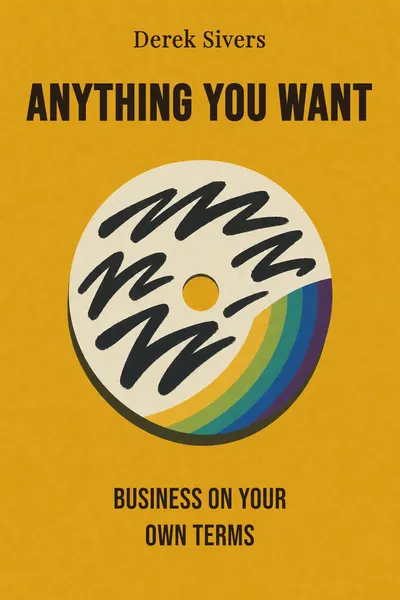
Anything You Want
Business on your own terms
Description
In 1997, a musician named Derek Sivers wanted to sell his own CD online. No store would take an independent record with no distributor, so he wrote a bit of code to take credit-card orders on his own website. A few friends who were also musicians asked if he'd sell theirs too. He said sure. That favor, done for people he knew, quietly turned into CD Baby — which would grow into the largest seller of independent music on the web, move hundreds of millions of dollars to artists, and eventually sell for about $22 million.
The strange part is how little Sivers seems to have wanted any of that. He never set out to build a company. He set out to solve one small problem for himself, then kept solving small problems for people who asked. He turned down investors, ignored most of the standard startup advice, and ran the thing according to a single question that had nothing to do with scale: does this make me and the people around me happy? The book he wrote afterward, barely a hundred pages, reads less like a business manual than like a friend telling us what he learned the hard way.
That's what makes the story worth sitting with. Sivers succeeded by most external measures, then spent his short book arguing that those measures are mostly a trap — that a business is a very personal thing, and that the point is not to grow it as big as possible but to shape it into something you actually want to live inside.
The question we’re asking : What does it look like to build a real company without ever wanting to be a real company?What we’ll see : How a favor for friends became a philosophy of running a business on your own terms.
Table of contents
01 Chapter 1 — The accident that became a company
Sivers is blunt about the origin: CD Baby was not a vision, it was a workaround. As a working musician in the late nineties, he'd finished an album and hit the same wall every independent artist hit. The online stores of the day required a distributor, and distributors wouldn't touch someone selling a few hundred copies out of his apartment. So he taught himself just enough programming to put a buy button on his own site. It worked. It sold his record. That was supposed to be the end of it.
Then a musician friend asked to be added. Sivers set a price he pulled out of the air — artists would pay a small setup fee and he'd take a flat cut per sale — and said yes. Another friend asked. Then a stranger. He kept saying yes, and kept coding the features each new request demanded, one at a time. There was no plan, no funding round, no growth target. The company grew because he solved the next real problem in front of him and refused to solve problems nobody actually had.

02 Chapter 2 — The customer is the whole plan
Ask Sivers for his marketing strategy and he'll more or less shrug. CD Baby grew mostly by word of mouth, and word of mouth grew because he obsessed over the moment a customer touched the company. His most famous flourish is the shipping confirmation email — a goofy, elaborate note about the CD being placed on a satin pillow and carried to the post office by white-gloved staff while the whole town waved goodbye. He wrote it in twenty minutes to amuse himself. It got quoted, forwarded, and passed around so widely that it brought in customers no ad ever could have.
The point isn't the joke. The point is that Sivers treated every interaction as the actual product. He tells stories of picking up the phone himself, of answering odd questions with more care than they deserved, of fixing complaints in ways that cost him money in the short term and loyalty gained in the long term. When a customer had a bad experience, his instinct wasn't to consult a policy, it was to ask what would delight this specific person right now. He'd rather lose a little money and win someone who'd tell ten friends.
03 Chapter 3 — Say no by default
For all his talk of saying yes to early customers, Sivers spends much of the book teaching the opposite reflex once a business is running. His rule became almost a mantra: if it's not a resounding "hell yes," it's a no. Opportunities, partnerships, features, expansions — most of them arrive dressed as good ideas, and most of them are merely fine. Fine is the enemy. A calendar full of fine commitments leaves no room for the rare thing that genuinely excites you, so he learned to decline nearly everything.
He pairs that discipline with a bias toward acting fast on the things that do clear the bar. Sivers didn't agonize over decisions; he made them quickly, kept them cheap and reversible where he could, and treated mistakes as tuition rather than catastrophe. Because CD Baby had no investors demanding a particular return, he was free to move on gut instinct and correct course when the gut was wrong. Speed and reversibility, in his hands, were a way of learning what worked without betting the company on being right the first time.
04 Chapter 4 — A business is a means, not the point
When Sivers sold CD Baby in 2008 for roughly $22 million, the number that most people would treat as the whole point of the story barely moved him. He gave most of it away, arranging for the proceeds to eventually go to a charitable trust for music education, and kept only enough to live simply. Reading the book, you slowly realize that the money was never the reward he was working toward — it was almost a byproduct he had to figure out what to do with. The reward had been the years of doing work he found meaningful, on his own terms.
This reframes everything the earlier chapters described. The customer obsession, the saying no, the refusal of investors — none of it was in service of a big exit. It was in service of a daily experience Sivers wanted to have. He'd built the company as a place to spend his life well, and once he no longer enjoyed running it, the reasons to keep it evaporated. A business, in his account, is a means to a life, and the moment it stops serving that life it has failed at the only test that matters, no matter what the balance sheet says.
05 Conclusion
It began with one musician trying to sell one CD, and it ended with a company that had moved a fortune to independent artists and then quietly dissolved its founder's stake into music education. In between, Sivers ran the thing by a single stubborn question: does this make the life around it better? Everything followed from that — the yeses to early friends, the nos to almost everyone after, the delight over the shipping email, the shrug at the eight-figure check. The company was never the goal. It was the medium.
Related books