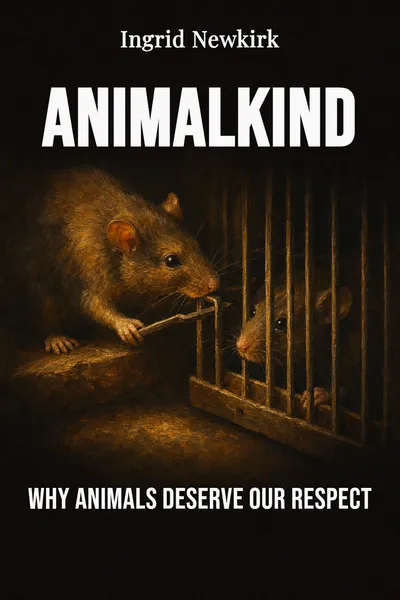
Animalkind
Why animals deserve our respect
Description
In 2020, Ingrid Newkirk published a book with a title that reads like a quiet correction. Not animal kingdom — animalkind. The word does the work of an entire argument before the first chapter starts: it places other species inside the same family that humankind has spent millennia keeping them out of. Newkirk is not a stranger to provocation. She founded People for the Ethical Treatment of Animals in 1980, and PETA has spent four decades being loud, divisive, and impossible to ignore. So a reader might expect a book of confrontation. What arrives instead, written with bestselling author Gene Stone, is something closer to a tour — a walk through what animals actually are, told by someone who has spent a lifetime watching them.
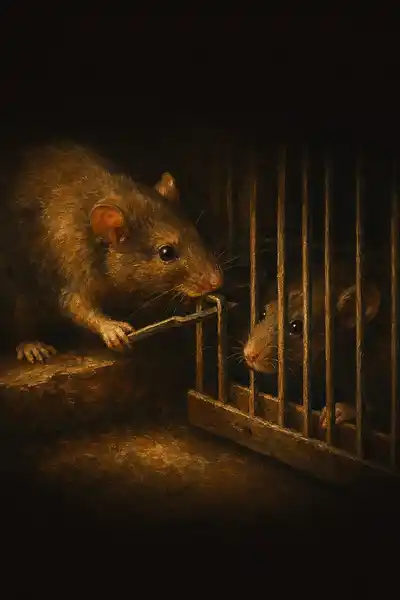
The premise is disarmingly simple. Before we decide what we owe animals, we should look honestly at what they are. And what science has uncovered over recent decades is a set of capacities that keep embarrassing our old assumptions. Bats that babysit. Rats that free trapped cage-mates. Bees that recognize human faces. Newkirk lines these up not as trivia but as evidence — the kind that makes the line we drew between us and them look less like a fact and more like a habit.
From there the book turns practical. If animals feel, remember, plan, and suffer in ways we are only beginning to measure, then the ordinary arrangements of modern life — the plate, the closet, the lab, the entertainment — start to look different. Newkirk's wager is that most cruelty is not chosen but inherited, carried along by convenience and the simple fact that the harm happens somewhere we never see.
The question we’re asking : If animals turn out to be far more capable of feeling and thinking than we assumed, what does that ask of the way we live?What we’ll see : How a lifetime of watching animals turns into a quiet argument that compassion is less a virtue than a set of everyday choices anyone can make.
Table of contents
01 Chapter 1 — The minds we keep underestimating
Newkirk opens where she thinks the whole question really begins: not with ethics, but with observation. For most of human history we assumed animals ran on something close to instinct — clever machinery, maybe, but nobody home. That assumption was convenient, because it let us treat them as objects without much guilt. The trouble is that it keeps falling apart the closer scientists look. The book gathers decades of findings that, taken together, sketch inner lives we used to reserve for ourselves.
The examples are chosen to surprise. Elephants appear to mourn, returning to the bones of the dead and lingering over them. Crows fashion tools and remember individual human faces for years, holding grudges and passing the grudge to their young. Prairie dogs have calls specific enough to describe the color of a passing human's shirt. None of this is presented as sentiment. Newkirk and Stone treat it as data, the steady accumulation of research that has outpaced the old common sense.

02 Chapter 2 — The case against the old habits
Having established what animals are, the book turns to what we do with them — and the answer, for Newkirk, is a long inventory of habits we rarely examine. Most of the harm, she argues, is not malice. Almost nobody wakes up wanting to cause suffering. The cruelty is structural, built into systems so normal that participating in them feels like nothing at all. Eating, dressing, buying soap: each connects, somewhere down the line, to an animal most of us never picture.
Food is the largest of these systems. Newkirk walks through industrial animal agriculture not to shock but to make visible what distance hides — the crowding, the confinement, the scale at which billions of sentient creatures are processed each year. Her case leans less on horror than on consistency. We have already agreed, when we look at our pets, that animals feel. The factory simply asks us to forget that agreement for the duration of a meal.
03 Chapter 3 — Cruelty hidden in plain sight
Some of the harm Newkirk describes is not industrial at all. It is the cruelty we have learned to read as fun, or tradition, or simple ignorance — and because it wears a friendly face, it is harder to see. The book spends time on entertainment, the long human appetite for watching animals perform: the circus elephant, the captive orca, the roadside zoo. What unites them is that the animal's whole existence has been bent to a few minutes of human pleasure.
Newkirk's treatment of marine parks is characteristic. An orca in the wild may travel a hundred miles in a day and live within a family that stays together for life. The same animal in a concrete tank lives shortened, often turning on its handlers in ways the industry once called accidents. The point is not that the trainers are villains. It is that the spectacle requires a denial of everything we now know about what the animal is — exactly the denial the book has been documenting from the start.
04 Chapter 4 — Compassion as a practical skill
The second half of Newkirk's argument is its quiet radicalism: she refuses to treat kindness to animals as a lofty ethical stance reserved for saints and activists. She treats it as a skill — a set of small, learnable choices that anyone can pick up, one at a time, without rebuilding their identity overnight. This reframing is the engine of the book. Moral grandeur intimidates; a swap at the grocery store does not.
So the tools she offers are deliberately modest. Read a label. Try a plant-based version of a meal you already like. Choose a cleaning product not tested on animals. Skip the marine park, support a sanctuary instead. Each is presented as a single decision rather than a vow, because Newkirk understands that lifelong commitments collapse and small habits compound. She is less interested in producing perfect people than in shifting the default a little, in millions of kitchens and closets at once.
05 Conclusion
The book ends roughly where its title started. Animalkind is a wager that the line we drew between ourselves and every other species was always more porous than we admitted, and that the science of recent decades has been steadily washing it away. Newkirk and Stone do not ask the reader to feel ashamed of having lived inside inherited systems. They ask only that, having seen what animals are, we let the seeing change something — a meal, a purchase, a habit, a default.
Related books