Analysis, Manifolds and Physics, Part 1
Geometry meets physics
Description
There is a particular kind of frustration that graduate students in theoretical physics knew well in the second half of the twentieth century. The physics they were learning — general relativity, gauge theories, the geometry of fields — kept leaning on mathematics they had never been taught properly. Manifolds, differential forms, fibre bundles, connections: these were the working vocabulary of the frontier, and yet the physics curriculum treated them as things you would pick up somehow, along the way. The mathematics departments taught them, but in a language and at a pace built for mathematicians, not for someone trying to make sense of a curved spacetime by Friday.
Analysis, Manifolds and Physics, Part 1, by Yvonne Choquet-Bruhat and her co-authors, was built precisely to sit in that gap. Choquet-Bruhat was no bystander to the problem: she was the mathematician who, in the early 1950s, had proved that Einstein's equations have well-posed solutions — that general relativity is, mathematically, a coherent theory that predicts. She knew from the inside how much rigorous geometry the physics actually required, and how badly it was being served. The book is her answer, and it became a reference text that generations of students carried through their training.
What makes it worth revisiting is not that it teaches hard material — plenty of books do — but the wager underneath it. The wager is that a physicist genuinely needs the mathematician's rigour, not a watered-down cartoon of it, and that a mathematician's tools, taught cleanly, are the shortest path into the physics rather than a detour around it.
The question we’re asking : Why did a generation of physicists need a book that refused to separate the geometry from the physics?What we’ll see : How a mathematician who proved general relativity holds together turned that conviction into a text that treats abstract structure and physical theory as one continuous subject.
Table of contents
01Chapter 1 — A book written to close a gap
The book announces its intended reader on the first page, and the choice tells you everything about the project. This is a text for graduate students in physics and applied mathematics, and for the people teaching them. Not for pure mathematicians who already live inside the material, and not for undergraduates meeting analysis for the first time. It aims at a very specific person: someone with real mathematical maturity who now needs the machinery of modern geometry to do physics, and who has been left to assemble that machinery from scattered sources.
The response to that need is a peculiar kind of book, and its structure carries the argument. Each chapter opens with a compact, rigorous exposition — definitions stated cleanly, theorems proved or precisely cited — and then turns immediately to problems and worked examples drawn from physics. The mathematics is never diluted to make it friendlier. What changes is the company it keeps. A theorem about differential forms arrives sitting next to the electromagnetic field it will describe, so the abstraction and its use are learned in the same motion rather than years apart.

02Chapter 2 — Manifolds before physics needs them
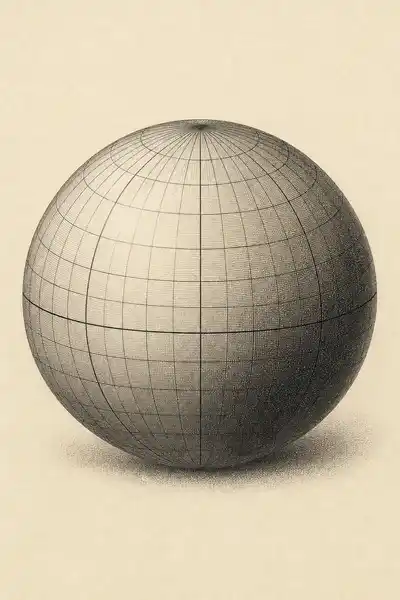
Before any physics appears, the book does the patient work of building the stage. It starts with the analysis a reader must have secure underfoot — topology, the calculus of functions, the machinery of differentiation done carefully — and then arrives at the central object of the whole enterprise: the manifold. A manifold is, at heart, a space that looks flat and familiar in any small neighbourhood but can curve and twist globally, the way the surface of the Earth is locally a flat map yet globally a sphere. Almost everything that follows is a structure built on top of that idea.
The order matters, and it is deliberate. Tangent vectors, tensors, differential forms, integration on manifolds — these are developed as pure mathematics, standing on their own, before a single physical quantity is hung on them. A physicist reading quickly might be impatient to reach the equations. The book resists that impatience on principle. It wants the reader to understand a differential form as a well-defined mathematical object first, so that when it later turns out to be the electromagnetic field, the identification feels like a discovery rather than a definition smuggled in by force.
03Chapter 3 — When the mathematics becomes the physics
The turn comes when the abstract objects start naming physical things, and the book stages it so that the mathematics does the revealing rather than the illustrating. The Riemannian and pseudo-Riemannian structures developed as geometry become the metric of spacetime; the curvature of a connection becomes gravitation; the whole apparatus of general relativity emerges not as an application bolted onto the geometry but as what the geometry was quietly describing all along. For a reader who has done the earlier work honestly, the effect is that Einstein's theory stops looking like physics dressed in mathematical clothing and starts looking like a chapter of geometry that happens to be true of the world.
The new chapter on connections on principal fibre bundles is where this reaches its most striking form. A fibre bundle is, roughly, a space that carries an extra internal space attached at every point — imagine a small symmetry group riding along above each location in spacetime. A connection tells you how to compare those internal spaces as you move from point to point. Stated that abstractly, it sounds like pure geometry with no obvious stake in reality. And then it turns out that this is exactly the structure of a gauge field — the mathematics behind electromagnetism and the forces inside the atomic nucleus.
04Chapter 4 — A grammar for the physical world
Step back from the individual chapters and the book makes a larger point about the state of theoretical physics in the twentieth century — one it never states as a thesis but embodies on every page. There came a moment when the frontier of physics could no longer be written down in ordinary calculus and vectors. To say what general relativity says, you needed manifolds and connections. To say what gauge theory says, you needed fibre bundles. The mathematics had stopped being a convenience and become the only available grammar in which the physical claims could even be phrased.
This is a genuinely strange situation, and worth sitting with. For most of the history of physics, mathematics served as a tool that could in principle be paraphrased — you could usually say in words, roughly, what an equation meant. In the theories this book covers, that paraphrase quietly fails. There is no faithful verbal picture of a connection on a principal bundle that isn't just the mathematics again in slower motion. The curvature is the field. The holonomy is the physics. The structure is not describing the world at one remove; it is the description, with nothing more literal underneath.
05Conclusion
The book set out to close a gap that had left a generation of physicists improvising their mathematics, and it closed it by refusing the compromise everyone expected — it never softened the geometry to make it welcome. From the patient construction of manifolds, through the moment the metric becomes spacetime, to the new chapter where a connection turns out to be a gauge field, the argument is one long demonstration that the physics and the mathematics were never two subjects to be bridged. They were one subject taught, unhelpfully, in two rooms.
Related books