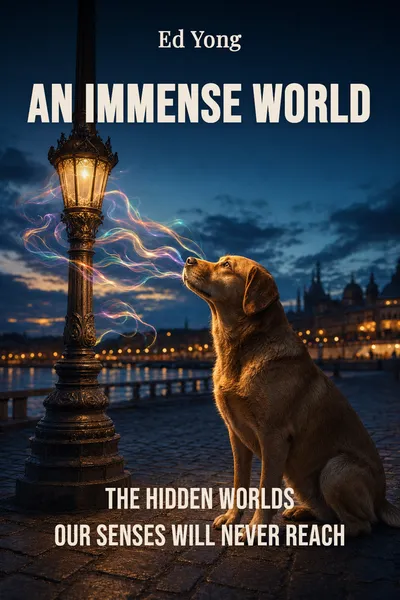
An Immense World
The hidden worlds our senses will never reach
Description
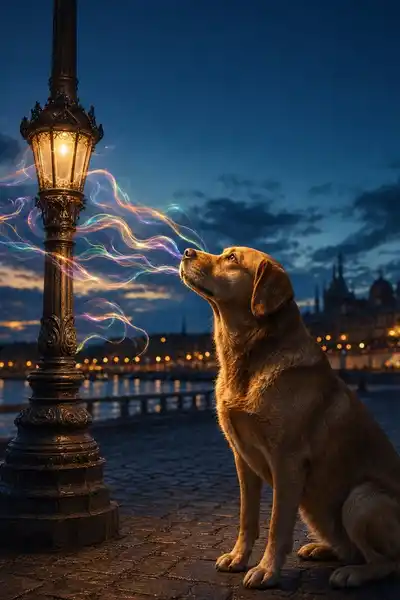
Take a dog for a walk and watch what actually happens. The dog stops at a lamppost, a tree trunk, a patch of grass that looks like every other patch of grass, and reads it for a long time, the way we might read a letter. We tug the leash because nothing is there. But something is there — a dense layer of chemical messages, who passed, when, whether they were anxious or in heat or sick. The dog lives in that layer. We don't even know it exists. The leash, in that small moment, is the gap between two worlds standing right next to each other.
This is the starting point of An Immense World, published in May 2022 by the science journalist Ed Yong. Its argument is built around a single German word borrowed from an early twentieth-century biologist, Jakob von Uexküll: Umwelt, meaning the particular sensory bubble each animal inhabits. A tick, a bat, a mantis shrimp, a human — each takes in only the slivers of reality its body is built to detect, and each mistakes that sliver for the whole. The book is a tour through those bubbles, and the tour keeps doing the same unsettling thing: it shows us how much is going on that we were never equipped to notice.
What keeps the book from being a catalog of animal trivia is where Yong points it. He is not collecting amazing-animal facts to make us say wow. He is asking what it means that every creature, ourselves included, is sealed inside an apparatus that quietly tells it that its slice is everything — and then he goes looking, sense by sense, for what falls outside ours.
The question we’re asking : What does it mean that every animal, including us, lives sealed inside its own slice of reality?What we’ll see : A journey through the senses we share, the ones we lack entirely, and what Yong argues we owe the creatures whose worlds we are quietly drowning out.
Table of contents
01 Chapter 1 — The dog at the end of the leash
Yong opens An Immense World with an image meant to disarm us, and it is roughly the leash scene. He asks us to picture a room — an ordinary room, with a person, a dog, a mosquito, a snake, a bat, a songbird, an elephant, all present at once. The point is that there is no single room. There are as many rooms as there are creatures in it, because each one is sampling a different set of signals. The mosquito tracks the carbon dioxide we exhale and the heat coming off our skin. The snake reads the infrared glow of warm bodies. The songbird sees colors we can't, in feathers that look plain to us. The same physical space splits into a stack of overlapping, mutually invisible worlds.
Uexküll's word for each of these worlds is Umwelt — not the environment as it objectively is, but the environment as a particular animal can perceive and act on it. A tick, in his famous example, lives in an Umwelt built from almost nothing: the smell of butyric acid from mammal skin, the warmth of a body, the touch of hair. It waits, sometimes for years, for those few cues. Everything else in the forest — birdsong, color, the shape of trees — simply does not exist for the tick. It isn't ignored. It was never there to begin with.

02 Chapter 2 — A million ways to take in the world
Much of the book is spent inside senses we recognize, stretched to scales we can barely imagine. Smell comes first, because it is the sense Yong thinks we most underrate. Dogs don't just smell more than we do; they smell in a different grammar, layering scents in time, tracking where a trail is fresher and where it is staler, effectively reading the recent past off the ground. African elephants carry the largest known repertoire of smell-related genes of any mammal studied so far — roughly two thousand — and use it to locate water and kin across great distances. For these animals, the world is a landscape of odor with the structure we give to sight.
Hearing opens out the same way. Yong spends time with the way many animals live in sounds outside our range. Elephants and some whales communicate in infrasound, frequencies so low they travel for miles, rumbling messages we feel at most as a faint pressure if at all. At the other end, bats and dolphins flood the world with ultrasonic calls and listen to the echoes, building a moving, three-dimensional picture of their surroundings out of returning sound. Yong is careful here: echolocation is not seeing-with-sound in some simple way. It is its own sense, with its own rules, and we should resist the urge to translate it back into our terms.
03 Chapter 3 — The senses we don't have a word for
The book gets stranger when it leaves the familiar five behind. Some animals sense things for which we have no everyday word, because we cannot feel them at all. Many fish detect the faint electric fields that all living bodies leak into water, using rows of jelly-filled pores; sharks can pick up the tiny voltage of a heartbeat hidden in sand. A group of fish has gone further and generates its own electric fields, then reads the distortions to navigate and even, Yong suggests, to communicate — a private channel of conversation conducted in electricity.
Then there is magnetoreception, the ability to sense the Earth's magnetic field. Migrating birds, sea turtles, and others appear to carry an internal compass, and possibly a kind of map, that lets them cross oceans and return to the beach where they hatched. Yong is honest about how mysterious this still is. Scientists are not fully sure how the sense works — whether it lives in the eyes, tied to quantum effects in a light-sensitive molecule, or somewhere else entirely. It is the rare sense whose very mechanism is still up for grabs, which makes it a useful reminder of how much remains unmapped.
04 Chapter 4 — Why we keep missing it
A moth circles a streetlight until it drops, exhausted, having mistaken a bulb for the moon it once steered by. That single image carries the book's largest claim. An Immense World is not finally about animals; it is about the trap of being any single kind of perceiver. Because our Umwelt is the only one we have ever lived in, we treat it as the baseline of reality and everything else as exotic. Yong's point, made patiently across the book, is to flip that: our sensory world is not the standard against which others are strange. It is one provincial sample, no more central than a dog's or a bat's, that happens to be ours and therefore feels like everything.
This reframing does practical work, and it is where Yong lands hardest. If other animals live by senses we cannot feel, then we can damage those worlds without ever noticing. He uses the term sensory pollution for what we are doing: flooding the night with artificial light that disorients moths and hatchling turtles, filling the ocean with engine noise that drowns out whales trying to find each other across a basin, scattering glass and brightness that scramble cues animals have relied on for millions of years. We are, in effect, shouting into rooms we cannot hear ourselves entering.
05 Conclusion
Come back to the dog at the lamppost, reading a world we can't see. By the end of An Immense World, that ordinary scene has been turned inside out. The dog is not lingering over nothing; we are the ones missing almost everything, and the leash marks the boundary between two perceivers who will never fully reach each other. The bat, the turtle, the electric fish, the songbird in its ultraviolet plumage — each is doing the same thing the dog is doing, living vividly inside a reality we walk straight past.
Related books