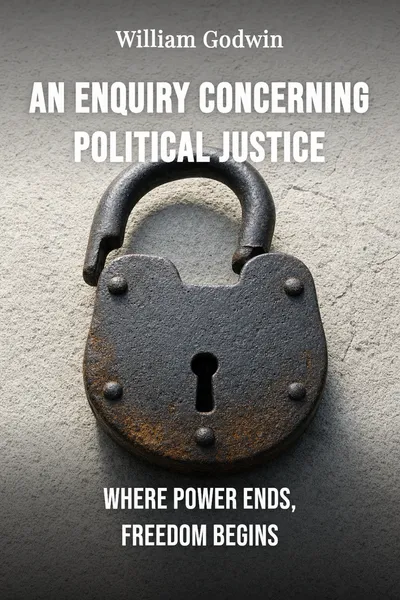
An Enquiry Concerning Political Justice
Where power ends, freedom begins
Description
In February 1793, a former dissenting minister named William Godwin published a two-volume treatise with the unwieldy title Enquiry Concerning Political Justice, and Its Influence on General Virtue and Happiness. It sold for three guineas, an expensive price that Godwin later claimed had spared him prosecution — the government reasoned, so the story goes, that anything so costly could not stir the working poor to revolt. The book landed in the middle of the most anxious moment British politics had known in a generation. France had executed its king a few weeks earlier; within days the two countries would be at war. Tom Paine's Rights of Man had already been declared seditious, and its author had fled to Paris. Into that heat Godwin dropped six hundred pages arguing, calmly and at length, that government itself was the problem.
What made the Enquiry unlike the pamphlets swirling around it was its temperature. Where Paine and Edmund Burke traded blows over the French Revolution, Godwin wrote as if he were doing geometry. He was not calling for barricades. He distrusted revolutions as much as he distrusted kings, because both worked by force rather than argument. His claim ran deeper and slower than any call to arms: that as human reason improved, the whole apparatus of coercion — laws, punishments, property, even the promises we make to one another — would gradually reveal itself as unnecessary, and quietly wither. It is the reason the book is usually named as the first sustained statement of what we now call anarchism.
For a few years the Enquiry made Godwin the most talked-about thinker in England, admired by a young Wordsworth and Coleridge, and then, just as swiftly, it made him a byword for dangerous naivety. The reputation buried the argument. But the argument is stranger and more careful than its caricature, and it turns on a single unsettling premise: that wherever power steps in, it is because reason has been given up on.
The question we’re asking : What did Godwin actually argue when he claimed that government is something a rational society outgrows rather than perfects?What we’ll see : How a mild, bookish minister built the first case for anarchism out of the Enlightenment's own faith in reason — and where that faith leads.
Table of contents
01 Chapter 1 — A book born from a decade on fire
Godwin had come to political philosophy by a long and unlikely road. Born in 1756 into a family of strict Calvinist dissenters, he trained as a minister and preached for several years before losing his faith — first in Calvinism, then in Christianity altogether. He drifted to London, scraped a living writing for the reviews, and read his way through the French philosophes, the Scottish moralists, and the utilitarians. By the time the French Revolution broke in 1789, he had assembled a private conviction that most of the misery around him was manufactured by bad institutions rather than by human nature.
The Enquiry was his attempt to prove it from the ground up. He signed a contract in 1791 and wrote at speed, reasoning his way forward as he went, so that the book sometimes seems to be discovering its own conclusions in real time. His method was deliberately unfashionable. He refused to argue from history, from tradition, or from what the British constitution happened to be. He wanted to ask, as if from nowhere, what arrangements a perfectly reasonable being would actually consent to — and then measure existing governments against that standard. Almost none of them survived the comparison.

02 Chapter 2 — Reason against the machinery of government
The engine of the whole book is a single idea Godwin borrowed from the Enlightenment and pushed further than anyone else dared: that human beings act according to their opinions, and that opinions can be corrected by reason. If people do wrong, it is because they judge wrongly; give them better understanding and their conduct improves. Character, for Godwin, was not fixed. It was the sum of the impressions the world had made on a mind, which meant that a better world would, over time, make better minds. Perfectibility was his word for this — not the claim that humans become flawless, but that there is no ceiling on how far reason can carry us.
From that premise the case against government follows with quiet force. If conduct is governed by judgment, then the proper way to change conduct is to persuade. Coercion does something else entirely: it makes a person act without being convinced, substituting the will of the state for the operation of their own mind. Every law, every punishment, every command, in Godwin's reading, is an admission that argument has been abandoned. It may compel the body, but it corrupts the understanding, teaching people to obey rather than to reason. A society run this way keeps its members permanently immature.
03 Chapter 3 — The tyranny of promises and property
Having dismantled the state, Godwin turned on the softer bonds that most reformers left standing. Promises, he argued, are a species of the same error as law. To promise is to bind your future self to a decision made in the past, before you knew what you now know. If tomorrow you can see that keeping your word will do harm, then reason, not the promise, should decide — and if reason would have you act rightly anyway, the promise adds nothing. Obligation, for Godwin, could never come from a prior commitment. It came only from what the situation truly required, judged fresh each time.
This is where the Enquiry produced its most notorious example, one that dogged Godwin's reputation for decades. Suppose a fire, and you can save only one person from a burning palace: the great benefactor Fénelon, whose work will improve thousands of lives, or his chambermaid, who happens to be your own mother. Godwin's cold answer is that you should save the man who will do the most good, and that the fact she is your mother carries no moral weight of its own. Justice, he insisted, is impartial; it does not recognise the special claims of blood or affection. Critics seized on the passage as proof that his philosophy dissolved every human tie.
04 Chapter 4 — The slow argument anarchism keeps having with itself
Strip away the eighteenth-century phrasing and Godwin's wager is easy to state: coercion is always a confession that persuasion has failed. Every prison, every enforced contract, every command backed by a threat marks a place where a society has stopped trying to convince and started trying to compel. Most political thought treats that trade-off as simply the price of living together — we accept some force because agreement is slow and people are unreliable. Godwin refused the bargain. He insisted that force never merely fills the gap left by weak reason; it actively stunts the reason that might have closed the gap on its own.
That is the enduring provocation of the Enquiry, and it is why the book keeps resurfacing whenever anarchism is taken seriously. It relocates the whole question. The issue is no longer which institutions are best designed, but whether institutions that work by compulsion can ever produce the kind of person capable of self-government. Later anarchists inherited the challenge more than the details. Godwin had no theory of class struggle and no taste for revolution; his successors added both. What they kept was his conviction that authority must justify itself at every step, and that unexamined obedience is itself a harm.
05 Conclusion
The Enquiry made Godwin briefly the most famous philosopher in England and then, as the war deepened and the reaction hardened, a figure of ridicule. He revised the book twice, softening some of its starker edges, and in 1798 he suffered a further blow to his reputation with the frank memoir he wrote of his late wife, Mary Wollstonecraft, who had died giving birth to their daughter Mary — later the author of Frankenstein. By the time he died in 1836, the man who had argued that reason would one day make government unnecessary was mostly remembered as a cautionary tale about where reason, taken too far, could lead.
Related books