An Ecological Currency
Money designed for the transition
Description
Every year, the numbers land on the same wall. The International Energy Agency, the various climate panels, the finance ministries — they all converge on a figure in the same neighborhood: the ecological transition needs a few trillion dollars a year, worldwide, sustained for decades, and the money isn't showing up on that scale. The gap between what needs building — grids, insulation, trains, clean industry — and what actually gets financed has become the quiet scandal underneath every climate summit. And the standard response is always the same shrug: it's expensive, the public purse is stretched, we'll do what we can afford.
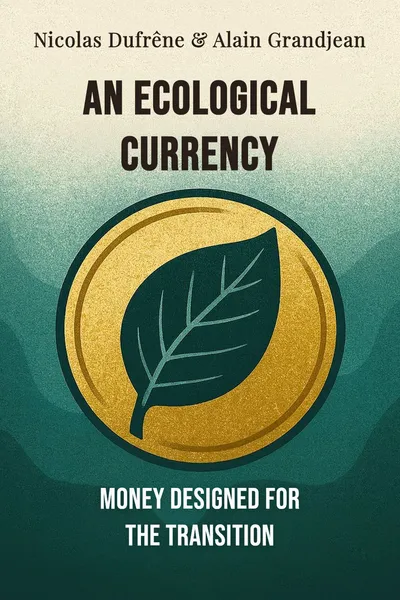
Nicolas Dufrêne and Alain Grandjean, in their book An Ecological Currency, refuse that shrug. Dufrêne runs the Rousseau Institute and spent years inside the French National Assembly watching how budgets actually get made; Grandjean is an economist and engineer who has advised on climate finance for two decades. Their argument starts from an uncomfortable observation: we keep treating money as a fixed quantity we have to ration, when in fact modern money is created — deliberately, constantly, by banks and central banks — and the only real question is what we choose to create it for.
That reframing changes the terrain. If money is issued rather than found, then the transition isn't blocked by a shortage of a natural resource. It's blocked by a set of rules about who gets to issue credit, and toward what. The two authors set out to design money that does a specific job — and to answer, head-on, the central bankers who say that job is not money's to do.
The question we’re asking : If money is created rather than saved, what stops us from creating it for the transition?What we’ll see : How two economists redesign the plumbing of money creation to fund ecology — and how the guardians of that plumbing answer back.
Table of contents
01Chapter 1 — The money we assume is neutral
The book opens by dismantling an intuition most of us carry without noticing: that money is a thing, a stock, something that exists in fixed supply and has to be earned before it can be spent. On this view a government is like a household — it takes in taxes, and it can only spend what it takes in, plus what it borrows from savers who already have it. Under that logic the transition really is a matter of arithmetic, and the arithmetic is grim. Dufrêne and Grandjean spend their early chapters showing why that picture is wrong, and why getting it wrong has real costs.
In the actual system, most money is created when a commercial bank makes a loan. The bank does not lend out someone else's deposit; it writes a new deposit into existence, backed by the borrower's promise to repay. When the loan is repaid, that money is destroyed again. This is not a fringe claim — the Bank of England laid it out plainly in a 2014 paper. Money, in other words, is a flow that expands and contracts according to who is judged creditworthy and for what. The supply is not given by nature. It is manufactured by decision.

02Chapter 2 — A currency built for one job
If money is issued for purposes, the authors ask, why not issue some of it explicitly for the ecological transition? This is the heart of their proposal: an ecological currency, or more precisely a set of monetary instruments whose entire reason for existing is to fund the investments the market will not finance on its own and the taxpayer cannot carry alone. The word currency is partly a provocation, but the design underneath it is concrete.
The most developed idea is a dedicated public financing channel — a body, backed or funded by the central bank, that lends at very low or zero interest for projects meeting strict ecological criteria. Insulating housing stock, building rail, decarbonizing heavy industry: long-lived investments whose returns are real but slow, spread across society, and therefore chronically underpriced by private lenders looking for a quick yield. Money created for these projects is not money poured into consumption; it is money turned into infrastructure that then reduces energy bills and emissions for decades.
03Chapter 3 — Who creates the money, and how
The instruments only make sense inside an institutional design, and this is where the book gets specific about power. Who decides that a project qualifies? Who sets the criteria that separate genuine transition spending from greenwashed padding? And crucially, who holds the pen that creates the money — the elected government, the independent central bank, or some new body sitting between them?
Dufrêne and Grandjean sketch several routes. The central bank could refinance the green loans directly, taking them onto its own balance sheet at favorable terms, much as it already does for other assets. Or a dedicated public bank could issue the credit, with the central bank standing behind it. In every version, the authors insist on a wall between the financing decision and short-term political convenience: the money is for durable investment scored against ecological criteria, not for whatever a minister wants to announce before an election.
04Chapter 4 — The politics hiding inside a balance sheet
The strongest objection to all of this comes from the central bankers themselves, and Dufrêne and Grandjean meet it squarely rather than dodging it. The orthodox position runs like this: a central bank has one job, price stability, and its independence exists precisely to keep it out of the business of choosing winners. The moment it starts favoring green projects over others, it becomes a political actor, it loses its credibility, and the discipline that keeps inflation in check unravels. Financing the transition, on this view, is the government's task, to be funded by taxes and ordinary borrowing — not money's task.
The book's reply is that this objection quietly assumes what it needs to prove. A central bank that refinances the entire banking system, buys corporate bonds, and floods asset markets in every crisis is already choosing where credit flows. Its collateral rules already favor some sectors over others — fossil-heavy firms among them. Neutrality, the authors argue, is not the absence of a choice; it is one particular choice that has been naturalized until it becomes invisible. To refuse to lend for the transition is itself an allocation decision, just one made by default.
05Conclusion
The book ends where it began, with that gap between what the transition costs and what gets financed — but the gap now looks different. It is no longer a shortfall of a scarce substance we failed to accumulate. It is the visible trace of a rulebook, one that lets money be created in abundance for some purposes and declares it impossible for others. Dufrêne and Grandjean have spent the book trying to make that rulebook legible, and then to redraft one clause of it.
Related books