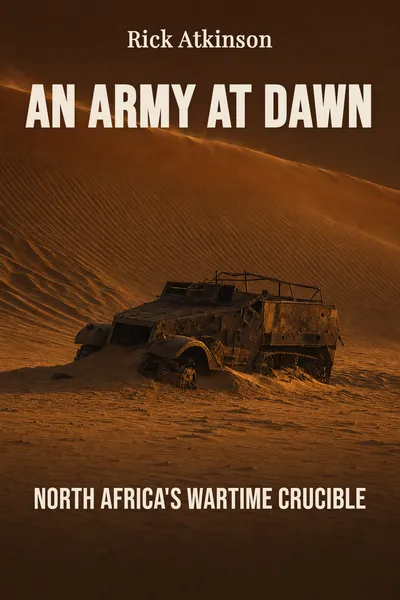
An Army At Dawn
North Africa's wartime crucible
Description
On the night of November 8, 1942, an American armada slid toward the coast of French North Africa in the dark. More than a hundred thousand soldiers, most of whom had never heard a shot fired in anger, were about to wade ashore at Casablanca, Oran, and Algiers. It was the first great offensive of the United States against the European Axis, and almost nothing about it went according to plan. Landing craft missed their beaches. Radios failed. French defenders, supposedly ready to welcome their liberators, opened fire instead. By the standards the Americans would later set, it was an amateurish beginning. And yet it was a beginning — the moment a continental republic that had spent a generation looking inward turned its enormous, untested weight toward a war an ocean away.
In An Army at Dawn, Rick Atkinson opens his Liberation Trilogy not at Normandy, where the popular memory of the American war tends to start, but here, in the dust and confusion of Tunisia, Algeria, and Morocco. His argument is simple and quietly radical: there is no understanding the eventual triumph in Europe without first reckoning with what happened in the desert in 1942 and 1943. North Africa was where an army that did not yet exist in any real sense had to be invented under fire.
It is an unglamorous theater, easy to skip on the way to the famous beaches. But Atkinson treats that obscurity as the point. This was the campaign where the United States stopped imagining itself as a great power and started, painfully and expensively, becoming one. The cost was measured in burned-out tanks, ruined reputations, and tens of thousands of young men who would never come home.
The question we’re asking : Why did the American road to victory in Europe have to run first through the deserts of North Africa, and what did that detour cost?What we’ll see : How a vast, unready republic learned the brutal trade of modern war — and was changed by the lesson.
Table of contents
01 Chapter 1 — The decision to start in the desert
The invasion of North Africa, code-named Operation Torch, was born from a quarrel as much as from a plan. The American generals, George Marshall above all, wanted to strike at Germany directly and soon — a cross-Channel assault into France in 1942 or 1943. The British, who had been fighting since 1939 and carried the scars to prove it, thought the idea suicidal. An army of green divisions hurling itself at the Atlantic Wall would, in their view, drown in its own blood. Winston Churchill pressed instead for the Mediterranean, the soft underbelly, a place to bleed the Axis without staking everything on one throw.
Franklin Roosevelt broke the deadlock. He wanted American troops fighting Germans somewhere in 1942, for reasons that were political as much as strategic: the public needed to feel the country was in the fight, and Stalin, bleeding by the millions on the Eastern Front, needed to see the Western allies do more than send supplies. North Africa was the available compromise. It was, Atkinson notes, a decision the army's own planners largely opposed and would spend years quietly resenting.

02 Chapter 2 — Green soldiers, green generals
The men who came ashore were, by and large, civilians in uniform. They had been clerks and farmers and students two years earlier, drafted and trained in a hurry by an army that itself barely existed in 1939, when the entire United States ground force ranked below that of Portugal. Atkinson lingers on their innocence — the wisecracks, the homesickness, the conviction that the thing would be over quickly. The desert disabused them. Cold rain, choking dust, dysentery, and a cunning enemy turned the romance of the great crusade into something grimmer within weeks.
The officers were learning too, often at terrible cost. Equipment that looked impressive on a parade ground proved inadequate against German guns. American tanks brewed up like matchboxes when struck. Doctrine written in peacetime classrooms collapsed on contact. Units got lost, friendly aircraft strafed friendly troops, and supply lines stretched across mountains in a chaos of mud and broken trucks. The professionalism that would later define the American war was nowhere yet in evidence.
03 Chapter 3 — Kasserine, the day the army stopped pretending
In February 1943, at a place called the Kasserine Pass in the Tunisian mountains, the reckoning came. Rommel struck the inexperienced American II Corps and tore through it. Units disintegrated. Tanks were destroyed in their hundreds. Frightened men streamed to the rear, abandoning equipment, fuel, and ground, in what came perilously close to a rout. It was the worst defeat American arms had suffered against the Germans, and for a few days it raised the awful question of whether the United States could fight this enemy at all.
Atkinson refuses to soften it. He details the failures of command, the muddled orders, the dispersal of force, the underestimation of an opponent who knew exactly how to exploit each mistake. The American press, kept partly in the dark, struggled to convey the scale of the humiliation. Within the army itself, the shock was bracing. The illusion that good intentions and industrial might would carry the day, unaided by hard competence, died in the Kasserine dust.
04 Chapter 4 — From Tunis to the man America became
Step back from the maps and the casualty lists, and Atkinson's larger claim comes into focus. North Africa was the hinge on which the United States turned from a wealthy bystander into an actual great power — not in the abstract sense of possessing resources, which it had long had, but in the concrete sense of knowing how to use them, and being willing to pay the price. A country can build ten thousand tanks and still not be a military power. It becomes one only when it learns to command armies, coordinate coalitions, and accept the moral weight of sending its young to die. That education happened in the desert.
The lessons were not only tactical. Eisenhower learned in Tunisia how to hold an alliance together, how to subordinate national pride to common purpose, how to manage generals more talented and more difficult than himself. These were the skills that would make him supreme commander at Normandy. The whole apparatus of American war-making — the logistics, the air-ground cooperation, the staff work, the brutal pragmatism about relieving men who could not perform — was forged here before it was perfected later. Without Tunisia, there is no triumphant June 1944.
05 Conclusion
By the time the last Axis soldiers surrendered in Tunisia in May 1943, the men who had stumbled ashore the previous November were scarcely the same army. They had been beaten, sometimes badly, and they had learned the only way an army can — by enduring it. The casualties were real and the mistakes were many, but the force that turned toward Sicily and then Italy was tempered in a way no training ground could have managed. North Africa had done its grim work.
Related books