
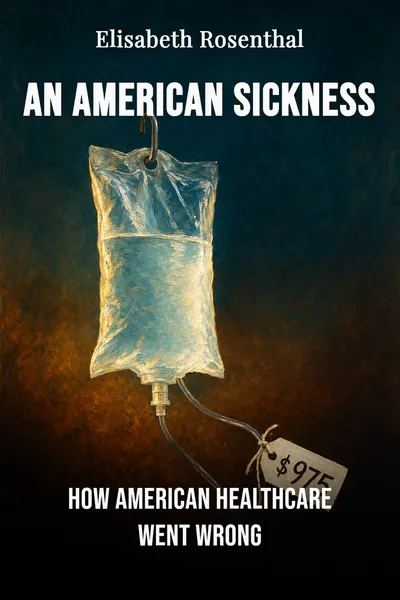
An American Sickness
How American healthcare went wrong
Description
In April 2013, a Time magazine writer named Steven Brill published a 24,000-word investigation into hospital bills, and one of the numbers he found became briefly famous: a single acetaminophen tablet, the drug most of us buy for a few cents, billed at $1.50 in an American hospital. Around the same time, a physician turned New York Times reporter, Elisabeth Rosenthal, was working a beat that would grow into a book. She kept collecting the same kind of artifact: a bag of saltwater billed at $91, a routine stitch that arrived as a $2,000 line item, a bill so long and so coded that the person who received the care could not tell what they had actually paid for.
Rosenthal had trained as a doctor before she became a journalist, which is part of why her book, published in 2017, reads less like an expose and more like a diagnosis. She was not shocked that healthcare cost money. She was interested in a narrower, stranger question: how a system that most people over fifty can still remember functioning differently had reorganized itself, in only a few decades, so that almost every actor in it had a financial reason to do more, charge more, and explain less.
What makes the book unusual is that it refuses to blame a villain. There is no single greedy actor to point at. Instead there is a set of incentives, adopted one at a time, each defensible on its own, that added up to something nobody designed and nobody can easily undo. That is the through-line worth following: not that people are bad, but that a system can grow sick organically, following the money at every turn.
The question we’re asking : How did American healthcare become so expensive and so opaque, in so short a time, without anyone deciding it should?What we’ll see : We follow the money through the bill, the hospital, and the drug, and end on what kind of market produces this.
Table of contents
01Chapter 1 — The bill nobody can read
The obvious place to start, and where Rosenthal starts, is the object every American patient eventually holds: the bill. It arrives weeks after the care, printed in a language nobody quite speaks, full of codes and charges that bear no stable relationship to what anything cost. A blood test might be $30 or $300 depending only on where you had it drawn. The same knee surgery might be billed at wildly different prices at two hospitals a mile apart. And crucially, almost nobody can find out the price in advance, because there isn't really a price. There is a list price nobody pays, a negotiated rate the insurer pays, and a cash price the uninsured are chased for.
Rosenthal's point is that this opacity is not an accident or a clerical failure. It is functional. In an ordinary market, we compare prices before we buy, and that comparison disciplines sellers. In American medicine, the buyer is often unconscious, or in pain, or being wheeled somewhere, and the person choosing the care is rarely the person paying for it. Remove the price signal and you remove the one force that keeps costs honest. The bill is confusing because a legible bill would invite the question the system cannot answer: why does this cost what it costs?

02Chapter 2 — The hospital became a business
To understand how the bill got that way, Rosenthal goes back to what a hospital used to be. For most of the twentieth century, American hospitals were largely charitable or community institutions, often religious, built to serve the sick as a civic duty. Many still carry the names of saints and founders on their doors. But the doors now open onto something else. Over a few decades, hospitals consolidated into large systems run by executives who think in margins, and the nonprofit designation, which most of them still hold, became a tax status rather than a description of behavior.
The mechanics of the shift are specific. Hospitals learned to code aggressively, turning every interaction into a set of billable events. They built profitable service lines, the cardiac wings and cancer centers that generate revenue, while quietly shedding money-losing services like psychiatric care and burn units. They merged with competitors, not to save money for patients but to gain pricing power over insurers, because a system that owns every hospital in a region can name its terms. Chief executives at large nonprofit hospitals came to earn seven-figure salaries, and the institutions accumulated reserves that would embarrass an actual business.
03Chapter 3 — The drugmaker's ten-thousand-dollar problem
The pharmaceutical chapter of Rosenthal's account follows the same logic into a different industry, and it produces some of the book's sharpest numbers. She returns often to the case that made drug pricing a public scandal: the EpiPen, a decades-old device delivering about a dollar's worth of epinephrine, whose price the maker Mylan raised from roughly $100 for a two-pack in 2007 to more than $600 by 2016. Nothing about the drug had changed. What had changed was the discovery that the market would bear it, because a parent whose child might stop breathing does not shop around.
The industry's defense is research: high prices, they argue, fund the discovery of new cures. Rosenthal takes the claim seriously and then dismantles it. A great deal of the basic science behind major drugs is funded by taxpayers through the National Institutes of Health, then commercialized privately. Much of what the industry spends is not on discovery but on marketing, on legal maneuvers to extend patents, and on small reformulations, a new coating, a combined pill, that reset the clock on a monopoly without adding therapeutic value. The most profitable drug is not the one that cures you; it is the one you take forever.
04Chapter 4 — A market built to buy nothing
Step back from the bill, the hospital, and the drug, and the deeper claim of Rosenthal's book comes into focus. Americans are told they have a healthcare market, and that markets are the thing that keeps prices honest. Her diagnosis is that they have the opposite: a market missing the one component that makes a market work, which is a buyer who knows the price and can walk away. Everything else has been fitted around that absence, and the absence is not a flaw the system tolerates. It is the source of the profit.
This is why the usual American reflex, more competition, does not fix it. In a normal market, more sellers drive prices down. In this one, more hospitals in a region can mean higher prices, because consolidation buys leverage rather than efficiency. More drugs of the same kind can mean higher prices, because the game is patents and marketing, not the underlying chemistry. The market signals that discipline every other industry run backwards here, and they run backwards precisely because the person consuming the care almost never sees, chooses, or pays the price at the moment of the decision.
05Conclusion
The bill that opens the book, the one nobody can read, turns out to be the whole argument in miniature. It is confusing because clarity would be dangerous to the people sending it; it is high because nothing in the chain is paid to make it lower; and it lands on someone who was never in a position to negotiate. Trace that single sheet of paper backward and you arrive at the hospital run like a business, the drug priced at whatever a frightened parent will pay, and a market carefully assembled to lack the one part that would keep it honest.
Related books