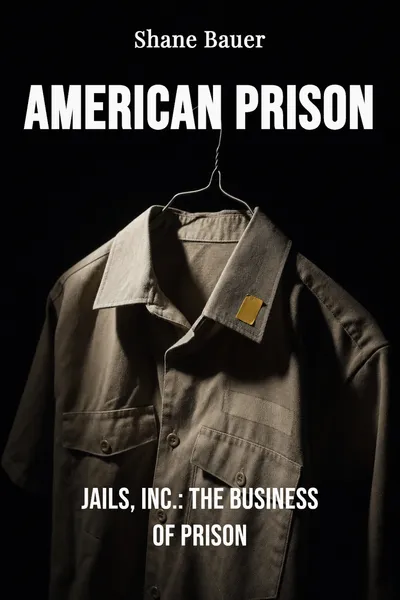
American Prison
Jails, Inc.: The business of prison
Description
In late 2014, a magazine reporter named Shane Bauer applied for a job as a corrections officer using his real name, his real Social Security number, and a résumé that was mostly true. Corrections Corporation of America — then the largest private-prison company in the United States — hired him within weeks to work at Winn Correctional Center, a medium-security men's prison tucked into the pine forests of rural Louisiana. His starting pay was nine dollars an hour, less than the local Walmart. Nobody at the company seemed to notice, or care, that a journalist had walked in the front door and put on the uniform.
What he found over the four months that followed became "American Prison," the book he built out of that experience and out of years of digging into records the company never expected a guard to read. Bauer had a particular reason to be there: he had himself spent more than two years in an Iranian prison after being captured near the Iran–Iraq border, and he knew from the inside what a cell does to a person. At Winn, he was on the other side of the bars, watching a facility so understaffed and so starved for cash that guards looked away from stabbings and men waited months for medical care that never came.
But the book is not only a diary of one grim assignment. Bauer keeps pulling a second thread, older and stranger, that runs from a Louisiana prison built on a former plantation all the way back to the men who first figured out that a captive person could be rented, leased, and made to turn a profit. The two stories keep folding into each other until it becomes hard to say where the history ends and the present begins.
The question we’re asking : What happens to a prison when the people running it answer first to a budget?What we’ll see : An undercover reporter's four months inside a for-profit lockup, set against the long American habit of pricing the people it locks away.
Table of contents
01Chapter 1 — Four months at $9 an hour
The training was brief and the message was blunt. Recruits at Winn were told, more or less openly, that their job was to keep costs down and warm bodies in beds. Bauer describes an instructor explaining that if an inmate tried to hang himself, a guard shouldn't necessarily rush in — cutting a man down could be dangerous, and anyway heroics weren't in the job description. The pay was so low that the prison was chronically short of officers, which meant a single guard might be responsible for a whole unit of hundreds of men. Understaffing wasn't a glitch. It was the model working as designed.
On the floor, the shortage bent everything. Bauer watched fights go unbroken because there was nobody to break them. He saw men with gangrene, with untreated wounds, with mental illness so severe they smeared themselves with their own filth, cycling through a system that had strong incentives not to send anyone to an outside hospital, because outside care cost the company money. Suicide watch was handled on the cheap. Medical staffing was thin. When a man's leg had to be amputated after his complaints were ignored, it read less like malice than like the predictable output of a place where every expense was a subtraction from someone's margin.

02Chapter 2 — A ledger that starts with slavery
Winn sits on land that was once a plantation, and Bauer treats that not as a coincidence but as a clue. He reaches back to the years after the Civil War, when the Thirteenth Amendment abolished slavery "except as a punishment for crime." Those five words did an enormous amount of work. Across the defeated South, states discovered that they could arrest freed Black men on vague charges — vagrancy, loitering — convict them, and then lease their labor to planters, railroads, and mines. The prisoner became a source of revenue again, only now the state collected the fee.
This was convict leasing, and Bauer lays out how brutal it was. The men leased out to private employers were often worked to death; a company that leased a convict had no stake in his survival, since a dead man could simply be replaced with another arrest. Death rates in some leasing operations were staggering. The horror of it was economic before it was anything else: the moment a human being's value lay in his labor but not in his life, there was no reason to keep him alive. Louisiana's own history runs straight through this, including the notorious plantation-turned-prison at Angola.
03Chapter 3 — What a private prison is built to save
Corrections Corporation of America was founded in 1983 with a straightforward pitch to state governments: we can run your prisons cheaper than you can. The promise depended on a contract in which the company was paid a set amount per inmate per day, and got to keep whatever it didn't spend. That structure is the whole story. Every dollar not spent on food, medical care, staffing, or maintenance became profit. The incentive didn't point toward rehabilitation, or safety, or even basic order. It pointed toward less.
Bauer shows how that logic played out at Winn in ways that were rarely dramatic and always corrosive. Wages were kept so low that turnover was constant and units went unwatched. Medical treatment was rationed. Programming that might have occupied the men — education, work, anything to fill the hours — was minimal, because programming costs money and empty time is free. A prison run to a budget doesn't have to be cruel on purpose. It only has to keep asking, of every expense, whether the contract requires it, and to answer no whenever it can.
04Chapter 4 — The arithmetic of a caged human being
Step back from Winn and the book's larger argument comes into focus. Bauer isn't only indicting one company or one badly run facility. He's asking what it means that America has, again and again, been willing to attach a price to a person it has locked up. The convict lease put a rental value on a prisoner's labor. The private-prison contract puts a per-diem value on a prisoner's mere existence. Different mechanisms, same underlying move: the incarcerated body becomes a line in someone's ledger.
That framing changes how the reader hears the familiar defense of privatization — that it's just efficiency, just letting the market do what governments do badly. Efficiency, in a prison, means spending less on human beings who cannot leave, cannot choose another provider, and cannot easily make their suffering known. The market discipline that trims waste from a factory becomes, behind bars, discipline applied to food, medicine, and the number of eyes watching a cell block at three in the morning. What looks like sound economics in a spreadsheet looks like neglect on the floor.
05Conclusion
Bauer left Winn after CCA grew suspicious, and his reporting, once published, drew a national response; the company disputed his account and the broader industry pushed back. Not long after, the U.S. Justice Department announced it would begin phasing out federal use of private prisons, citing safety and cost concerns — a decision quickly reversed under a new administration. The reversal is almost too fitting. The business Bauer described does not depend on a scandal to survive; it depends on a contract, and contracts are easy to renew.
Related books