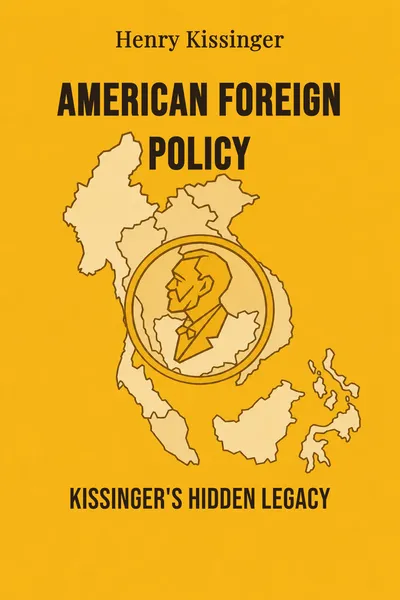
American Foreign Policy
Kissinger's hidden legacy
Description
In February 1972, Richard Nixon stepped off Air Force One in Beijing and shook the hand of Zhou Enlai — a gesture his predecessors had refused for more than two decades. Walking a step behind, often out of frame, was a German-born Harvard professor with a heavy accent and a talent for back channels. Henry Kissinger had spent the previous year flying secretly to China, telling almost no one in his own government. The opening to the People's Republic, one of the sharpest turns in Cold War history, had been built in the dark, by a man who preferred it that way.
For most of the 1970s, Kissinger ran American foreign policy with a freedom no national security adviser or secretary of state has matched since. He negotiated the exit from Vietnam and shared a Nobel Peace Prize for it. He engineered detente with Moscow and the first major arms-control treaties. And he did all of it while the same machinery of secrecy that produced the China opening was also producing the covert bombing of Cambodia and a tacit green light for the coup that ended Salvador Allende's government in Chile.
In his own writing on American foreign policy, Kissinger sets out to explain the worldview behind both halves of that record. The case he makes is not a confession and not quite a defense. It is an argument about what a great power can and cannot do, and about the price of pretending otherwise. To read him is to confront a single question that has trailed him for half a century, and that he never quite lets us answer for him.
The question we’re asking : Is the truer picture Kissinger the master diplomat, or Kissinger the architect of policies that cost thousands of lives far from any battlefield?What we’ll see : How one man's idea of how power actually works produced both the openings the world celebrated and the operations it would rather forget.
Table of contents
01 Chapter 1 — The man who wrote himself into the job
Kissinger arrived at the center of American power as an outsider who had studied it longer than most insiders. Born in Fürth, Germany, in 1923, he fled the Nazis with his family in 1938 and returned to Europe as a US Army soldier during the war. By the 1950s he was at Harvard, writing about nuclear weapons and the European statesmen of the nineteenth century. His real subject, even then, was how order gets built and held among rival powers that cannot trust each other.
That academic work matters because Kissinger governed the way he wrote. He admired Metternich and Castlereagh, the diplomats who stitched Europe back together after Napoleon, and he drew from them a conviction that stability — not justice, not democracy, not righteousness — was the rarest and most valuable thing a statesman could produce. A world that was merely stable, in his view, was a world where war stayed contained. That premise runs underneath everything he later did in office.

02 Chapter 2 — A doctrine built on limits
The Kissinger of the textbooks is the architect of detente, and the word repays a second look. Detente did not mean friendship with the Soviet Union. It meant managing a rivalry that neither side could win outright, lowering the odds of a nuclear war that would end both societies. The 1972 SALT agreement capped strategic arsenals; the back-and-forth of summits and grain deals gave Moscow a stake in not blowing up the relationship. The point was never to love the adversary. It was to make the adversary calculable.
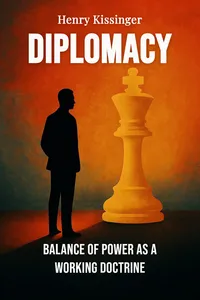
The opening to China ran on the same logic, only more daring. Kissinger saw that the Soviet Union and Communist China, despite the Western habit of treating them as a single bloc, were bitter rivals. By talking to Beijing, Washington could play the two against each other and tilt the whole balance of power in its favor. It was a chess move dressed as a diplomatic breakthrough, and it worked. The Soviets, suddenly worried about an American-Chinese understanding, grew more willing to deal.
03 Chapter 3 — The bombs that never made the front page
The same secrecy that built the China opening also built operations the public learned about only later, and the most consequential was the bombing of Cambodia. Beginning in 1969, the United States dropped enormous tonnages of ordnance on a country it was not at war with, targeting North Vietnamese supply routes and sanctuaries that ran through Cambodian territory. The campaign was hidden from Congress and falsified in the records. The strategic argument was that the sanctuaries were killing American soldiers; the cost, paid by Cambodians, was never put to any vote.
What the bombing helped unleash is part of the indictment. A neutral country was pulled into the war, its politics destabilized, and within a few years the Khmer Rouge had taken power and begun a genocide that killed a fifth of the population. The causal chain is debated, and Kissinger has always rejected the idea that the bombing produced Pol Pot. But the secrecy is not debatable, and it is exactly the kind of insulation from democratic accountability that his own theory recommends — turned to ends that are far harder to defend.
04 Chapter 4 — What a realist leaves behind
Step back from the individual operations and a single trade comes into view, the one Kissinger spent his career making and rationalizing. Realism, as he practiced it, buys strategic advantage with moral cost, and it insists that this exchange is not a corruption of statecraft but its essence. The opening to China and the secret bombing of Cambodia are not two Kissingers, a good one and a bad one. They are one Kissinger applying one method, and the method does not distinguish between the moves history later applauds and the ones it later condemns.
This is what makes his legacy so hard to file away. The critics who call him a war criminal and the admirers who call him the most gifted American diplomat of his era are often describing the same decisions. Detente and Cambodia flow from the same premise: that power is scarce, that the world cannot be moralized, and that a great nation must act on cold calculation or lose the contest to those who do. You cannot keep the breakthroughs and discard the atrocities while keeping the philosophy intact. They come as a set.
05 Conclusion
The professor who walked a step behind Nixon in Beijing went on to become the most scrutinized statesman of his generation, courted by presidents long after he left office and pursued by lawyers and historians wherever he traveled. He never softened the core of his case. Power was finite, the world was dangerous, and a country that refused to spend the one to manage the other would simply be overtaken by rivals who had no such scruples. He asked to be judged by results, not intentions, knowing full well what some of those results had been.
Related books