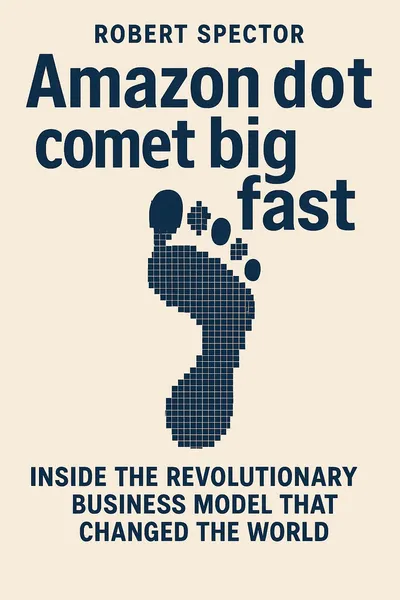
Amazon dot com get big fast
Inside the revolutionary business model that changed the world
Description
Amazon started as an online bookseller in Jeff Bezos's garage in 1994. It grew rapidly due to focus on customer service, wide selection, and low prices. Amazon went public in 1997 and expanded into selling many other products beyond books.
It lost money for years due to investing in growth, but is now profitable. Amazon revolutionized e-commerce with innovations like 1-click ordering and recommendations. It aims to be earth's most customer-centric company.
Though criticized for aggressive tactics, Amazon undeniably transformed retail.
Table of contents
01 Bezos' early life and education
Jeff Bezos, born on January 12, 1964, was adopted by his stepfather, Mike Bezos, a petroleum engineer. Jeff's early life involved frequent relocations due to his stepfather's job. He attended Princeton University in 1982, majoring in electrical engineering and computer science, and graduated summa cum laude in 1986. His senior thesis involved designing a computer that calculated DNA edit distances. After graduation, he worked at Fitel, a financial telecommunications startup, where he launched Equinet, a global network connecting investors, brokers, and banks.

02 Founding amazon.Com
Jeff Bezos left his job at D.E. Shaw and Co. to start his own business, guided by criteria that included a large pool of technical talent, minimal sales tax collection requirements, and proximity to book wholesalers. Seattle, Washington, was chosen for its alignment with these needs. In the summer of 1994, Jeff and Mackenzie Bezos embarked on a journey to the Pacific Coast in a Chevy Blazer, during which Jeff began drafting his business plan and arranged for legal assistance to incorporate Cadabra Inc. on July 5, 1994, in Washington state. The company was later renamed Amazon.com Inc. and reincorporated in Delaware.
During their move, the Bezoses interviewed software programmers in Northern California, hiring Shel Kaphan as vice president of research and development. Settling in Bellevue, they rented a house with a garage, echoing the origins of Hewlett-Packard, and hired their second employee, Paul Barton-Davis. Bezos focused on hiring smart, adaptable individuals, regardless of their specific backgrounds.
03 Funding and growing the company
Jeff Bezos founded Amazon with a vision centered on exceptional customer service, a principle that has underpinned the company's success and fostered immense customer loyalty. Initially, Bezos saw the potential in online book sales but anticipated a slow shift in consumer habits towards online shopping. The launch of Amazon.com in July 1995 coincided with the burgeoning internet era, marked by Netscape's IPO, capturing early adopters and benefiting from minimal competition. Amazon's growth quickly surpassed expectations, with the company celebrating its first paying customer shortly after launch. The team's enthusiasm was palpable, with a web server beep for every order placed, although this was soon disabled as order volumes surged. In its first month, Amazon shipped to all 50 states and 45 countries, far exceeding Bezos's projections.
04 Focusing on customer service
In 1995, Amazon.com faced financial challenges, losing $303,000, which exceeded the personal funding capacity of the Bezos family. Jeff Bezos, the founder, sought additional investors, valuing the company at $6 million. By the end of the year, he had raised $981,000. In 1996, the company was projected to generate around $5 million in revenue. As the company grew, it moved to a larger building and began receiving unsolicited investment offers. One such offer was from General Atlantic Partners, who proposed $1 million for a 10% stake, valuing Amazon at $10 million.
Recognizing the company's potential, Bezos focused on maintaining Amazon's market leadership and building momentum. This strategy paid off when the Wall Street Journal published an article on Amazon, doubling its website traffic overnight. With rising interest from venture capitalists, Bezos secured an investment of $8 million from Kleiner Perkins, a leading Silicon Valley firm, for a 13% stake, valuing Amazon at $60 million.
05 Going public in 1997
Jeff Bezos, the founder and CEO of Amazon, has always placed a high emphasis on customer service, aspiring for Amazon to be the most customer-centric company in the world. He identified selection, convenience, and price as the three critical factors for online shoppers.
To meet these needs, Amazon developed an efficient website with features like customer reviews and discussion forums to foster a sense of community. The company streamlined its order and shipment process, reducing delivery times from four days to 24 hours, and welcomed smaller publishers to its platform, broadening its selection.
06 Expanding the business model
In 1996, Amazon.com, Jeff Bezos's start-up, exceeded its forecasted sales of $6 million by generating $15.7 million, a year-over-year increase of over 3,000 percent. However, losses also increased from $303,000 in 1995 to $5.8 million in 1996. As the internet gained mainstream status, Amazon faced new challenges, including competition from Barnes & Noble, CUC International's NetMarket, and major publishers.
In response, Bezos enhanced Amazon's website and prepared for an initial public offering (IPO) to finance the company's vision. Despite a weak climate for tech IPOs, Amazon's shares were in demand. The company sold 2.5 million shares at $18 each, and by year-end, the share price had rebounded to $52.
07 Building the amazon brand
Amazon.com, founded by Jeff Bezos in 1995, was born out of his vision to harness the potential of the internet. Bezos, a former Wall Street quantitative analyst, understood the importance of recruiting talent and gaining media coverage. He aimed to make Amazon the leading figure in internet commerce, focusing on these areas from the start.
Bezos' ability to shape his public persona as the e-commerce spokesperson significantly contributed to Amazon's success. He skillfully addressed questions about Amazon's lack of profits, emphasizing that profits, while important, are not the sole purpose of a company's existence.
In its quest for global expansion, Amazon acquired British e-bookstore Bookpages in 1998, relaunching it as Amazon.co.uk. Similar arrangements were made in Germany through Amazon.de. Amazon also partnered with Yahoo! to become a leading online book merchant in many countries.
08 Continued growth and impact
Founded in 1994 as an online bookstore, Amazon has grown into a diversified business titan, generating over $514 billion in annual revenues by 2023 across various divisions. Its North America segment alone accounted for $87.9 billion in sales in Q3 2023, up 11% year-over-year. Internationally, Amazon's Q3 2023 sales hit $32.1 billion, a 16% increase. Amazon Web Services, its cloud computing arm, brought in $23.1 billion for the quarter, up 12%.
Amazon's growth has been supported by major investments totaling over $750 billion since 2010. The company directly employs over 1 million workers in the U.S. and supports 2 million additional jobs through its investments. It also enables 1.5 million American small and medium-sized businesses to sell on its marketplace.
Related books