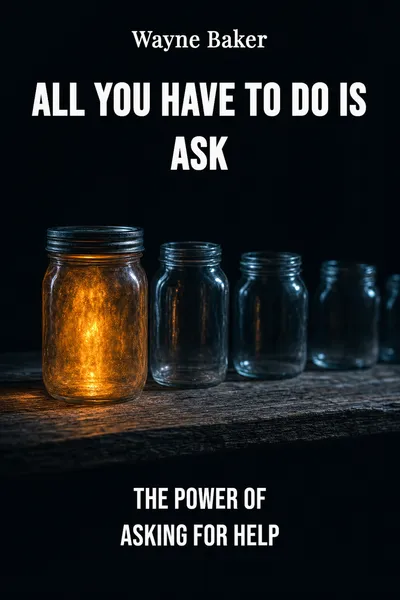
All You Have to Do Is Ask
The power of asking for help
Description
Wayne Baker, a sociologist and management professor at the University of Michigan's Ross School of Business, has spent years running a deceptively simple exercise with executives, students, and teams. He hands people a problem they're stuck on and asks them to request help from the room. What happens next is almost always the same: hands go up, resources appear, contacts get traded, someone knows exactly the person who can solve the thing. The participants leave stunned by how much was sitting unused in the people around them. Baker turned that exercise into a 2020 book, "All You Have to Do Is Ask," and into a broader claim about how value actually moves through groups.
The claim cuts against a lot of what we tell ourselves. Most of us believe success comes from grinding alone, from being the kind of person who doesn't need anything. Baker's research says the opposite. Studies he cites suggest that somewhere between seventy-five and ninety percent of help at work is given in response to a direct request — meaning that if nobody asks, most of the available help simply never moves. The resources are there. The willingness is there. The bottleneck is the request itself, and the request is the thing we're worst at making.
Which raises an uncomfortable possibility. If asking is that powerful and that available, why do so many capable people refuse to do it? And if the refusal is costing us, what would it take to actually get good at the one move that unlocks everything else?
The question we’re asking : If help is everywhere and mostly free, why is asking for it the hardest thing we do?What we’ll see : How a sociologist reframed asking as a trainable skill, and the simple machinery that turns reluctance into a habit a whole group can share.
Table of contents
01 Chapter 1 — The wall in our own head
Start with the part Baker thinks we get most wrong: the reasons we don't ask. They feel like rational calculations and they're mostly not. We tell ourselves asking makes us look incompetent, that the other person is too busy, that we'll owe a debt we can't repay, that we should be able to figure this out on our own. Each one sounds like prudence. Each one, Baker argues, is a story we've absorbed about what strong, self-sufficient people do, and the story is wrong.
The most stubborn barrier is the fear of looking weak. We imagine that the colleague we ask will think less of us. But the research points the other way. People who ask for advice are generally rated as more competent, not less, because a well-framed question signals judgment — it shows you know what you need and who might have it. Baker leans on work by Francis Flynn and Vanessa Bohns showing that we also badly underestimate how willing others are to help. In their experiments, people predicted far more rejection than they actually got. The cost of asking is mostly imaginary; the cost of staying silent is real.

02 Chapter 2 — The reciprocity ring and the science behind it
Baker's signature tool is something he developed with his wife, Cheryl Baker, called the Reciprocity Ring. The setup is plain. A group sits together, and each person writes down one meaningful request — a contact they need, a skill they're missing, a piece of knowledge, even something personal. Then, one by one, they read the request aloud, and the rest of the room responds with whatever they can offer: an introduction, an answer, a lead, a name. Nobody pays for help and nobody keeps score. Within an hour or two, a room of strangers has moved a startling amount of value.
Why does it work so well? Partly because asking out loud, in turn, removes the awkwardness — everyone is doing it, so nobody is exposed. Partly because it surfaces resources that were invisible. You'd never know the person across the table has a cousin in exactly the industry you're trying to break into. But the deeper engine is what sociologists call generalized reciprocity. In a direct exchange, I help you and you help me back. In generalized reciprocity, I help you, you help someone else, and help eventually circles back to me from a direction I couldn't have predicted. The giving and the getting are decoupled, which is precisely what frees people to be generous.
03 Chapter 3 — Asking well is a skill, not a personality trait
If the barriers are learned and the engine can be built, then asking itself can be practiced. This is where Baker is most practical, and where the book earns its blunt title. He argues that good requests share a small set of features, often summed up with the acronym SMART — specific, meaningful, action-oriented, realistic, and time-bound. A vague "let me know if you think of anything" gives the other person nothing to grab. A precise request — who you're trying to reach, by when, and why it matters — is something a person can actually act on.
Specificity does a lot of quiet work. "Do you know anyone in publishing?" puts the burden on the listener to scan their entire memory. "I'm looking for an introduction to an editor of business books, ideally before the end of the month" hands them a clean task. Baker also pushes us to widen the circle of who we ask. We tend to lean on close friends, but close friends know roughly what we know. The breakthroughs more often come from weak ties — acquaintances, the people two steps out — whose networks barely overlap with ours, an insight that runs straight back to Mark Granovetter's classic finding about the strength of those looser connections.
04 Chapter 4 — The quiet economy of giving and getting
Step back from the individual request and Baker's larger argument comes into focus: a team, a company, a community is best understood as an economy of circulating resources, and asking is the mechanism that keeps that economy liquid. Knowledge, contacts, favors, and expertise are constantly being created inside any group, but they only have value if they move. A request is the trigger that sets a resource in motion. A culture where nobody asks is a culture where wealth piles up in private corners and rots.
This is why Baker, a network scientist by training, is finally less interested in self-improvement than in system design. He distinguishes between cultures of generosity and cultures of taking, and notes a counterintuitive finding from organizational research, much of it associated with Adam Grant: the people who give the most can end up either the most successful or the most burned out, and what separates the two outcomes is whether they also ask. Givers who never request anything drain themselves. Givers who ask keep the exchange balanced and sustainable. Asking, in this light, isn't the opposite of generosity — it's the thing that protects it.
05 Conclusion
The exercise Baker runs always ends the same way it began: a room full of people who walked in convinced they had to solve their problems alone, leaving with introductions, answers, and the strange relief of having been helped. Nothing about the room changed except that someone made it safe to ask. The resources were there the whole time. What was missing was the request — the small, frightening, eminently learnable act of saying out loud what we need.
Related books