"All the Real Indians Died Off"
Myths that erase, systems that dispossess
Description
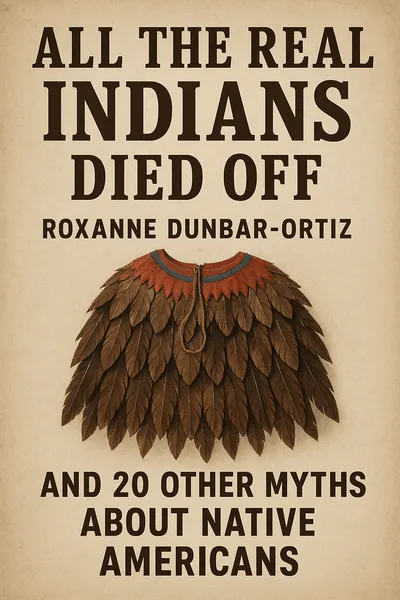
"All the Real Indians Died Off" by Roxanne Dunbar-Ortiz systematically dismantles twenty-one persistent myths about Indigenous peoples that perpetuate colonial violence and erasure in contemporary American society. Drawing upon decades of Indigenous scholarship and activism, Dunbar-Ortiz confronts the mythological foundations of American settler colonialism in this systematic debunking of pervasive stereotypes. Published in 2016, this work emerged within a broader movement of Indigenous intellectual decolonization, challenging narratives that justify ongoing colonial relations. The author leverages her expertise in Indigenous history to expose how seemingly innocuous cultural assumptions function as mechanisms of erasure and dispossession.
The work addresses the central research question of how persistent myths about Indigenous peoples serve contemporary settler colonial structures and what their material consequences are. Dunbar-Ortiz defends the thesis that twenty-one widespread myths about Indigenous peoples constitute a coherent ideological system that legitimizes ongoing colonial violence and erasure while obscuring Indigenous survival and resistance. The main stake of this intellectual project is to dismantle the mythological apparatus that enables continued Indigenous dispossession while revealing the vitality of contemporary Indigenous communities.
The work constructs a comprehensive critique demonstrating how these persistent myths constitute a coherent ideological system maintaining settler colonial relations. It reveals the sophisticated mechanisms through which seemingly benign cultural assumptions function as tools of ongoing dispossession and erasure. By exposing these mythological structures, the author creates space for understanding Indigenous experiences through frameworks of resistance, survival, and contemporary political engagement rather than disappearance and victimization. The intellectual contribution lies in systematically connecting cultural representation to material consequences while providing tools for institutional decolonization.
Table of contents
01 The Architecture of Colonial Mythology
Dunbar-Ortiz demonstrates how these myths constitute a sophisticated ideological apparatus rather than mere cultural misunderstandings. The author reveals how narratives of Indigenous disappearance, primitive technology, and ecological incompetence function as interlocking justifications for territorial appropriation. These mythologies operate through what might be termed temporal displacement, positioning Indigenous peoples as historical artifacts rather than contemporary political actors. The theoretical framework employed draws heavily from critical race theory and settler colonial studies, particularly the work of Patrick Wolfe regarding the logic of elimination inherent in settler societies. Dunbar-Ortiz exposes how myths of Indigenous inferiority and inevitability of disappearance create epistemological foundations for ongoing dispossession, transforming historical genocide into natural evolutionary processes.

02 Cultural Appropriation and Strategic Essentialism
The analysis extends to examining how romantic mythologies of Indigenous peoples serve equally destructive functions through strategic appropriation. Dunbar-Ortiz explores how the "noble savage" construct enables settler societies to simultaneously celebrate and consume Indigenous culture while denying Indigenous political sovereignty. This dynamic reveals the sophisticated mechanisms through which colonial societies manage the contradiction between celebrating Indigenous culture and eliminating Indigenous peoples. The author demonstrates how environmental romanticism, spiritual appropriation, and cultural commodification function as forms of symbolic violence that obscure material dispossession. These processes transform living cultures into consumable products while denying Indigenous communities control over their own cultural representations and sacred practices.
03 Resistance, Survival, and Contemporary Realities
Dunbar-Ortiz fundamentally reframes Indigenous experiences from victimization narratives toward active resistance and cultural continuity. The work reveals how myths of Indigenous passivity and cultural death obscure centuries of sophisticated political resistance, legal challenges, and cultural revitalization. This reframing exposes the profound rupture between dominant historical narratives and Indigenous lived experiences. The author demonstrates how contemporary Indigenous movements represent continuations of historical resistance rather than recent political awakening. This analysis reveals how settler colonial societies systematically erase evidence of Indigenous agency to maintain myths of legitimate conquest and natural cultural evolution.
04 Critical Assessment and Future Directions
While Dunbar-Ortiz provides crucial demythologizing work, the analysis occasionally risks creating its own binary oppositions between authentic Indigenous perspectives and settler colonial myths. The focus on twenty-one specific myths, while pedagogically effective, may inadvertently suggest that colonial ideology operates through discrete, separable components rather than systemic relationships. Additionally, the work's emphasis on debunking may limit engagement with more subtle forms of colonial ideology that operate through incorporation rather than exclusion.
Related books