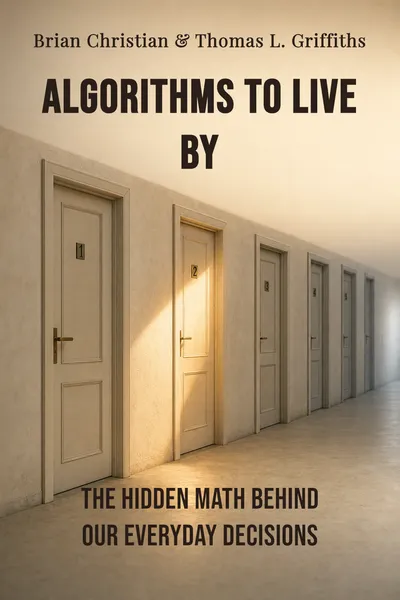
Algorithms to Live By
The hidden math behind our everyday decisions
Description
Picture the last time we looked for an apartment in a city we wanted to live in. Three places seen on a Saturday, a fourth that was somehow already gone by Sunday morning, a landlord wanting a yes by the end of the call. Commit too early and we wonder forever what the fifth place would have been. Wait too long and the good ones slip away while we deliberate. This is not a failure of character or nerve. It is, as Brian Christian and Thomas Griffiths argue, a problem computer scientists have a name for, a proof for, and a startlingly precise answer to. The answer is 37 percent.
Christian, a writer trained in both English and computer science, and Griffiths, a cognitive scientist who has spent his career studying how the mind makes decisions, published Algorithms to Live By in 2016. Their wager is unusual. Most popular books about decision-making borrow from psychology and warn us about the ways our intuitions betray us. This one goes the other direction. It treats the messy, anxious, time-pressured choices of ordinary life as versions of problems engineers have already studied for decades: when to stop searching, how to sort, what to keep and what to forget, how much to bet on the unfamiliar over the familiar. The machines, it turns out, have been quietly facing our dilemmas all along.
What makes the book land is that it never asks us to behave like computers. It asks the opposite question. Once we understand the structure of the problem we are actually facing, the agonizing often dissolves, and a better way of being human comes into view. The mathematics is not there to make us cold. It is there to tell us, sometimes, to relax.
The question we’re asking : Can the mathematics built to run machines actually tell us how to live, love, and choose?What we’ll see : How a handful of classic computer-science problems quietly map onto the everyday decisions we agonize over.
Table of contents
01 Chapter 1 — The apartment hunt is a math problem
Computer scientists call it the optimal stopping problem, and the cleanest version is known as the secretary problem. We are interviewing candidates one at a time. After each, we must either hire on the spot or reject and move on forever. We cannot go back. We want the best one, but we will only ever know how someone ranks against those already seen, never against those still to come. How long should we keep looking before we commit? The structure is exactly the one Christian and Griffiths find lurking in apartment hunting, job searching, and the part of dating where we wonder whether someone better is out there.
The answer, proven mathematically, is to look without choosing for the first 37 percent of the search, then take the next option that beats everyone seen so far. If we expect to consider a hundred apartments, we treat the first thirty-seven as pure reconnaissance, learning what the market offers without committing, then pounce on the first one that tops them all. The figure comes from the number mathematicians write as one over e, the base of the natural logarithm, and it is also our chance of actually landing the best option this way. Roughly a third of the time it works perfectly. The rest of the time, no strategy could have done reliably better, because the information simply was not there.

02 Chapter 2 — When to stop looking and start playing
The next great dilemma the book unpacks is the tension between trying something new and sticking with what we know. Engineers call it the explore-exploit trade-off, and they study it through what is charmingly named the multi-armed bandit problem, after a row of slot machines, each with unknown odds. Pull the familiar lever that has paid out before, or gamble on an untested one that might pay more? Every restaurant choice, every decision to replay a beloved album or risk a new one, every call about whether to stay in a job or jump, is a version of this. We are all standing in front of the machines.
The crucial variable, Christian and Griffiths show, is not our personality but our time horizon. How long we expect to keep playing changes everything. With many pulls ahead, exploration is worth the gamble, because a discovery can pay dividends for years. With few pulls left, we should exploit what we already love. This is why a tourist with one night in a city should book the restaurant everyone recommends, while a new resident should wander into the unknown one. It also reframes a familiar arc of life. The young explore restlessly because the payoff window is long; the old return to favorites not from rigidity but from a rational reading of the clock.
03 Chapter 3 — The trade-off nobody escapes
If optimal stopping and explore-exploit feel liberating, the book's middle chapters introduce the harder truth that every gain comes with a cost somewhere else. Take sorting, the problem of putting things in order. We assume order is always worth the effort, yet Christian and Griffiths note that sorting is expensive and that error, in the wrong proportion, is sometimes cheaper than perfection. A messy email inbox sorted only by search may beat a meticulously filed one. The effort of organizing only pays if we will actually use the order more than we paid to create it. Sometimes the pile on the desk is, mathematically, the right call.
Caching, the science of what to keep close and what to let go, sharpens the point. A computer cannot hold everything in fast memory, so it must constantly decide what to evict, and the strategy that works best is to discard whatever we have gone longest without needing. The authors apply this to closets, libraries, and the human mind itself. Our memory, they argue, may not be failing as we age so much as facing a harder retrieval problem, sifting a far larger store. Forgetting is not always decay. Often it is good cache management, the mind quietly evicting what it has stopped using to keep the useful things within reach.
04 Chapter 4 — Why thinking less is sometimes thinking better
The broadest claim of Algorithms to Live By is one that runs against our instincts about what it means to decide well. We tend to assume that more thinking, more data, and more deliberation produce better choices, and that when things go wrong we simply did not think hard enough. The computational view dismantles this. Every algorithm runs on a real machine with finite time and finite memory, and the best algorithm is never the one that finds the perfect answer regardless of cost. It is the one that finds a good-enough answer within the resources available. Christian and Griffiths call this the central insight that computer science offers a human life.
This reframes a feeling most of us carry as failure. Computer scientists have a precise vocabulary for the cost of thinking itself, and they have proven that for many problems, finding the truly optimal solution would take longer than the universe has existed. Faced with such problems, machines do not seize up demanding more information. They use shortcuts, accept approximation, sometimes even introduce a little randomness, and they get on with it. The authors argue that our own mental shortcuts, the snap judgments and rough rules we are so often told to distrust, are frequently not bugs but well-tuned responses to exactly this predicament.
05 Conclusion
We began in front of an apartment, a landlord waiting, the fear of choosing wrong pressing in. Algorithms to Live By does not make that fear disappear, and it never pretends to. What it offers instead is a map of the territory, drawn by the engineers who have spent decades formalizing the exact dilemmas we feel as private agonies. Look, then leap, at the 37 percent mark. Explore while the horizon is long, savor when it shortens. Keep close what we use, let the rest go. Accept that some things are best done imperfectly, and that a sound process can still meet a disappointing end.
Related books