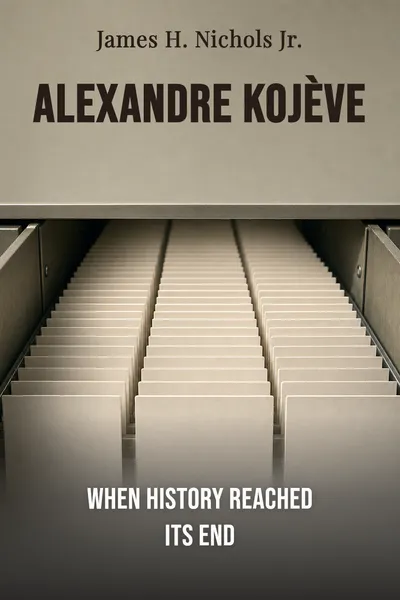
Alexandre Kojève
When history reached its end
Description
Between 1933 and 1939, in a small room at the École pratique des hautes études in Paris, a Russian émigré named Alexandre Kojève spent six years reading a single book aloud to a few dozen people. The book was Hegel's Phenomenology of Spirit, published in 1807 and famously among the hardest works in the Western tradition. Kojève did not summarize it so much as rebuild it, sentence by sentence, into something stranger and more urgent than what Hegel had written. Among the listeners, at one point or another, were Raymond Aron, Jacques Lacan, Maurice Merleau-Ponty, Georges Bataille, and Raymond Queneau, who would later gather the lecture notes into a book. Almost none of them fully agreed with him. Almost all were marked for life.
What Kojève told that room was audacious. History, he argued, had an internal logic and a destination — and that destination had, in a real sense, already been reached. The great human drama driving wars, revolutions, and the restless motion of civilization was essentially over. What remained was administration. James H. Nichols Jr., in his study of Kojève, sets out to make this claim legible: where it came from, what it actually meant, and why a thinker who published relatively little should have shaped so much twentieth-century thought about power, desire, and the modern state.
Kojève is a difficult figure to hold in one hand. He was a serious philosopher who spent the second half of his life as a French trade negotiator. He read Hegel through Marx and Heidegger and came out somewhere none of them had pointed. Nichols treats him not as a curiosity but as someone whose questions still press on us — about what humans want once they have what they wanted.
The question we’re asking : What did Kojève mean when he said history had reached its end, and why did the claim unsettle a generation of European thinkers?What we’ll see : How a marginal émigré rebuilt Hegel into a theory of desire, recognition, and the modern state — and then lived out his own conclusion.
Table of contents
01 Chapter 1 — A Russian émigré in a Paris seminar room
Alexandre Kojève was born Alexandre Kojevnikov in Moscow in 1902, into a comfortable and cultivated family. The Russian Revolution scattered his early life; by the early 1920s he had left for Germany, where he studied philosophy at Heidelberg and absorbed the currents reshaping the discipline. He finished his doctoral work on the Russian religious thinker Vladimir Solovyov, then settled in Paris, one of countless émigrés rebuilding a life on borrowed footing. He was multilingual, mathematically trained, drawn equally to Eastern philosophy and to the hard problems of Western metaphysics.
The seminar that made his name was, in a sense, an accident of substitution. A friend, the philosopher Alexandre Koyré, had been lecturing on Hegel's religious writings and left the post; Kojève took it over in 1933 and turned it toward the Phenomenology of Spirit. For six academic years he led his listeners line by line through the text. Nichols stresses what kind of exercise this was: not neutral commentary. Kojève was doing philosophy through Hegel — pressing the old text until it yielded a picture of the human condition that was recognizably his own.

02 Chapter 2 — History as a fight for recognition
At the center of Kojève's reading sits a single scene from Hegel: the encounter between two self-consciousnesses that becomes the struggle between master and slave. Nichols walks through it carefully, because everything else depends on it. What separates human desire from animal appetite is that humans do not merely want objects — they want to be wanted. We desire the desire of another; we want recognition as free beings from someone whose acknowledgment counts. An animal wants food. A human wants to matter in the eyes of another human.
That wanting, pushed to its limit, produces conflict. Two people who each demand recognition and are willing to risk their lives to get it meet in a fight to the death. But a corpse cannot recognize anyone, so the fight resolves into hierarchy: one party, more afraid of death, submits and becomes the slave; the other, having risked everything, becomes the master. For Kojève, this is not an event that happened once. It is the hidden engine of history — the origin of inequality, of work, of the long labor by which the human world gets built.
03 Chapter 3 — The end of history, and what comes after
This is the claim that made Kojève famous and infamous at once. If history is the struggle for recognition, and if that struggle resolves in the universal and equal state, then history — in the strong sense, the drama with a plot — is finished. Not that events stop happening. Wars, elections, discoveries continue. But nothing genuinely new is at stake. The principle has been settled; what remains is working out details across the globe. Nichols is clear that Kojève meant this seriously, and that he took Hegel to have already glimpsed it in 1806, watching Napoleon ride through Jena.
What unsettled his listeners was the question of what human life becomes afterward. If the great motor of desire and struggle has run down, what is left for beings who defined themselves through that struggle? Kojève's answers changed over time, and Nichols traces the shift carefully. In one version, post-historical humanity slides back toward animality — satisfied, comfortable, no longer negating and transforming the world, absorbed in consumption and leisure. There is something bleak in the image: the end of history as the end of the specifically human.
04 Chapter 4 — The philosopher who chose administration
Here Nichols reaches the fact that makes Kojève more than a theory. In 1945, after the war, Kojève effectively stopped being a philosopher in the public sense and became a French civil servant. He joined the Ministry of Economic Affairs and spent the next twenty years as a trade negotiator, central to the talks that built the European Common Market and the framework of postwar international trade. He was, by many accounts, formidable — sharp, tireless, respected across the table. He kept writing, but philosophy became a private occupation folded into a life of committees and tariffs.
It is tempting to read this as retreat, a brilliant man giving up thought for a desk job. Nichols suggests the opposite, and the suggestion is the heart of his book. Kojève's turn to administration was not a betrayal of his philosophy but its logical extension. If history is over — the fundamental questions settled, what remains is the universal state working itself out — then the properly modern task is not to keep asking questions but to build and manage the institutions that embody the answer. The wise man, at the end of history, becomes an administrator.
05 Conclusion
Kojève died in 1968, appropriately enough during a meeting of the European Economic Community in Brussels, collapsing at the negotiating table where he had spent his second life. He had published little, taught briefly, and left behind a book he had barely meant to write. Yet the questions raised in that Paris seminar — about desire as the hunger to be recognized, about history as a struggle with a destination, about what becomes of us once that struggle is won — had spread outward through psychoanalysis, political theory, and debates over the modern state.
Related books