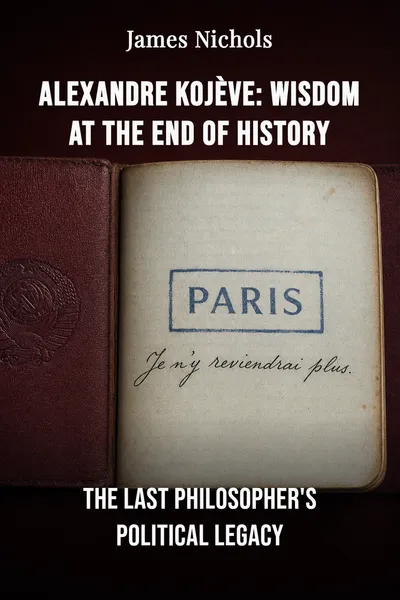
Alexandre Kojève: Wisdom at the End of History
The last philosopher's political legacy
Description
In the winter of 1933, a small lecture hall at the École Pratique des Hautes Études in Paris filled with people who would go on to shape French intellectual life for the next half-century. The man at the front was a Russian émigré in his early thirties named Alexandre Kojève, and the course he was teaching was a line-by-line reading of Hegel's Phenomenology of Spirit. He kept it up for six years, until 1939. In the audience, at various points, sat Raymond Aron, Georges Bataille, Jacques Lacan, Maurice Merleau-Ponty, and a generation of younger thinkers who would carry his interpretation into existentialism, into psychoanalysis, into the whole postwar French reckoning with history and desire.
What makes the seminar strange, in retrospect, is what its teacher did next. Kojève did not become a professor. After the war he joined the French Ministry of Economic Affairs, helped design the early structures of European integration and the precursors to what became the world trade system, and spent the rest of his life as a senior civil servant who insisted, with a straight face, that history had already ended. He died in 1968, mid-sentence, during a meeting in Brussels. He had published relatively little under his own name, yet he had told one of the twentieth century's most consequential stories about where humanity was going — and then walked away from philosophy to help build the destination.
In his study of Kojève, James Nichols sets out to make this single life hold together: the early writings before the turn to Hegel, the substance of that Hegelianism, and the political afterlife of a man who claimed thinking itself was finished. The puzzle Nichols keeps returning to is not whether Kojève was right, but what kind of person concludes that the work of the mind is done — and then reports to the office.
The question we’re asking : What did Alexandre Kojève actually mean by the end of history, and why did the philosopher who announced it go to work as a bureaucrat?What we’ll see : A reading of Kojève's life and writings that follows the strange line from a Paris lecture hall to the corridors of postwar European power.
Table of contents
01 Chapter 1 — A Russian émigré who read Hegel out loud
Kojève was born Aleksandr Kozhevnikov in Moscow in 1902, into a well-off family — the painter Wassily Kandinsky was an uncle by marriage. He left Russia in the early 1920s, in the wake of the Revolution, and studied in Heidelberg under Karl Jaspers, writing a dissertation on the Russian religious philosopher Vladimir Solovyov. Nichols spends real time on these early years, because the standard image of Kojève as simply Hegel's French interpreter skips the formation that came first. Before Hegel there was Russian religious thought, German philosophy, and a serious interest in the relation between the human and the absolute.
Nichols also takes the early writings on their own terms — including Kojève's work on the foundations of physics and his reflections on atheism and religion. The point is not that these are minor warm-ups. It is that the questions Kojève would later answer through Hegel were already his questions: what does it mean to be a self, how does desire relate to consciousness, what would it take for a human being to be genuinely satisfied. He came to Hegel looking for answers he had been chasing in other vocabularies.

02 Chapter 2 — What the end of history actually meant
The phrase "the end of history" has had a strange popular career, and Nichols is careful to recover what Kojève meant by it — which is more precise and more unsettling than the slogan suggests. History, for Kojève following his Hegel, is the story of the struggle for recognition. When that struggle is resolved — when a social and political order exists in which every human being is recognized as a free and equal subject — there is nothing left for History, with a capital H, to accomplish. The fights that made history history are over. What remains is administration, not drama.
Nichols's most valuable contribution here is to show that the end of history took on two meanings for Kojève at two different moments, and that the difference matters. In the seminar of the 1930s, the end of history pointed toward a positive fulfillment: the universal and homogeneous state, in which the citizen is fully recognized and human desire is at last satisfied. This is the optimistic reading — the long human project completing itself in a rational order, with the satisfied citizen as its final figure.
03 Chapter 3 — From the seminar to the trade negotiation
When the seminar ended and the war came, Kojève did the thing that still startles his readers: he stopped doing philosophy and went into government. From the late 1940s he worked in the French Ministry of Economic Affairs, becoming one of the éminences grises of French economic diplomacy. He was deeply involved in the General Agreement on Tariffs and Trade — the GATT, the postwar framework that would eventually become the World Trade Organization — and in the construction of the European Economic Community. He shaped policy without ever holding elected office or a famous title.
Nichols insists this was not a retreat from his ideas but an application of them. If history was effectively over, if the universal and homogeneous state was the horizon, then the serious work was no longer to theorize the end but to administer the approach to it. Trade rules, economic integration, the patient construction of supranational institutions — these were, on Kojève's own logic, the concrete labor of bringing the post-historical order into being. The civil servant was the philosopher's consistent successor, not his betrayal.
04 Chapter 4 — The philosopher who decided thinking was over
Step back from the dates and the offices, and Kojève becomes a limit case for a question the twentieth century kept asking: what is the right relationship between thinking and acting, between the philosopher and the world? Most engaged intellectuals of his era — and there were many — believed thought should guide action while remaining, in some sense, above it. Kojève drew a harder conclusion. If wisdom is possible, if the human story can actually be understood whole, then philosophy as the love of a wisdom not yet possessed has nothing left to do. The wise man does not philosophize; he knows. And knowing, he can simply get to work.
Nichols presents this as the genuinely radical core of Kojève, the part that cannot be softened into a teaching position. To claim the end of history is also to claim that the time for new fundamental thought is over — that what remains is realization, administration, the closing of accounts. It is a deeply un-modest claim dressed in the manner of a calm bureaucrat, and Kojève seems to have found it not tragic but liberating. He could be ironic about almost everything precisely because, by his own account, the essential question was settled.
05 Conclusion
Kojève died in 1968, fittingly, while addressing a meeting of the European Economic Community in Brussels — at work, mid-thought, inside the institutions he had helped build to administer a history he believed was already over. He left behind a body of work smaller than his influence and a reputation that runs through other people: the students of the 1930s seminar who became the architects of French thought, the friend-antagonist Strauss, and a phrase that escaped him entirely and entered ordinary political speech.
Related books