
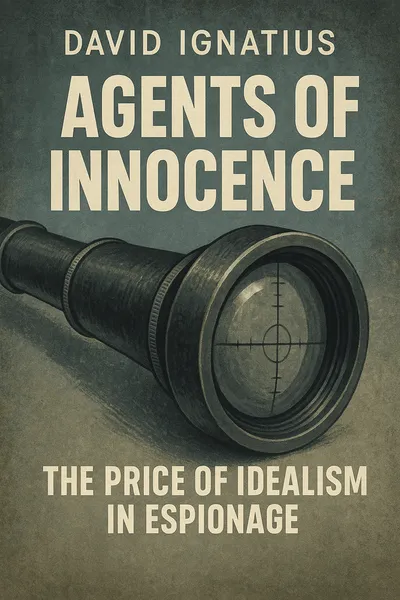
Agents of Innocence
The price of idealism in espionage
Description
David Ignatius emerges from the intersection of journalism and literature as a uniquely positioned observer of American foreign policy's moral complexities. Drawing upon his extensive experience covering Middle Eastern affairs and intelligence operations, Ignatius crafts a debut novel that transcends conventional espionage fiction to examine the philosophical tensions inherent in covert diplomacy. Set against the volatile backdrop of Lebanon during the late Cold War period, Agents of Innocence represents a critical intervention in understanding how American intelligence operations navigate the treacherous terrain between ideological commitment and pragmatic necessity. The work situates itself within the broader discourse of American interventionism while interrogating the personal and institutional costs of maintaining democratic values through fundamentally undemocratic means.
The central research question driving this analysis asks: How does the deployment of American intelligence operatives in morally ambiguous environments challenge the foundational assumptions of democratic foreign policy? Ignatius defends the thesis that the pursuit of national security through covert operations necessarily corrupts both individual agents and institutional integrity, rendering the preservation of democratic ideals impossible within the intelligence apparatus. The main stake of this argument is to demonstrate that the collision between American exceptionalism and Middle Eastern political realities exposes the fundamental contradictions within liberal democratic approaches to international security.
Ignatius achieves his analytical power through the systematic demonstration that American intelligence operations cannot maintain the moral innocence their democratic justification requires. The novel reveals how the structural imperatives of covert action create institutional cultures that reward moral compromise while punishing ethical reflection, producing operatives and organizations increasingly disconnected from the values they ostensibly serve. The novel's strength lies in its refusal to locate these contradictions within individual moral failures or temporary institutional aberrations. Instead, Ignatius presents corruption as the inevitable consequence of attempting to advance democratic values through fundamentally undemocratic means. This analysis suggests that the problems identified transcend particular operational contexts or historical periods, representing permanent features of intelligence work within democratic societies.
Table of contents
01 The Architecture of Moral Compromise: Individual and Institutional Corruption
Ignatius constructs his narrative around the systematic erosion of ethical boundaries that defines intelligence work in contested political spaces. The protagonist's journey from idealistic operative to morally compromised agent serves as a microcosm of broader institutional dynamics that privilege operational success over moral consistency. The author employs the Lebanese context not merely as exotic backdrop but as a laboratory for examining how democratic societies reconcile their stated values with the necessities of geopolitical competition.

02 The Political Economy of Betrayal: Transactional Intelligence Networks
The novel's exploration of recruitment and asset development reveals the fundamentally transactional nature of intelligence relationships, where loyalty becomes a commodity to be purchased rather than earned. Ignatius meticulously documents how financial incentives, ideological manipulation, and personal coercion combine to create networks of compromise that extend far beyond immediate operational objectives. This analysis exposes the inherent instability of intelligence operations built upon purchased allegiances rather than shared commitments.
03 Identity and Institutional Pathology: The Psychological Transformation of Intelligence Operatives
The psychological transformation of intelligence operatives represents perhaps the novel's most penetrating insight into the institutional culture of American espionage. Ignatius demonstrates how the maintenance of operational security requires the systematic compartmentalization of moral reasoning, creating individuals capable of extraordinary professional effectiveness alongside profound personal dysfunction. This analysis reveals intelligence work as fundamentally alienating, severing operatives from both their official institutional identities and their private moral commitments.
04 The Limits of Democratic Imperialism: Structural Contradictions in Liberal Foreign Policy
Ignatius's most significant contribution lies in his analysis of how intelligence operations expose the fundamental contradictions within liberal democratic approaches to international security. The novel demonstrates that the preservation of democratic institutions at home requires the systematic violation of democratic principles abroad, creating a moral schizophrenia that ultimately threatens both domestic and international legitimacy.
The author's treatment of accountability mechanisms reveals how the classification systems and compartmentalized structures necessary for operational security effectively insulate intelligence activities from democratic oversight. This institutional design ensures that democratic publics remain ignorant of actions taken in their name, while policymakers maintain plausible deniability regarding operational details that might prove politically embarrassing.
05 Critical Assessment and Contemporary Relevance
Despite its considerable analytical strengths, Agents of Innocence suffers from certain limitations that constrain its critical effectiveness. The novel's focus on American perspectives, while understandable given its thematic concerns, nevertheless reproduces certain orientalist assumptions about Middle Eastern societies that complicate its critique of American cultural arrogance. The author's background in mainstream journalism occasionally surfaces in explanatory passages that reduce complex political dynamics to simplified analytical frameworks.
Additionally, Ignatius's treatment of gender dynamics remains relatively superficial, failing to examine how masculine institutional cultures within intelligence agencies shape both operational approaches and ethical reasoning. The novel's psychological analysis, while compelling, tends toward individual rather than structural explanations for institutional pathology, potentially understating the degree to which organizational design rather than personal weakness drives moral compromise.
Related books