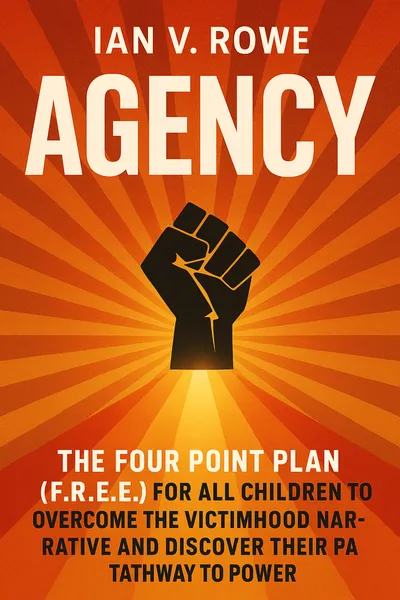
Agency
Against determinism, for choice
Description
Ian V. Rowe presents a provocative intervention in contemporary debates surrounding social mobility and systemic inequality in America. Drawing upon his extensive background in educational policy and social entrepreneurship, Rowe challenges prevailing narratives that emphasize structural determinism over individual empowerment. The work emerges within a polarized intellectual landscape where discussions of inequality oscillate between purely structural and purely individual explanations, positioning itself as a bridge between these seemingly irreconcilable perspectives.
The central research question driving Rowe's analysis asks: How can individuals transcend structural barriers through the cultivation of personal agency while acknowledging systemic constraints? His defended thesis argues that personal agency, manifested through educational achievement, character development, and strategic life choices, represents the most effective mechanism for achieving social mobility regardless of background circumstances. The main stake of his argument lies in demonstrating that empowerment through agency constitutes a more effective approach to addressing inequality than exclusive focus on structural reform.
Rowe's intellectual contribution lies in articulating a coherent alternative to dominant narratives about inequality and social mobility. His synthesis demonstrates how agency-centered approaches can acknowledge structural constraints while maintaining focus on individual empowerment. The work's coherence emerges through its consistent emphasis on practical strategies grounded in empirical evidence rather than ideological positioning. The author succeeds in demonstrating that agency and structure need not be viewed as competing explanations but as interactive elements in a complex system. His framework provides actionable insights for individuals, educators, and policymakers while avoiding both naive individualism and deterministic structuralism.
Table of contents
01 The Theoretical Framework of Agency
Rowe constructs his theoretical edifice upon a sophisticated understanding of agency that transcends simplistic notions of individual choice. His conceptualization draws from multiple disciplinary traditions, incorporating elements of behavioral economics, educational psychology, and sociological theories of social capital. The author presents agency not as unfettered free will, but as the capacity to navigate and transform constraints through strategic action and mindset cultivation.

02 Educational Pathways and Social Mobility
The empirical foundation of Rowe's argument rests heavily upon educational interventions and their measurable impacts on life trajectories. His analysis reveals how strategic educational choices, particularly those emphasizing character development alongside academic achievement, create multiplier effects that extend beyond individual students to influence family and community dynamics.
03 Cultural Capital and Identity Formation
Rowe's third analytical axis explores the complex relationship between cultural identity and social mobility. He navigates the tension between maintaining authentic cultural connections and acquiring dominant cultural capital necessary for advancement. This analysis reveals the psychological and social costs of mobility while arguing for strategies that minimize these trade-offs.
04 Ethical Dimensions and Social Responsibility
The final analytical dimension addresses the moral implications of agency-centered approaches to social problems. Rowe confronts accusations that emphasis on individual responsibility constitutes victim-blaming, arguing instead that denying agency to disadvantaged populations represents a more profound form of dehumanization. His ethical framework positions empowerment as both a practical strategy and a moral imperative.
05 Critical Assessment and Future Directions
Despite its theoretical sophistication, Rowe's analysis exhibits certain limitations that constrain its explanatory power. The work's emphasis on educational pathways, while empirically grounded, may underestimate the persistence of structural barriers in other domains such as criminal justice, healthcare, and housing. Additionally, the focus on individual agency risks obscuring the ways in which successful mobility often depends upon exceptional circumstances or supports unavailable to most disadvantaged individuals.
The author's background in educational entrepreneurship may introduce systematic bias toward solutions that align with his professional experience and institutional affiliations. This creates potential blind spots regarding alternative approaches to addressing inequality that do not center educational intervention.
Related books