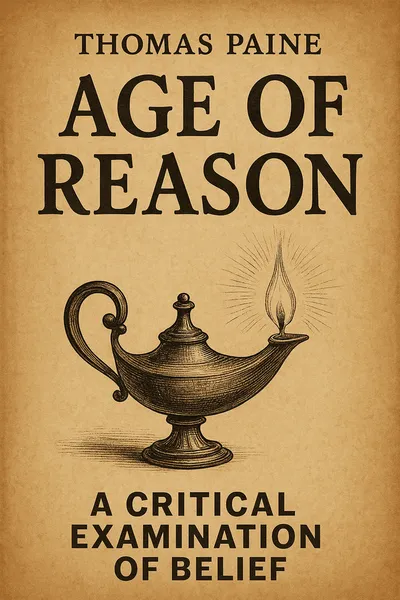
Age of Reason
A critical examination of belief
Description
Thomas Paine's "The Age of Reason" emerges from the radical intellectual ferment of late eighteenth-century Enlightenment thought, positioning itself as a systematic critique of organized Christianity and institutionalized religion. Written during Paine's imprisonment in revolutionary France, this work represents the culmination of Enlightenment deistic philosophy applied to theological questions. Paine approaches religious belief through the lens of natural philosophy and rational skepticism, challenging ecclesiastical authority and scriptural literalism. The text situates itself within broader debates surrounding secularization, scientific rationalism, and the relationship between religious institutions and political power that characterized the revolutionary period.
The central research question driving Paine's analysis is: How can rational inquiry replace superstition and institutional religious authority in humanity's understanding of divinity and moral conduct? His defended thesis maintains that true religion consists in the application of human reason to natural phenomena rather than acceptance of revealed scripture and ecclesiastical doctrine. The main stake of this argument involves liberating human consciousness from the intellectual and political tyranny of organized religious institutions while preserving belief in divine existence through natural theology.
Paine's comprehensive critique of organized Christianity establishes rational inquiry as the proper foundation for religious belief and moral conduct. His deistic alternative preserves divine existence while eliminating supernatural elements that conflict with natural philosophy and democratic principles. The work's intellectual coherence derives from its consistent application of Enlightenment rationalism to theological questions, demonstrating systematic connections between religious reform and political liberation. Paine's synthesis of natural theology, institutional criticism, and moral philosophy creates a unified framework for understanding religion's proper role in rational society. His argument ultimately subordinates religious authority to democratic reason while maintaining spiritual dimension in human experience.
Table of contents
01 Natural Deism Against Revealed Religion
Paine constructs a fundamental opposition between natural religion, derived from rational observation of the universe, and revealed religion, dependent upon scriptural authority and clerical interpretation. His deistic framework posits that divine existence becomes evident through contemplation of natural laws and cosmic order, rendering supernatural revelation superfluous. This epistemological stance reflects broader Enlightenment confidence in human reason's capacity to discern truth independently of traditional authorities.

02 Religious Institutions as Political Control Mechanisms
The text develops a sustained analysis of Christianity's political dimensions, examining how religious institutions function as instruments of social control and political domination. Paine argues that established churches perpetuate ignorance and dependency by monopolizing religious interpretation and maintaining artificial distinctions between clergy and laity. His critique extends beyond theological disagreement to encompass sociological analysis of religion's role in legitimizing existing power structures.
03 Biblical Criticism and Historical Methodology
Paine employs proto-historical critical methods to examine biblical texts, questioning their authorship, chronology, and internal consistency. His textual analysis anticipates later biblical scholarship by treating scripture as human historical documents subject to rational evaluation rather than divinely inspired revelation immune from criticism. This methodological approach represents a significant departure from traditional hermeneutics, applying secular scholarly standards to religious texts.
04 Rational Moral Philosophy and Social Ethics
The work articulates a natural moral philosophy grounded in rational reflection rather than divine commandment, arguing that ethical principles emerge from human reason applied to social existence. Paine contends that genuine morality requires autonomous moral judgment rather than heteronomous obedience to religious authority. His ethical framework emphasizes universal principles discoverable through reason and applicable across cultural boundaries, rejecting particularistic religious moral systems.
05 Critical Assessment and Contemporary Relevance
Paine's analysis exhibits characteristic Enlightenment limitations in its optimistic assessment of reason's capacity to resolve religious and moral questions definitively. His deistic theology relies upon teleological assumptions about natural order that subsequent scientific developments have complicated. The work's cultural specificity, focused primarily on Christian contexts, limits its applicability to non-Western religious traditions. Paine's institutional critique, while penetrating, underestimates religion's positive social functions and community-building capacities. His historical methodology, though innovative for its time, lacks sophisticated hermeneutical awareness of interpretive complexity.
Related books