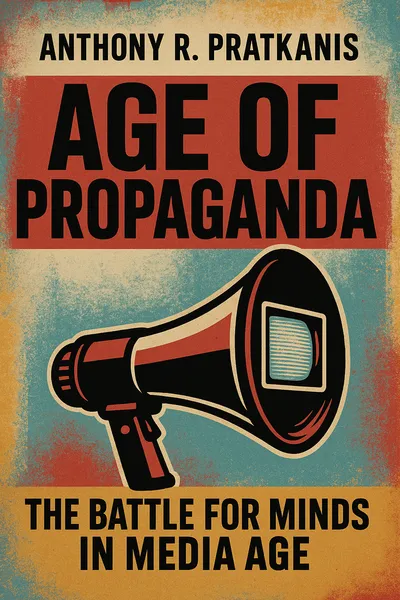
Age of Propaganda
The battle for minds in media age
Description
Pratkanis presents a comprehensive examination of contemporary persuasion techniques within the framework of mass media saturation and democratic degradation. Writing from his expertise in social psychology, the author situates his analysis within the broader context of American media dominance and its global implications. The work emerges from growing concerns about the quality of public discourse in late twentieth-century democracies, where traditional deliberative processes face unprecedented challenges from sophisticated influence campaigns.
The central research question driving this work is: How do modern propaganda techniques undermine democratic deliberation and what psychological mechanisms make citizens vulnerable to manipulative messaging? Pratkanis defends the thesis that contemporary society has entered an unprecedented era where propaganda techniques have evolved beyond traditional models, exploiting psychological vulnerabilities to replace reasoned discourse with emotional manipulation. The main stake is to demonstrate that the proliferation of sophisticated persuasion techniques poses an existential threat to democratic governance by eroding citizens' capacity for critical evaluation of information.
The author's analysis reveals the inadequacy of traditional defenses against propaganda, showing how classical approaches focused on obvious persuasion attempts fail to address subtle psychological manipulation. The work establishes that the problem extends beyond partisan political communication to encompass broader patterns of commercial and institutional influence that shape public consciousness. The work synthesizes psychological research with political analysis to demonstrate how modern influence campaigns exploit cognitive vulnerabilities in ways that fundamentally alter the conditions for democratic participation.
Table of contents
01 The Psychology of Modern Influence
Pratkanis establishes a theoretical foundation rooted in cognitive psychology to explain contemporary propaganda's effectiveness. The author demonstrates how modern influence techniques exploit fundamental cognitive biases and heuristic processing that govern human decision-making. Unlike classical propaganda models focused on obvious persuasion attempts, contemporary approaches operate through subtle manipulation of cognitive shortcuts and emotional triggers.

02 Media Saturation and Democratic Discourse
The examination of media omnipresence reveals how quantitative changes in information exposure produce qualitative transformations in democratic participation. Pratkanis analyzes how the sheer volume of mediated messages creates cognitive overload, forcing citizens to rely increasingly on simplified decision-making strategies that propaganda techniques can easily exploit.
03 The Erosion of Critical Discourse
Pratkanis identifies fundamental tensions between democratic ideals and contemporary communication practices. The work reveals how sophisticated influence techniques create artificial consensus and manufacture apparent public support for positions that may lack genuine popular backing. This analysis exposes the paradox of increased information availability coinciding with decreased quality of public reasoning.
04 Ethical and Societal Implications
The final analytical axis addresses the broader societal consequences of propaganda proliferation. Pratkanis explores how the degradation of public discourse affects social cohesion, institutional legitimacy, and democratic governance capacity. The analysis reveals how propaganda techniques contribute to political polarization and social fragmentation by exploiting existing divisions and creating artificial controversies.
05 Critical Assessment and Future Implications
Despite its valuable insights, Pratkanis's analysis suffers from several limitations. The work occasionally overstates the novelty of contemporary propaganda techniques, underestimating historical precedents for sophisticated influence campaigns. The author's psychological focus, while illuminating, sometimes neglects structural economic and political factors that enable propaganda proliferation.
The analysis also tends toward technological determinism, attributing excessive causal power to media technologies while underemphasizing human agency and resistance capabilities. Additionally, the work provides limited attention to cross-cultural variations in propaganda effectiveness, potentially overgeneralizing from American experiences.
Related books