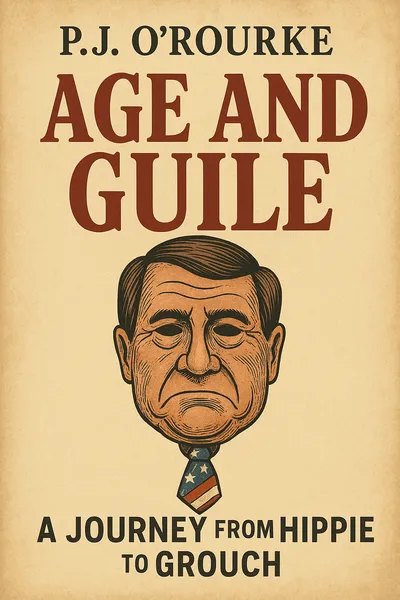
Age and Guile
A journey from hippie to grouch
Description
P.J. O'Rourke presents a retrospective examination of his personal political evolution, tracing his journey from countercultural activist to conservative commentator in "Age and Guile." The work operates simultaneously as memoir and cultural analysis, positioning the author's transformation as emblematic of broader generational shifts in American political consciousness. Through this autobiographical lens, O'Rourke explores the tensions between ideological purity and practical governance, between youthful rebellion and mature responsibility.
The author leverages his established satirical voice to interrogate both his former beliefs and current positions, creating a work that functions as both personal confession and social commentary on the political maturation of the Baby Boom generation. The central thesis defended throughout the work is that the evolution from liberal idealism to conservative pragmatism represents intellectual growth rather than ideological betrayal, demonstrating how life experience necessarily modifies political understanding.
O'Rourke's central research question examines how the transition from youthful radicalism to mature conservatism reflects broader changes in American political culture and individual psychological development. The work's main stake is to legitimize political transformation as natural development while challenging both progressive assumptions about moral superiority and conservative claims about inherent wisdom.
Table of contents
01 The Dialectics of Generational Political Identity
O'Rourke's analysis reveals the complex mechanisms through which generational political identity formation occurs within specific historical contexts. The author demonstrates how the countercultural movements of the 1960s provided a framework for political engagement that ultimately contained the seeds of its own transformation. His examination of this process illuminates the ways in which political beliefs function not merely as intellectual positions but as identity markers deeply embedded in social and psychological structures.

02 The Sociology of Ideological Conversion
The work examines how material conditions and life experience interact with abstract political principles to produce ideological transformation. O'Rourke's analysis demonstrates the ways in which changing social position—through career advancement, family formation, and property acquisition—creates new interests that challenge previously held beliefs. This examination reveals the material basis underlying apparently abstract political commitments.
His treatment of this theme exposes the class dynamics inherent in political transformation, showing how upward mobility creates incentives for conservative political alignment. The author's analysis suggests that political beliefs often function as post-hoc rationalizations for materially determined interests rather than as independently derived principles. This perspective challenges both progressive narratives about enlightened political consciousness and conservative claims about principled ideological commitment.
03 Cultural Capital and Political Legitimacy
O'Rourke's examination reveals the complex relationship between cultural capital and political authority within American intellectual discourse. His analysis shows how the transformation from countercultural rebel to conservative commentator requires navigation of competing legitimacy structures, each with distinct criteria for authentic political voice. The work explores how political transformation necessitates renegotiation of cultural position and intellectual authority.
04 The Ethics of Political Evolution
The work addresses fundamental questions about the moral implications of political transformation, examining whether ideological change represents growth or betrayal. O'Rourke's analysis challenges essentialist notions of political identity while defending the ethical legitimacy of belief evolution. His treatment of this theme reveals the moral complexity inherent in political commitment and change.
The author's examination demonstrates how political transformation creates ethical obligations toward both former and current belief systems. His analysis shows the necessity of acknowledging error without undermining the sincerity of previous commitments, while defending current positions without claiming infallibility. This perspective reveals the moral sophistication required for authentic political evolution.
05 Critical Assessment and Contemporary Relevance
O'Rourke's work presents a sophisticated analysis of political transformation that challenges conventional narratives about ideological development and change. Through his examination of personal political evolution, the author demonstrates the complex interplay of material conditions, social position, and intellectual development in shaping political belief. His analysis reveals political identity as dynamic and contextual rather than fixed and essential.
The work's contribution lies in its demonstration of how political transformation can represent intellectual growth rather than moral failure. O'Rourke's analysis provides a framework for understanding ideological change as natural development rather than betrayal, while acknowledging the material and social factors that influence political belief formation. His treatment offers insights into the relationship between personal experience and political commitment that transcend his specific ideological trajectory.
Related books