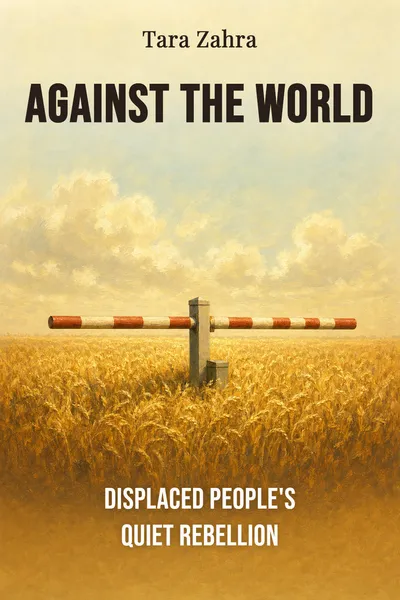
Against The World
Displaced people's quiet rebellion
Description
Tara Zahra's "Against The World" presents a groundbreaking examination of displacement and resistance in interwar Europe, arguing that the period witnessed the emergence of new forms of resistance to nationalist orthodoxies through the lived experiences of displaced populations who challenged fixed notions of belonging and citizenship. The work positions itself within contemporary debates about nationalism and belonging, offering historical perspective on current global migration crises. Zahra's analysis spans the tumultuous decades between the World Wars, when millions found themselves displaced by shifting borders, ethnic cleansing, and political upheaval across Central and Eastern Europe.
The central research question explores how displaced populations in interwar Europe navigated and resisted the increasingly rigid demands of nationalist states for exclusive loyalty and belonging. The defended thesis maintains that displaced individuals and communities developed alternative forms of identification and solidarity that transcended national boundaries, effectively challenging the hegemonic nationalist discourse of the era. The main stake of this work is to demonstrate that resistance to nationalism emerged not from elite intellectual circles but from the everyday practices and survival strategies of ordinary displaced people.
Zahra's intellectual contribution lies in her demonstration that resistance to nationalism emerged organically from the experiences of displacement rather than from theoretical or political movements. Her synthesis of archival research with theoretical sophistication reveals the coherent logic underlying seemingly fragmented experiences of displacement. The work successfully challenges linear narratives of assimilation and integration by showing how displaced populations maintained agency while adapting to changing circumstances. Zahra's analysis demonstrates that the interwar period witnessed not only the consolidation of nationalist states but also the emergence of alternative forms of political belonging that transcended territorial boundaries. The coherence of her argument rests on the recognition that displacement generated its own forms of knowledge and resistance that challenged dominant political orthodoxies.
Table of contents
01 Theoretical Frameworks and Analytical Approach
Zahra's analytical approach draws heavily from postcolonial theory and subaltern studies to illuminate how displaced populations exercised agency within constrained circumstances. The author employs James C. Scott's concept of hidden transcripts to reveal how refugees and displaced persons developed covert forms of resistance against state categorization.

02 Statelessness, Politics of Belonging, and Institutional Resistance
The examination of statelessness reveals how the interwar European state system created categories of belonging that excluded millions from political membership. Zahra demonstrates how the League of Nations' refugee regime, while ostensibly humanitarian, reinforced nationalist logic by treating displacement as temporary aberration requiring eventual reintegration into national communities. Her analysis reveals how displaced populations subverted these expectations by creating parallel institutions, maintaining transnational networks, and developing alternative economies that operated across national boundaries.
03 Cultural Resistance and Identity Formation Among Displaced Populations
Zahra's exploration of cultural resistance illuminates how displaced communities maintained and transformed their identities while resisting assimilationist pressures. The analysis reveals tensions between preservation and adaptation, showing how displaced populations selectively adopted elements from host societies while maintaining core cultural practices. Language emerged as a particularly contested terrain, with displaced communities using multilingualism as both survival strategy and resistance tool.
04 Ethical Implications and Contemporary Relevance
The ethical dimensions of Zahra's analysis extend beyond historical documentation to engage with contemporary debates about hospitality, citizenship, and human rights. Her examination of how host societies responded to displacement reveals patterns of exclusion that persist in contemporary migration policies. The author demonstrates how humanitarian discourse often masked exclusionary practices, with assistance programs designed to manage rather than integrate displaced populations.
05 Critical Assessment and Future Directions
Despite its analytical sophistication, Zahra's work exhibits certain limitations that constrain its explanatory power. The focus on Central and Eastern Europe, while historically justified, limits the generalizability of findings to other contexts of displacement. The author's emphasis on resistance risks romanticizing displacement experiences while underplaying the genuine trauma and loss experienced by displaced populations. Additionally, the work's theoretical framework, heavily influenced by postmodern approaches to identity, may obscure material inequalities and power relations that shaped displacement experiences. The analysis could benefit from greater attention to class differences among displaced populations and how economic resources influenced resistance strategies.
Related books