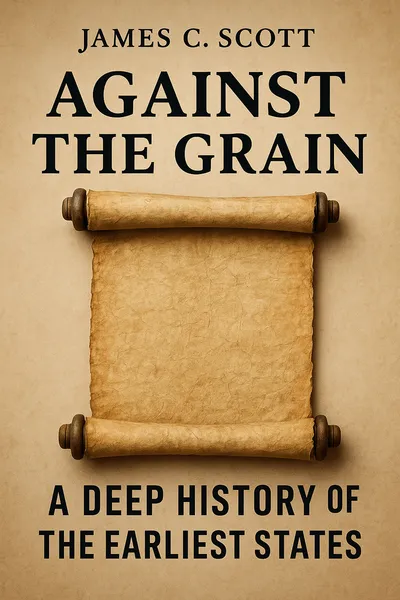
Against the Grain
A Deep History of the Earliest States
Description
Scott's latest contribution interrogates one of civilization's foundational narratives by challenging the conventional wisdom surrounding the Neolithic Revolution. Drawing upon archaeological evidence and anthropological insights, the work positions itself against triumphalist accounts of agricultural development and state formation. The author leverages his expertise in resistance studies and state critique to reexamine the transition from foraging to farming societies, questioning whether this transformation represented genuine progress or a costly detour in human development.
The central research question asks: Why did humans abandon relatively egalitarian and sustainable hunter-gatherer lifestyles for the hierarchical constraints of agricultural states? Scott's defended thesis argues that early state formation was a fragile, coercive process that imposed significant costs on human welfare, health, and freedom while benefiting only narrow elites. The main stake is to deconstruct the civilizational narrative that portrays agriculture and state formation as unqualified human achievements.
Scott's comprehensive critique demonstrates remarkable intellectual coherence in challenging one of the most persistent narratives in human history. The work successfully integrates archaeological evidence, anthropological theory, and political analysis to construct a compelling alternative account of early state formation. By systematically deconstructing assumptions about agricultural progress and civilizational development, Scott forces readers to confront uncomfortable truths about the costs of political centralization and environmental manipulation. The argument's strength lies in its interdisciplinary approach and willingness to question fundamental premises of social scientific inquiry. Scott's synthesis reveals how conventional periodization schemes and developmental models obscure the agency and sophistication of non-state societies while naturalizing forms of domination that are historically contingent. The intellectual contribution extends beyond historical revisionism to offer theoretical tools for understanding contemporary patterns of state power and resistance.
Table of contents
01 The Myth of Agricultural Progress
Scott's deconstruction of agricultural triumphalism reveals the profound theoretical implications of rethinking the Neolithic Revolution. Rather than accepting the conventional narrative of inevitable progress from barbarism to civilization, the analysis exposes how archaeological evidence contradicts assumptions about improved nutrition, health, and social organization under early agriculture. The transition from diverse foraging strategies to grain-based monocultures represented a narrowing of subsistence options that increased vulnerability to environmental shocks and social stratification.

02 The Coercive Architecture of Early States
The examination of state formation processes reveals the fundamentally coercive nature of early political centralization. Scott's analysis illuminates how agricultural surplus provided the material basis for supporting non-productive elites, professional armies, and administrative bureaucracies, but only through systematic exploitation of cultivators. The concentration of grain production created opportunities for taxation, conscription, and social control that were impossible in dispersed foraging societies.
03 Ecological Crisis and Social Fragmentation
The deepening analysis of early agricultural societies reveals fundamental tensions between environmental sustainability and political centralization. Scott exposes how intensive grain cultivation led to soil depletion, deforestation, and ecological degradation that undermined the long-term viability of early states. These environmental pressures created recurring crises that destabilized political arrangements and forced populations to develop adaptive strategies, including flight to peripheral areas beyond state control.
04 The Ethics of Civilizational Critique
The final analytical dimension addresses the profound ethical implications of questioning civilizational narratives. Scott's critique raises uncomfortable questions about contemporary assumptions regarding development, progress, and social organization. If early states represented costly detours rather than advances in human organization, what does this suggest about modern state systems and their claims to legitimacy? The analysis implies that much of what we consider civilizational achievement may have been purchased through systematic exploitation and environmental degradation.
05 Critical Assessment and Future Directions
Despite its analytical sophistication, Scott's work exhibits certain limitations that constrain its explanatory power. The emphasis on coercion and exploitation, while empirically grounded, sometimes obscures the genuine innovations and adaptive advantages that agricultural states provided under specific historical circumstances. The analysis risks romanticizing hunter-gatherer societies by focusing primarily on their egalitarian aspects while minimizing evidence of violence, resource constraints, and social tensions within foraging communities.
Additionally, the work's focus on early states in the Middle East and Mediterranean regions limits its global applicability. Alternative pathways to agricultural development and state formation in other regions may not conform to the coercive patterns Scott identifies, suggesting that his model may be more historically specific than universal. The critique also tends to underestimate the role of environmental pressures and demographic changes in driving agricultural transitions, potentially overstating the degree of choice involved in these transformations.
Related books