

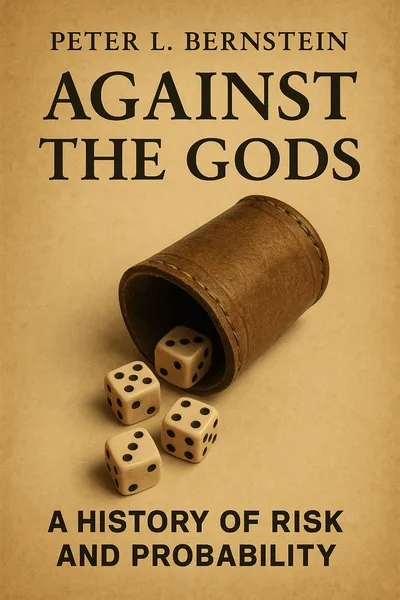
Against the Gods
A history of risk and probability
Description
Bernstein's work emerges within the broader intellectual tradition examining the intersection of mathematics, economics, and human behavior. Drawing upon his extensive background in financial analysis and historical scholarship, the author constructs a sweeping narrative that traces humanity's evolving relationship with uncertainty. The work positions itself as both historical chronicle and philosophical meditation, arguing that the development of probability theory constitutes a revolutionary transformation in human consciousness. This ambitious undertaking reflects contemporary anxieties about market volatility and decision-making under uncertainty, particularly relevant during periods of financial upheaval.
The mastery of risk through mathematical probability represents humanity's greatest intellectual achievement, fundamentally transforming our capacity to make decisions and shape the future. Central research question: How did humanity transition from passive acceptance of fate to active management of risk through mathematical understanding? Defended thesis: The development of probability theory and risk assessment represents the defining boundary between ancient and modern modes of thought. Main stake: To demonstrate that mathematical approaches to uncertainty constitute the foundation of modern civilization's capacity for progress and rational decision-making.
Bernstein constructs a compelling narrative demonstrating probability theory's central role in constituting modern consciousness and social organization. His historical analysis reveals the profound transformation involved in moving from fatalistic acceptance to mathematical mastery of uncertainty. The work successfully demonstrates how technical developments in mathematics translated into wholesale reorganization of economic institutions and social relationships. The author's interdisciplinary approach effectively bridges mathematical history, economic analysis, and social theory, creating a coherent account of risk thinking's emergence and evolution. Bernstein's narrative maintains intellectual coherence while addressing multiple dimensions of his subject, from abstract mathematical developments to concrete institutional applications.
Table of contents
01The Archaeological Foundations of Rational Uncertainty
Bernstein's historical excavation reveals the profound epistemological shift underlying modern risk consciousness. The author traces how ancient civilizations, dominated by fatalistic worldviews and divine determinism, gradually yielded to mathematical frameworks that rendered uncertainty calculable. This transformation emerges not as mere technical advancement but as fundamental restructuring of human agency itself.
The theoretical framework employed draws heavily from both mathematical history and philosophy of science, demonstrating how Pascal and Fermat's correspondence inaugurated entirely new categories of thought. Bernstein illuminates how these mathematical innovations transcended their gaming origins to become tools of social organization and economic planning. The conceptual apparatus reveals probability theory as simultaneously descriptive and prescriptive, offering both analytical tools and normative frameworks for decision-making.

02Institutional Transformations and Market Rationalization
The sociological implications of Bernstein's analysis extend far beyond mathematical development to encompass wholesale reorganization of social institutions. Insurance companies, stock markets, and banking systems emerge as concrete manifestations of probabilistic thinking, transforming abstract mathematical concepts into operational social machinery.
Bernstein demonstrates how risk quantification enabled unprecedented forms of collective action and resource allocation. The author's examination reveals how markets themselves function as vast computational systems, aggregating individual risk assessments into collective pricing mechanisms. This institutional analysis exposes the profound political dimensions of risk management, as mathematical frameworks become tools of social control and economic organization.
03Epistemological Tensions and the Limits of Calculation
Bernstein's narrative encounters significant theoretical tensions when confronting the boundaries of probabilistic reasoning. The author grapples with inherent contradictions between mathematical elegance and empirical messiness, revealing how real-world applications consistently exceed theoretical frameworks.
The analysis exposes fundamental ruptures within risk thinking itself, particularly the tension between frequency-based probability and subjective judgment. Bernstein illustrates how financial markets regularly experience events that exceed probabilistic models, suggesting inherent limitations in mathematical approaches to uncertainty. These breakdowns reveal not mere technical inadequacies but deeper philosophical problems regarding the nature of uncertainty itself.
04Ethical Implications and Social Responsibility
The ethical dimensions of Bernstein's analysis raise profound questions about the social distribution of risk and the moral implications of probabilistic thinking. The author's framework reveals how risk calculation often obscures questions of justice and responsibility, replacing ethical judgment with technical computation.
Bernstein's treatment exposes how probabilistic institutions can legitimize inequality by rendering social outcomes as natural consequences of risk-taking behavior. The mathematical apparatus provides seemingly objective justification for distributional outcomes while obscuring underlying power relations and structural constraints. This transforms moral questions into technical problems, potentially undermining democratic deliberation about social priorities.
05Critical Assessment and Contemporary Relevance
Despite its ambitious scope, Bernstein's analysis exhibits several significant limitations. The work's emphasis on mathematical rationality tends to marginalize alternative approaches to uncertainty, potentially reproducing Western bias toward quantitative reasoning. The author's celebration of probabilistic thinking sometimes obscures its role in legitimizing exploitative practices and social inequalities.
The historical narrative occasionally oversimplifies complex cultural transformations, reducing diverse intellectual traditions to teleological progression toward mathematical rationality. Bernstein's treatment of non-Western approaches to uncertainty remains superficial, limiting the work's cross-cultural relevance and analytical depth.