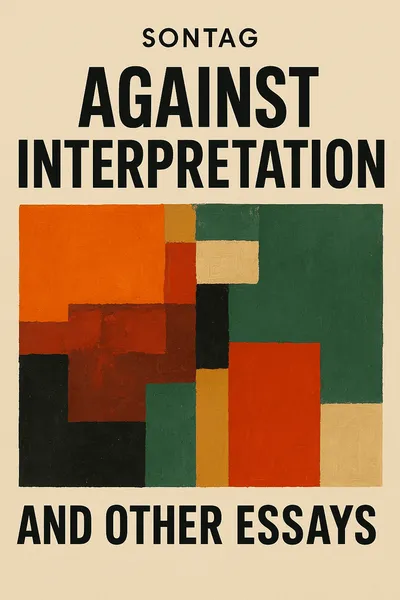
Against Interpretation
And Other Essays
Description
Published in 1966, Against Interpretation crystallizes Sontag's rebellion against the dominant hermeneutic traditions that had colonized aesthetic discourse throughout the mid-twentieth century. Writing during an era when psychoanalytic, Marxist, and symbolic interpretations proliferated across academic and critical circles, Sontag positions herself as a defender of art's autonomous reality. Her intervention occurs at a crucial historical moment when American intellectual culture was increasingly absorbing European theoretical frameworks, often at the expense of direct aesthetic engagement.
Sontag's central research question asks: How can contemporary culture restore immediate aesthetic experience against the tyranny of interpretative frameworks that reduce art to mere content? Her defended thesis maintains that interpretation, as traditionally practiced, constitutes an act of violence against artistic works, substituting meaning for presence and reducing aesthetic complexity to conceptual simplification. The main stake of her argument is to rehabilitate sensuous engagement with art and establish an erotics of aesthetic experience that privileges form over hermeneutic excavation.
The work's intellectual contribution lies in its systematic critique of interpretation as cultural practice while proposing alternative approaches to aesthetic engagement. The theoretical synthesis she achieves successfully bridges formalist aesthetic theory with broader cultural criticism, demonstrating how aesthetic questions connect to fundamental issues of cultural health and intellectual integrity. Her position remains internally consistent while generating productive tensions that continue to influence contemporary aesthetic discourse.
Table of contents
01The Violence of Hermeneutic Reduction
Sontag's foundational argument rests upon diagnosing interpretation as a fundamentally aggressive enterprise that transforms aesthetic objects into vehicles for predetermined theoretical agendas. Her critique targets the systematic tendency within academic and critical discourse to treat artworks as puzzles requiring decoding rather than experiences demanding direct engagement. This hermeneutic violence manifests through the compulsive search for hidden meanings, symbolic structures, and allegorical dimensions that ultimately obscure the work's material presence.

02Cultural Pathology and Critical Discourse
The second major axis of Sontag's analysis concerns the broader cultural pathology that generates interpretative compulsion within contemporary society. She identifies interpretation as symptomatic of a civilization increasingly alienated from direct sensuous engagement with reality. This cultural diagnosis extends beyond aesthetic criticism to encompass wider patterns of mediation that characterize modern existence.
03Form, Surface, and Aesthetic Immediacy
Sontag's positive program emerges through her advocacy for formal analysis that respects art's surface manifestations rather than excavating presumed depths. Her conception of aesthetic experience privileges the how over the what, emphasizing technical execution, material properties, and structural relationships. This formalist orientation challenges both traditional humanistic interpretation and emerging sociological approaches that reduce art to social documentation.
04Ethical Dimensions and Cultural Responsibility
The ethical implications of Sontag's position extend beyond aesthetic theory to encompass broader questions of cultural responsibility and intellectual honesty. Her critique of interpretation carries implicit moral weight, positioning direct aesthetic engagement as more authentic and respectful toward artistic creation than hermeneutic manipulation. This ethical dimension suggests that interpretative practices reflect deeper cultural problems regarding authority, authenticity, and genuine encounter.
05Critical Assessment and Contemporary Relevance
Sontag's position contains several significant limitations that compromise its theoretical adequacy. Her opposition between interpretation and immediate experience relies upon problematic assumptions about aesthetic transparency and the possibility of theory-free engagement. The work lacks sufficient recognition of interpretation's unavoidable role in any aesthetic encounter, including her own theoretical intervention. Additionally, her critique sometimes conflates legitimate hermeneutic inquiry with reductive interpretative practices, potentially undermining valuable analytical approaches.
Related books