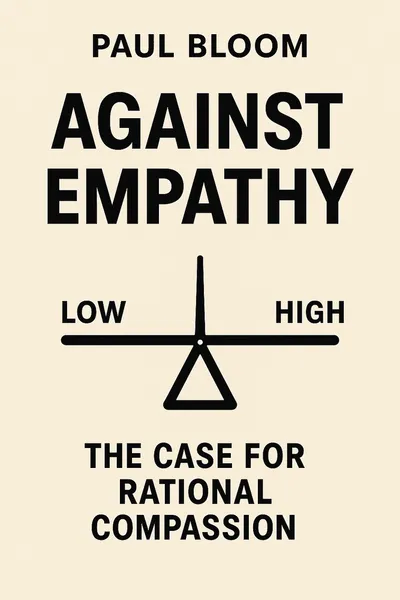
Against Empathy
Why reason beats moral feeling
Description
Paul Bloom's provocative treatise challenges one of contemporary society's most cherished assumptions about human morality. Writing against the backdrop of increasing calls for empathetic leadership in politics, education, and social policy, Bloom positions himself as a contrarian voice questioning empathy's moral supremacy. His work emerges from decades of experimental research in moral psychology, challenging popular narratives promoted by figures like Barack Obama and organizations advocating for empathy-based interventions. The book situates itself within broader debates about emotion versus reason in ethical decision-making, drawing from evolutionary psychology, neuroscience, and moral philosophy.
Bloom's central research question asks: Is empathy truly the foundation of moral behavior, or does it systematically distort our ethical judgments? His defended thesis argues that empathy is a biased, parochial emotion that leads to poor moral decisions and should be replaced by rational compassion. The main stake involves fundamentally reconceptualizing the relationship between emotion and morality in contemporary ethical frameworks, challenging readers to reconsider deeply held assumptions about what makes actions truly moral.
Table of contents
01The Systematic Biases of Empathic Morality
Bloom's deconstruction of empathy begins with a fundamental categorical distinction that challenges popular discourse. Rather than treating empathy as a monolithic virtue, he dissects it into cognitive empathy—understanding others' mental states—and affective empathy—feeling others' emotions. This analytical separation reveals empathy's inherent limitations as a moral guide. The author demonstrates how affective empathy operates like a spotlight, illuminating certain individuals while leaving others in darkness, creating systematic biases that favor the identifiable, similar, and proximate over the statistical, different, and distant.

02Empathy in Politics and Policy Formation
The author's analysis extends empathy's failures into the political realm, revealing how empathic appeals systematically distort public policy formation. Bloom examines how political movements exploit empathic responses through strategic use of individual narratives, photographs, and personal testimonies that trigger emotional responses while obscuring broader statistical realities. This empathic politics creates policy frameworks that respond to dramatic, visible suffering while systematically neglecting more extensive but less emotionally salient problems.
03The Empathic Paradox of Violence
Bloom's most provocative argument concerns empathy's relationship to violence and aggression. Contrary to conventional wisdom positioning empathy as violence's antithesis, he demonstrates how empathic concern for particular individuals or groups frequently motivates aggressive behavior toward others. This empathic violence manifests in parental aggression protecting children, nationalistic violence defending compatriots, and revenge seeking justice for victims with whom one empathically identifies.
04Rational Compassion as Moral Alternative
Having deconstructed empathy's moral claims, Bloom constructs an alternative ethical framework based on rational compassion. This approach combines concern for others' wellbeing with impartial reasoning that resists empathy's biases toward the vivid, similar, and proximate. Rational compassion draws from utilitarian traditions emphasizing aggregate welfare while incorporating insights from effective altruism movements that use evidence-based approaches to maximize positive impact.
05Critical Assessment and Future Directions
Bloom's systematic critique reveals empathy as a morally ambiguous emotion whose limitations outweigh its benefits in complex contemporary contexts. His argument successfully demonstrates empathy's systematic biases, its complicity in violence and discrimination, and its inadequacy for addressing large-scale moral challenges requiring impartial consideration. The alternative framework of rational compassion provides a coherent response to empathy's failures while preserving genuine concern for human welfare.
Despite its analytical rigor, Bloom's argument suffers from several significant limitations. His characterization of empathy remains somewhat narrow, potentially overlooking more sophisticated forms of empathic engagement that incorporate reflective and imaginative capacities. The sharp distinction between empathy and rational compassion may create false dichotomies that obscure their potential complementarity in moral reasoning. Additionally, the work's emphasis on utilitarian frameworks risks reproducing other forms of bias while claiming neutrality. The analysis also underestimates empathy's role in moral motivation and social coordination.
Related books