
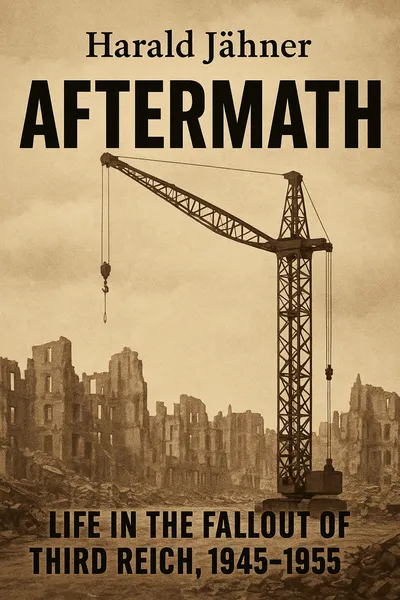
Aftermath
Germans rebuilt themselves from within
Description
"Aftermath" by Harald Jähner presents a comprehensive examination of the profound cultural and social revolution that transformed German society between 1945 and 1955. The book's central thesis argues that post-war Germany experienced fundamental reshaping through a complex interplay of liberation, reconstruction, and moral reckoning that went far beyond institutional reform.
Jähner challenges conventional narratives that emphasize political and institutional rebuilding by demonstrating that Germany's true transformation occurred through spontaneous cultural reinvention. His central research question explores how German society culturally and socially reinvented itself in the decade following total defeat and occupation. The author contends that the immediate post-war period constituted a profound cultural revolution that transformed German society more radically than any institutional reform, with Germany's transformation occurring not through political denazification but through spontaneous cultural reinvention.
The book's main stake is to reveal how social practices, gender relations, and collective mentalities underwent radical reconfiguration during this pivotal period. Jähner demonstrates that Germans actively participated in their own cultural reformation, not merely as passive recipients of Allied programs but as agents of social reinvention. This perspective challenges deterministic interpretations of post-war transformation, revealing how spontaneous cultural dynamics often preceded and shaped institutional changes. The work situates itself within broader historiographical discourse on German reconstruction while offering a unique cultural lens that decodes the symbolic dimensions of Germany's post-war metamorphosis.
Table of contents
01The Archaeology of Cultural Rupture
Jähner's analytical framework excavates the layers of cultural transformation that emerged from Germany's civilizational collapse. His approach transcends traditional historiography by examining how social practices, aesthetic preferences, and interpersonal relations underwent fundamental reconfiguration. The author demonstrates how the complete breakdown of institutional authority created unprecedented spaces for cultural experimentation and social innovation.

02Gender Relations and Social Reconfiguration
The examination of transformed gender relations reveals how traditional social hierarchies collapsed and reconstituted themselves through new configurations of power and intimacy. Jähner analyzes how women's wartime experiences fundamentally altered domestic arrangements, professional expectations, and romantic practices. This transformation extended beyond mere economic necessity to encompass fundamental shifts in gender identity and social positioning.
03Material Culture and Symbolic Reconstruction
Jähner's analysis of material culture reveals how objects, spaces, and aesthetic choices became vehicles for expressing transformed social identities. The scarcity economy paradoxically stimulated creative adaptation and aesthetic innovation, as Germans developed new relationships with consumer goods, domestic spaces, and public environments. This material transformation reflected deeper shifts in values, aspirations, and collective self-understanding.
04Memory, Guilt, and Moral Reconfiguration
The ethical dimensions of post-war transformation reveal how Germans navigated the complex relationship between acknowledgment of past crimes and construction of future identities. Jähner examines how moral reckoning occurred not primarily through formal denazification procedures but through subtle shifts in cultural practices, social interactions, and collective narratives. This process involved selective memory, strategic forgetting, and gradual moral reorientation.
05Critical Assessment and Contemporary Relevance
Jähner's analysis demonstrates that Germany's post-war transformation constituted a profound cultural revolution that reshaped social relations, gender dynamics, material practices, and moral frameworks. His work reveals how this transformation occurred through spontaneous cultural innovation rather than imposed institutional reform. The author successfully demonstrates that understanding post-war Germany requires examining cultural processes alongside political and economic reconstruction. The coherence of his argument rests on recognizing culture as an autonomous force capable of generating social change independent of formal political mechanisms.